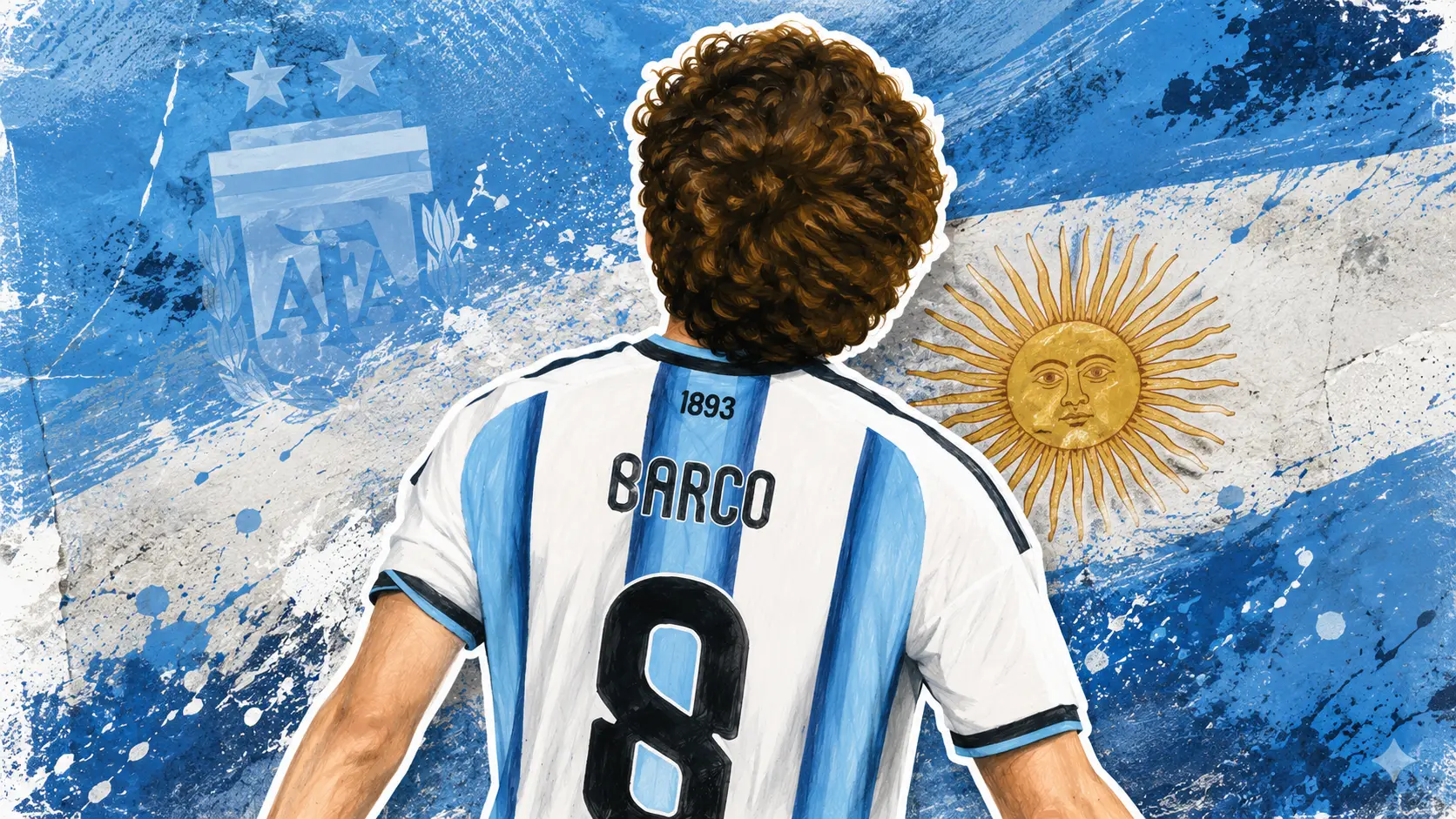
Argentina beat Iceland 3-0 in Auburn, Alabama, last Tuesday. The result was unimportant. The eighth minute was worth watching, when a 21-year-old from Buenos Aires province struck from outside the box and put the defending champions ahead. Valentín Barco had already been on the World Cup roster. The goal made his place feel stitched, with his teammates risibly cheering him on.
Barco’s versatility
Barco is listed as a central midfielder. He has also played left-back and left midfield. He’s left-footed, around 5-foot-7, and does not win games through physical imposition. His value is harder to describe – and that, precisely, is what makes scouts reach for “versatile” when what they mean is “we haven’t decided yet.”
Versatility is often praised as a quality. It isn’t always. A player who can perform three roles adequately may simply be one who hasn’t mastered any of them. What separates Barco from that category is the thing his detractors tend to undervalue: he receives under pressure and turns safe possession into a forward one. That is specific footballing intelligence, and it doesn’t come from being useful everywhere.
The long way around
His path to this point isn’t the one that gets written up in transfer-market stories. Born in 25 de Mayo, a town in Buenos Aires province, he entered Boca Juniors’ academy as a child. His family drove long distances to get him to training. By 16, he was making his first-team debut – one of the youngest in the club’s history.
Boca’s Copa Libertadores run in 2023 gave him the nerve-testing environment that technique alone can’t provide. Nine appearances in that campaign, including the final. Brighton bought him in January 2024 on a long contract and then, essentially, didn’t use him.
This isn’t unusual. English clubs overpay for young South American talent and then protect their investment by not risking it. Barco made seven appearances, went to Sevilla on loan, was recalled, and eventually joined Strasbourg in February 2025. It isn’t the route anyone drew up.
France gave him what England didn’t
Strasbourg offered continuity. Fifteen appearances, a manager prepared to play him, and the structural benefit of a team that needed him to build rhythm rather than perform one audition at a time. The club qualified for Europe. Barco’s loan became permanent by July 2025.
There’s a version of that story that ends as a competent player in Ligue 1 who almost made it in the Premier League. It didn’t go that way. Strasbourg reached a Conference League semifinal – historic for the club and Barco was part of the run. Chelsea remains open as a possible next destination, which would make sense within the same ownership network that already links the two clubs. That part isn’t confirmed.
Argentina named him to the World Cup squad.
What Scaloni actually has
Rodrigo De Paul. Enzo Fernández. Alexis Mac Allister. Argentina’s midfield is not short of options, and none of them need Barco to function. This is why his inclusion carries a particular logic – he isn’t a rotation player within an established philosophy. He’s a different instrument entirely.
Left-footed coverage that can begin in midfield and drift wider. An extra passing option when Argentina want to slow a game and recirculate. A player who, when a defense leaves him space, has what the Iceland goal demonstrated: a quick trigger, no hesitation, and the technique to finish from range.
The question isn’t whether he’s talented. That part has followed him from Boca to the Premier League to France. The harder question – the one Scaloni hasn’t publicly resolved – is whether tournament football, where roles narrow and improvisational value becomes harder to deploy, suits a player defined by ambiguity.
Argentina will use this World Cup to answer that question one way or the other. Either Barco finds his moment in the bracket – a specific game, a specific pressing situation, a moment where his left foot and his nerve become the exact tool required – or he moves through the tournament as proof that squads carry more ideas than they eventually use.
At 21, he reaches this moment as an experienced footballer. Boca’s academy pressure. A Libertadores final. An English holding pattern. A French education. The Iceland goal isn’t a breakthrough. It’s the latest entry in a record that already says quite a lot.
The remaining question is whether Scaloni reads it the same way.