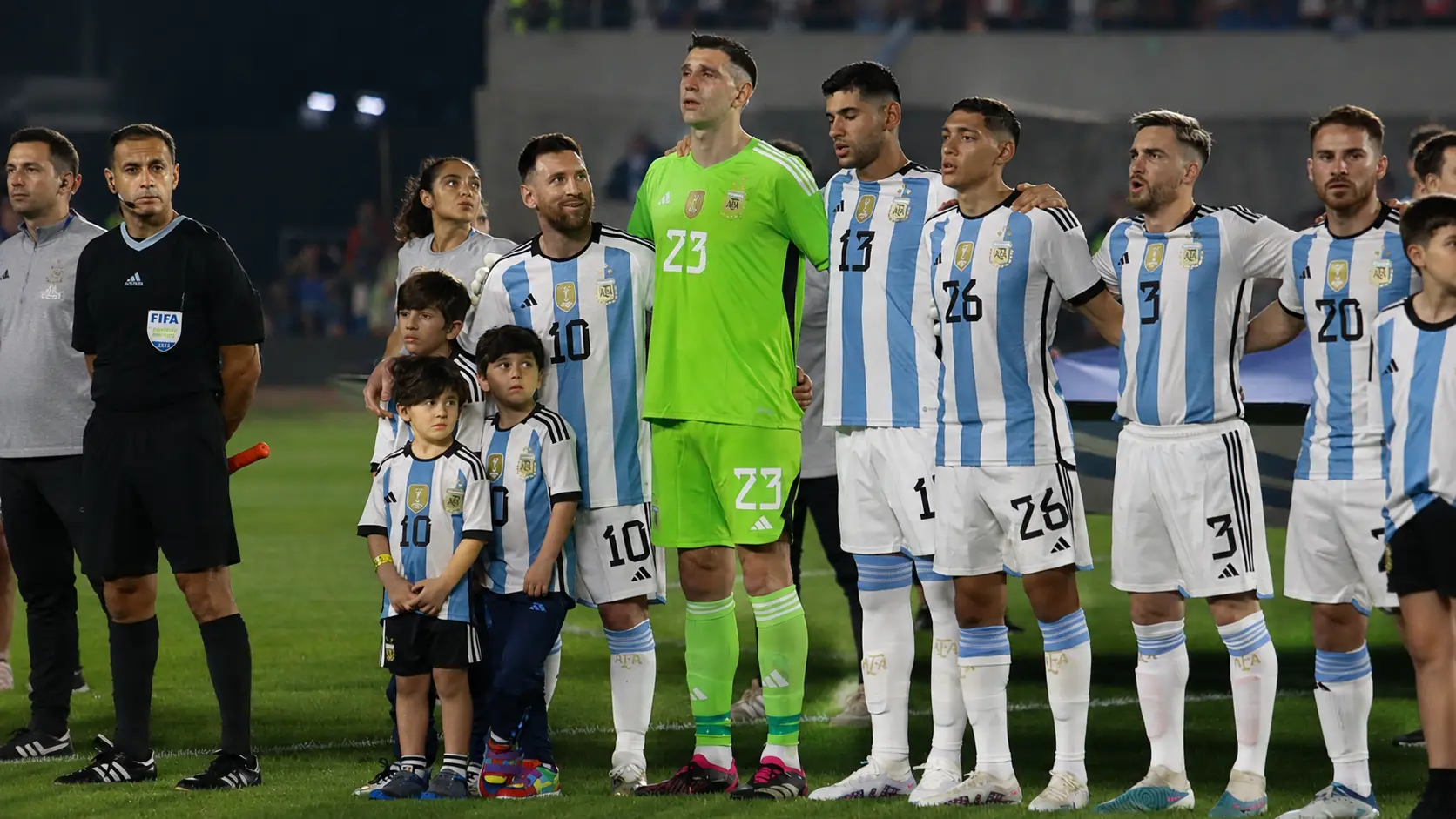
Argentina’s World Cup 2026 roster reads like a choice, not just a selection. Lionel Scaloni has not torn up the team that won in Qatar. He has carried most of it forward, with enough new names to show that the next version of Argentina is already being shaped.
The headline is still Lionel Messi. At 38, the Inter Miami forward is set for his sixth World Cup, returning as the center of a title defense that is both sporting and symbolic. Around him is a familiar structure: Emiliano Martínez in goal, Nicolás Otamendi and Cristian Romero in the defensive core, Rodrigo De Paul, Enzo Fernández and Alexis Mac Allister in midfield, and Lautaro Martínez and Julián Álvarez in attack.
That continuity is the point. Argentina are bringing back 17 players from the group that lifted the trophy in 2022. This is not a squad built around nostalgia alone. It’s a bet that the habits formed across the last cycle still matter, especially in a tournament that will test depth, recovery and clarity more than any men’s World Cup before it.
The final 26 are clear. Martínez, Gerónimo Rulli and Juan Musso are the goalkeepers. The defenders are Gonzalo Montiel, Nahuel Molina, Lisandro Martínez, Otamendi, Leonardo Balerdi, Romero, Nicolás Tagliafico and Facundo Medina. The midfield group is Giovani Lo Celso, Leandro Paredes, De Paul, Exequiel Palacios, Enzo Fernández, Mac Allister and Valentín Barco. The forwards are Messi, Nicolás González, Giuliano Simeone, Lautaro Martínez, José Manuel López, Julián Álvarez, Thiago Almada and Nico Paz.
The absences give the list its sharper edge. Ángel Di María is no longer part of the picture after retiring from international football following the 2024 Copa América. Giovani Lo Celso, who missed Qatar through injury, returns to a World Cup squad with a different kind of opportunity. Barco, Paz, Giuliano Simeone, Almada and José Manuel López give Scaloni a younger layer, not enough to call this a rebuild, but enough to keep the team from being frozen in 2022.
The repeat bid turns on what Scaloni changes
Repeating as world champions remains one of the hardest assignments in international football. Italy did it in 1934 and 1938. Brazil did it in 1958 and 1962. No men’s team has done it since. Argentina will try in a 48-team World Cup that now includes 12 groups, a Round of 32 and a longer knockout route for the winner.
Group J gives Argentina a manageable but varied opening. The defending champions begin against Algeria on June 16, then face Austria and Jordan. On paper, that should allow Scaloni to control minutes. In practice, it may force the first major decisions of the tournament: how much Messi plays, how quickly injured or recently managed players are pushed, and whether the younger options are trusted before the knockouts make every choice more severe.
The case for Argentina is still strong. Martínez gives them a goalkeeper who has already decided matches at this level. Romero, Otamendi and Lisandro Martínez offer different defensive profiles. De Paul, Enzo Fernández, Mac Allister, Palacios and Lo Celso give Scaloni enough midfield combinations to change rhythm without changing identity. Lautaro and Álvarez are both capable of leading the line, together or separately.
The risk is just as obvious. The 2022 team had Di María as its release valve in the biggest moments. This version needs that unpredictability from elsewhere. Almada can provide it. Paz might. Barco gives a different angle from the left. González and Simeone bring directness and work rate. None of them has Di María’s exact match-winning history for Argentina, which means the attack may need to become more collective by design.
Messi’s role is the central question, but not in the old way. Argentina no longer need to prove they can exist around him. They have already done that across pieces of the cycle. The question is whether they can use one of the most decorated players in football without asking him to carry the whole tournament on 38-year-old legs.
That is where Scaloni’s list becomes interesting. It protects the old core while pushing responsibility toward the next one. If Argentina repeat, it probably will not be because they recreated Qatar. It will be because they knew which parts of Qatar were worth preserving, and which parts had to be replaced before the rest of the world forced the issue.