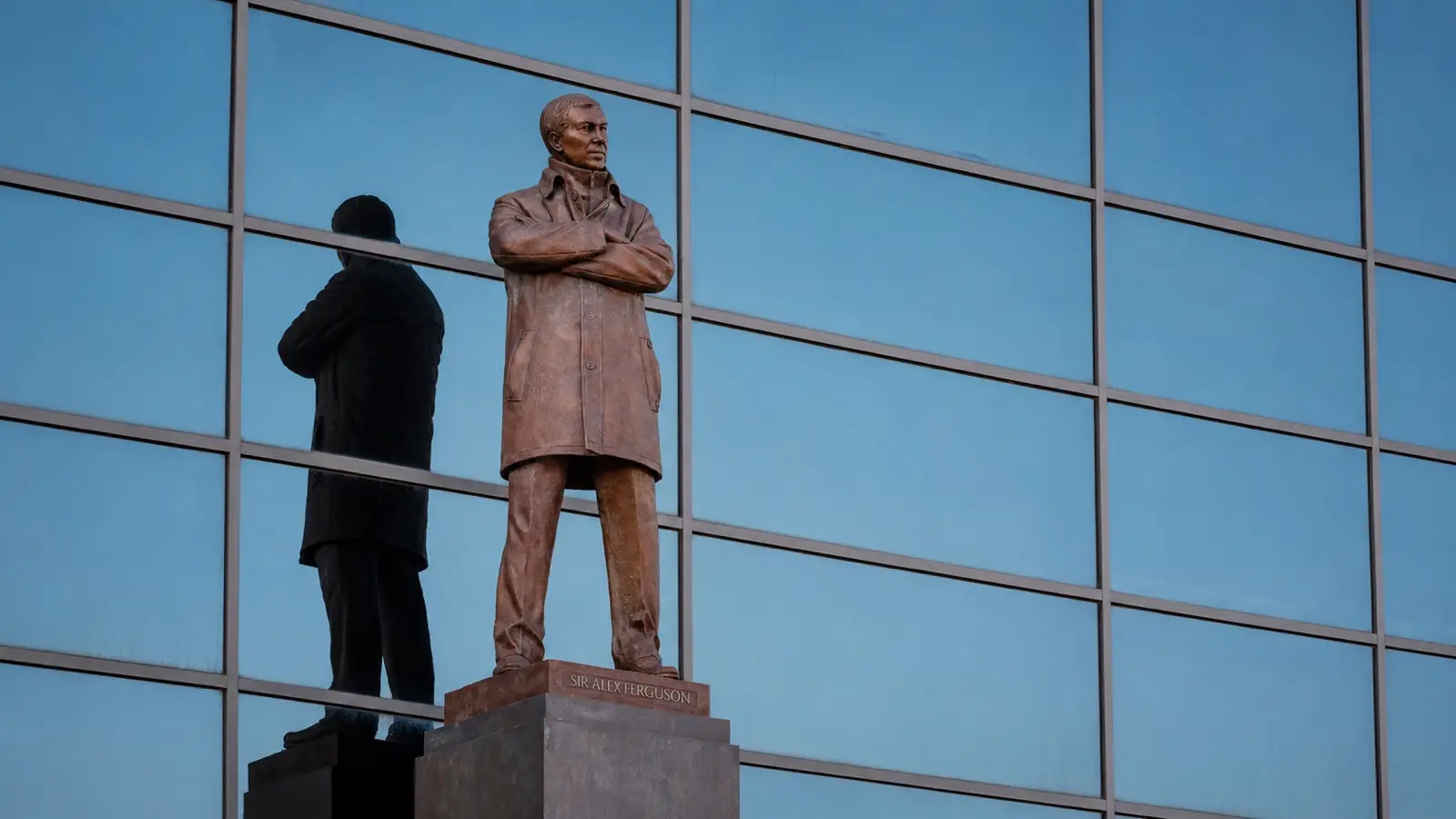
Forty years after Sir Alex Ferguson arrived at Manchester United, choosing his greatest player still depends on what you value. Cristiano Ronaldo has the strongest case for the highest individual peak. Eric Cantona changed the direction of the team. Ryan Giggs stayed through every one of Ferguson’s 13 league titles.
Ferguson’s place among the Premier League’s greatest managers rests partly on his ability to build another champion after a great side had broken up. His two Champions League wins, nine years apart, came with very different teams. The fairest comparison starts with what each player contributed to United during his reign, whether that meant changing a season or sustaining success for a generation.
Eric Cantona
Cantona’s arrival from Leeds during the 1992/93 season gives him a claim that’s difficult to measure in goals. United were still waiting for their first league title since 1967. Ferguson already had the beginnings of a championship team, but Cantona supplied a different kind of attacking presence: a forward comfortable dropping away from the defense, receiving the ball and choosing the pass that brought someone else into the game.
Cantona linked midfield with attack while remaining a scoring threat himself. His creative contribution gives the familiar story about his confidence and personality a footballing explanation.
He won four Premier League titles with United before retiring in 1997. The speed of that transformation is the foundation of his case: he joined a club still trying to end its long wait and left one accustomed to finishing first. Other players stayed longer, but Cantona’s best years coincided with the point at which Ferguson’s United learned how to turn promise into repeated championships.
Roy Keane
Roy Keane won seven Premier League titles with United and took over the captaincy in 1997. His influence came from the speed and clarity of his decisions as well as his appetite for confrontation. He could win possession, move it early and put himself in position to receive it again. United’s midfield worked better when he controlled both the ball and the space around it.
Turin in 1999 remains the clearest example. With Juventus leading 2–0 in the Champions League semifinal second leg, Keane headed in David Beckham’s corner in the 24th minute. The booking that ruled him out of the final came afterward. He continued to drive the comeback, and goals from Dwight Yorke and Andy Cole completed a 3–2 win. His performance carried United toward a match he already knew he couldn’t play in.
Paul Scholes
Paul Scholes offered another form of control. The early version threatened the penalty area and scored; the later version could change the direction of an attack from much deeper. His passing made a crowded midfield easier to escape and brought distant teammates into play. Eleven Premier League titles establish his longevity, while his return from retirement in January 2012 showed how much Ferguson still valued what he supplied. Scholes could influence a game without needing its tempo to become frantic.
Ryan Giggs
Giggs has the strongest argument on sheer continuity. He appeared in every one of Ferguson’s league-winning campaigns, adapting as his manager’s teams changed around him. The young winger’s acceleration was the most obvious weapon; the older player found different ways to create space and deliver the ball. His goal at Wigan on the last day of the 2007/08 season helped secure another title. By then, he was contributing alongside players who belonged to a very different United generation.
David Beckham
Beckham’s place rests on the precision he added to those teams. His delivery could turn a run at the far post or a crowded penalty area into a genuine chance, and six league titles give that quality a substantial record behind it. Keane’s goal in Turin is one concrete example. In the 1999 final, with Keane and Scholes suspended, Beckham played centrally. His usefulness extended beyond the right-sided role that defined his partnership with Gary Neville.
Michael Carrick
Michael Carrick helped give Ferguson’s later midfield a different rhythm. He offered passing angles and an ability to move possession through the center without making every attack a sprint. With Scholes suspended, the attacking side of Carrick’s game came into sharp focus against Roma in 2007. He scored twice in United’s 7–1 Champions League quarterfinal win.
Peter Schmeichel
Behind those midfielders, Peter Schmeichel could change a match in two directions. His reach and aggressive positioning protected United’s goal, while his long throws could send the team forward before opponents had recovered. He won five Premier League titles and the league’s Player of the Season award in 1995/96. In his final United appearance, he captained the side to the 1999 Champions League trophy in the suspended Keane’s absence.
Rio Ferdinand
Rio Ferdinand’s defensive case starts with the situations he could prevent. His pace allowed him to recover ground, and his comfort carrying the ball gave United a way to advance without immediately surrendering possession. Six league titles, from 2002/03 to Ferguson’s final season, put him at the center of the manager’s later success. Any discussion of the greatest defenders of the 21st century has to account for that combination of athleticism, technique and sustained achievement.
Nemanja Vidic
Nemanja Vidic deserves an individual case alongside him. He won five league titles and was Premier League Player of the Season in both 2008/09 and 2010/11, an unusual level of recognition for a defender. His anticipation and commitment in duels made attacks difficult to finish. Ferdinand could cover space behind the defense; Vidic could make the first contest decisive. Their partnership was exceptional, but Vidic’s two season awards also stand as evidence of his own influence.
Denis Irwin
The supporting defensive cases are strong enough to complicate any shortlist. Denis Irwin collected seven Premier League titles.
Gary Neville
Gary Neville won eight Premier League titles while supplying the overlaps and crosses that made United’s right flank so productive.
Edwin van der Sar
Edwin van der Sar added calm behind Ferguson’s later defense and won four titles. During the 2008/09 league season, he went 1,311 minutes without conceding. That run belonged to the defensive unit, with a goalkeeper capable of maintaining its composure at the back.
Wayne Rooney
Wayne Rooney’s versatility creates a different selection problem. He could be the scorer around whom an attack was built or the player whose movement and passing helped someone else dominate. During Ronaldo’s great 2007/08 season, Rooney supplied 18 goals of his own while also creating for his teammate. In 2011/12, he scored 34 in all competitions. Ferguson could ask him to carry a heavier scoring burden or contribute to a more varied attack, and still expect decisive output.
Ruud van Nistelrooy
Ruud van Nistelrooy’s 150 United goals make the case for a specialist whose movement and finishing repeatedly turned service into goals.
Ole Gunnar Solskjaer
Ole Gunnar Solskjaer scored 126 across 11 years, with the winner in the 1999 Champions League final forever the defining contribution. Ferguson’s success required both a striker who could dominate the scoring and players capable of making a decisive intervention when the opportunity arrived.
Robin van Persie
Robin van Persie compressed his contribution into Ferguson’s last season. His 26 Premier League goals won the Golden Boot in 2012/13, and his hat trick against Aston Villa secured the title. It’s a powerful case for the value of one outstanding campaign. He couldn’t match the longevity of Giggs or Scholes under Ferguson, but his first United season helped Ferguson finish his career as champion.
Cristiano Ronaldo
Ronaldo’s 2007/08 season makes the strongest case for the highest individual peak. Of his 42 goals across all competitions, 31 came in the Premier League and eight in the Champions League. United finished that season with both trophies. He could begin an attack away from the penalty area and still be the player finishing it. He scored in the Champions League final and won the Ballon d’Or later that year.
Who was Ferguson’s greatest player?
Ronaldo gets the vote for the best football played under Ferguson. Cantona has the strongest claim to changing the team’s direction, while Giggs has the clearest case for sustaining it. Scholes, Keane, Rooney and the great defenders make those judgments difficult. Ferguson’s achievement was to accommodate such different forms of excellence, then find another combination capable of winning when one had run its course.
Get more Stadio United on Google.