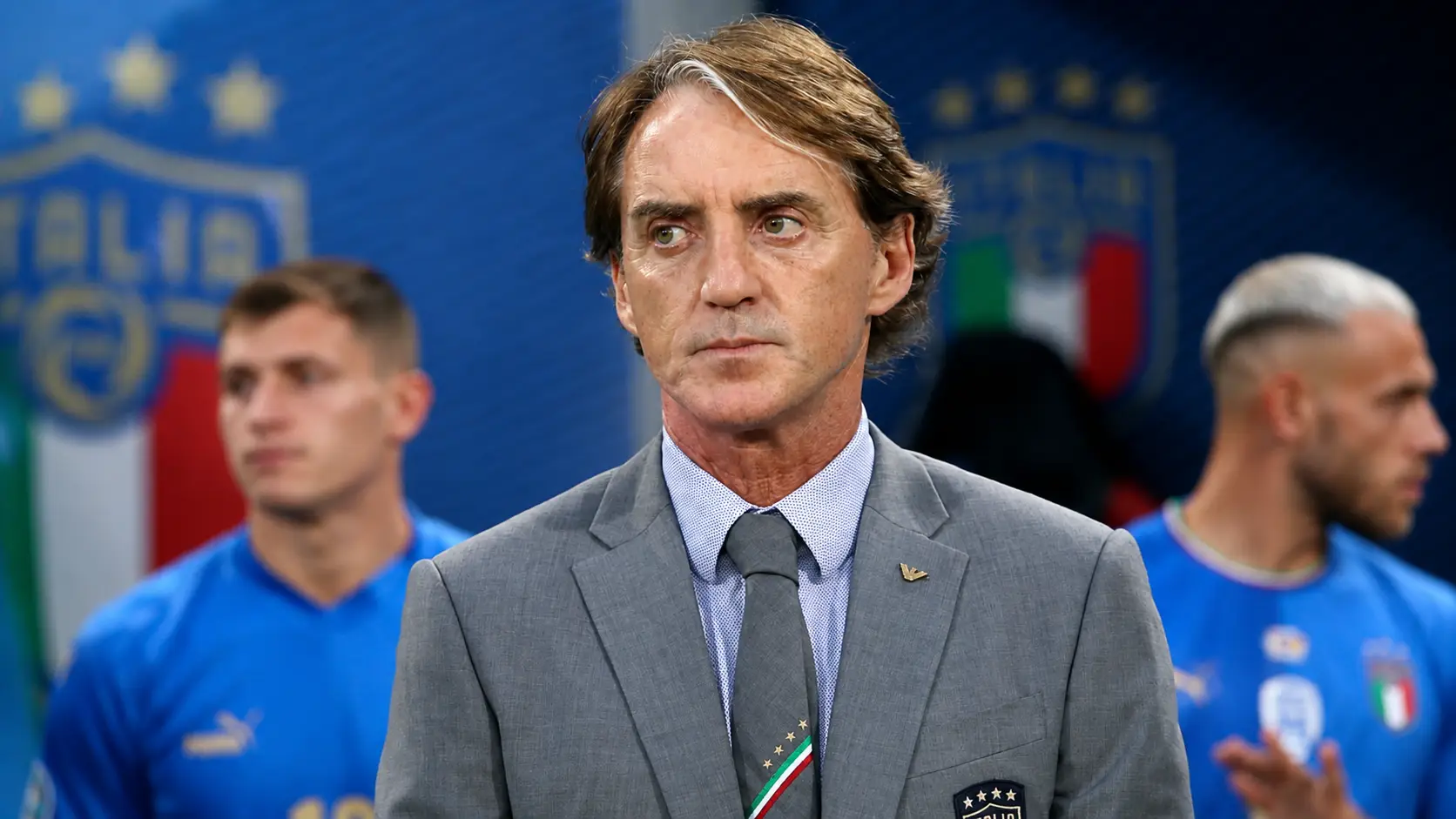
Roberto Mancini is again moving toward the Italy job, according to multiple reports. Italy will not be at the 2026 World Cup after losing a March playoff final to Bosnia and Herzegovina on penalties. It is the country’s third straight men’s World Cup miss, a sequence that has turned a proud national team into a problem Italy keeps diagnosing without curing.
The reported move is not yet official from the federation, of course. But the shape of the decision is clear enough: return to the coach who restored Italy after the 2018 failure, then ask him to work on a deeper repair job. In that sense, the story sits inside Italy’s fault lines, where football identity, institutional caution, and player development keep colliding.
Mancini’s first Italy spell began in 2018, after the Azzurri had missed the World Cup in Russia. Three years later, he delivered Euro 2020 at Wembley, a title that made Italy look modern, lighter and more precise. His best team pressed with purpose, trusted midfield control and gave a drifting national program a recognizable shape.
The record also contains the result that still shadows him. Italy lost to North Macedonia in the 2022 World Cup playoff semifinal, turning Wembley from proof of renewal into a memory with a warning attached. Mancini resigned in August 2023, then took the Saudi Arabia job weeks later. He left that role by mutual agreement in 2024 and resurfaced at Al Sadd in Qatar in November 2025, a club stop that now becomes part of the negotiation if Italy’s interest becomes an appointment.
Mancini is not a sentimental hire in the simple sense. His résumé includes Inter titles, Manchester City’s 2011-12 Premier League title and Italy’s European Championship. A second Italy tenure, if it happens, would be judged less by old trophies than by whether he can solve problems that have survived several coaches.
Why the return would carry more than nostalgia
The failures around the national team are not only tactical. The federation’s outgoing leadership’s reform plan said foreigners account for about 68 percent of Serie A minutes and Italian under-21 players account for less than 2 percent of total Serie A playing time. The same report described professional Italian football as losing more than $818 million per year. This is not a formation issue. It is the terrain the next coach will inherit.
There is also a stadium and infrastructure problem. UEFA has warned that Italy’s place as a Euro 2032 co-host depends on upgrades. Interestingly, only six Italian stadiums were built or redeveloped between 2007 and 2024. Germany had 19 over the same period, England 13, and France 12. The national team’s decline is happening inside a system that has struggled to modernize its player pathway and its buildings.
Silvio Baldini’s interim spell gave the federation a brief look at another route. Promoted from the under-21s, he named a young squad for the June friendlies and won 1-0 against Luxembourg and Greece, with Pio Esposito decisive in both matches. Those results do not fix anything by themselves. They do show that Italy’s next coach will be measured partly by how well he turns youth selection from a gesture into a working pipeline.
A Mancini return would test whether his best Italy ideas can travel into a second cycle. His first successful side was not built by clinging to old hierarchies. It worked because he widened the pool, trusted technical midfielders and gave players a clear way to play. The question now is whether he can do that again with a different generation and a tighter deadline.
Italy does not need a ceremonial rerun. It needs a coach who can quickly identify a core, demand stronger connections between Serie A clubs and the federation, and make room for young players before another qualifying cycle narrows around old habits. Mancini can offer credibility, familiarity, and a known method. He would also return carrying responsibility for the 2022 failure that ended the first cycle.
If the deal is completed, the appointment will say as much about Italy as it does about Mancini. The federation would be choosing the last coach who made the Azzurri look coherent. The work waiting for him would be to prove that memory can become a plan.