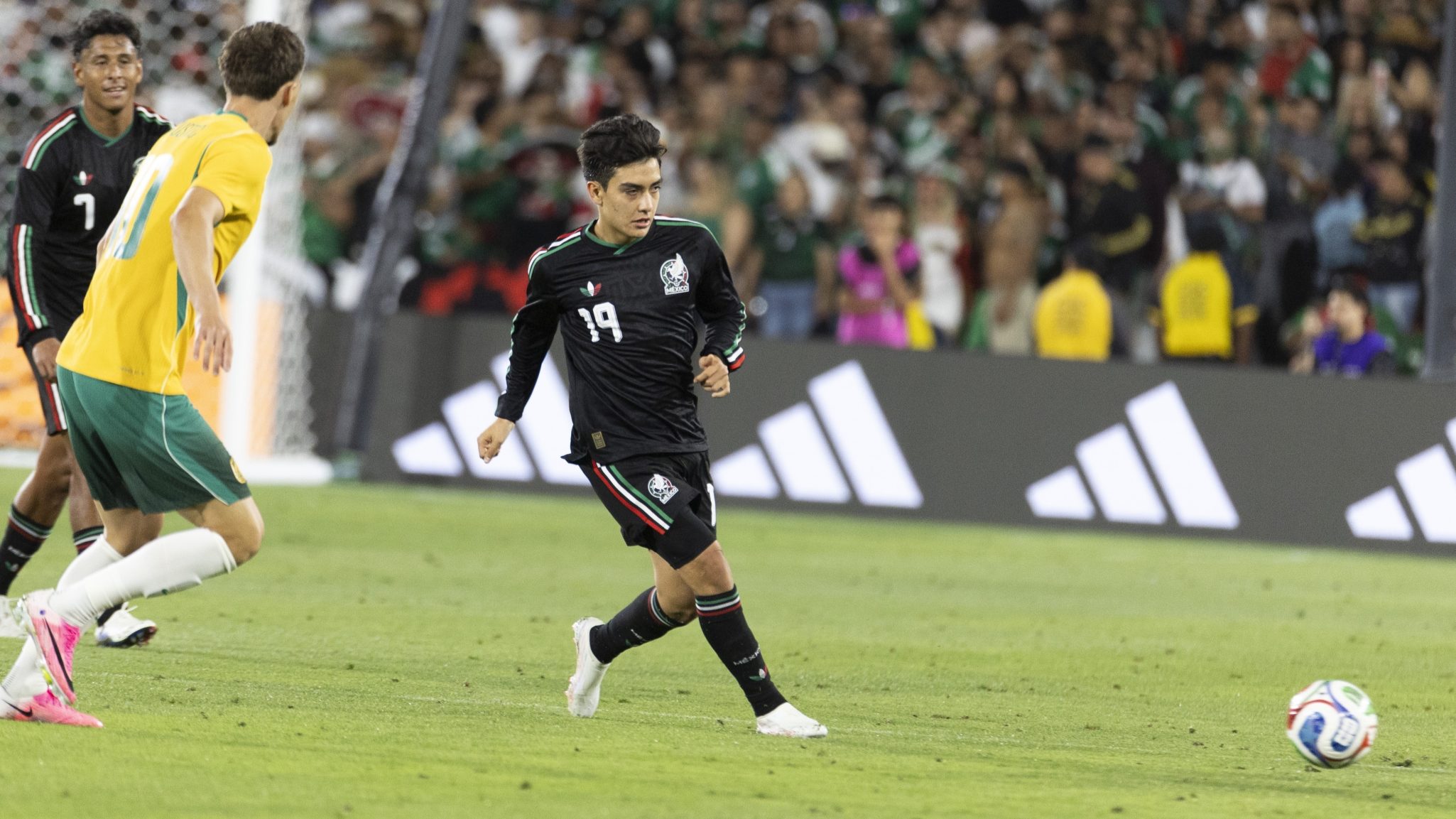
Gilberto Mora is set to wear Mexico’s No. 10 at 17, taking a shirt associated with some of Mexico’s greatest players. Reports indicate that he’ll switch from No. 19 during Rafael Márquez’s first international window, with Alexis Vega absent from the squad. It’s an assignment for this window, not confirmation that the number has permanently changed hands. Wink, wink.
Why Gilberto Mora is ready for greater responsibility
His case for greater responsibility began under Javier Aguirre. At 16, Mora supplied Raúl Jiménez’s assist in Mexico’s 1–0 win over Honduras in the 2025 Gold Cup semifinal, then started the final against the United States. Mexico won that game 2–1, and Mora has since played at a World Cup. He’d already contributed to winning a senior international tournament before the national team’s most recognizable attacking number became available.
Tijuana had made its own decision about the shirt. In June, Xolos announced a three-year contract extension and gave Mora No. 10, explicitly tying the number to his development and the club’s confidence in him. He’s since carried it into the Apertura, including a two-penalty performance in a 2–0 win over Pumas. The national-team assignment would extend a responsibility he’s already experiencing at club level.
Aguirre’s most revealing assessment wasn’t about Mora’s age or scoring records. Speaking with Alberto García Aspe while Mora was still 16, he grouped him with Tomás Boy, Benjamín Galindo and Cuauhtémoc Blanco. The connection was their awareness before receiving the ball: understanding what’s developing, then knowing whether to release it immediately or hold possession. Aguirre was identifying a way of thinking, rather than declaring that Mora had matched three careers.
That’s a better starting point than searching for a teenage replica of Blanco. A creative midfielder doesn’t have to make every touch spectacular. Sometimes the valuable decision is a quick pass that lets somebody else attack; sometimes it’s keeping the ball until a teammate’s run becomes available. Mora’s challenge is to make those judgments repeatedly against senior opponents. A number can advertise that role. It can’t perform it for him.
The players who defined Mexico’s No. 10
Cuauhtémoc Blanco has the strongest case when creativity and international achievement are judged together. His 1999 Confederations Cup produced six goals, including the golden goal against the United States in the semifinal and Mexico’s decisive fourth in the 4–3 final victory over Brazil. He later wore No. 10 at the 2002 and 2010 World Cups. The tricks belong to his identity, but the decisive contributions make him the benchmark.
Tomás Boy offers a different reference point. Mexico’s captain and No. 10 at the 1986 World Cup, he played in all five matches as the hosts reached the quarterfinals. His vision and distribution put the organizer’s work at the center of the role. For a developing midfielder, that’s a demanding model: being responsible for how an attack takes shape, rather than only how it ends.
Benjamín Galindo combined creation with a scorer’s contribution. Wearing Mexico’s No. 10 at the 1991 Gold Cup, he finished as the tournament’s leading scorer with four goals. Aguirre’s comparison brings him especially close to the Mora discussion. The connection isn’t a shared number alone, but the ability to recognize an opportunity before the pass arrives.
Giovani dos Santos, Mexico’s No. 10 at the 2014 and 2018 World Cups, supplied a signature moment against the United States in the 2011 Gold Cup final. After evading Tim Howard, he chipped the retreating defense to complete a 4–2 comeback. Few finishes better capture the inventive side of the shirt, particularly in the rivalry between Mexico and the United States.
Luis García’s claim rests on a different kind of contribution. Wearing No. 10 at the 1994 World Cup, he scored both goals in Mexico’s 2–1 win over Ireland. He also held the number in 1998, although he didn’t play in that tournament. His inclusion keeps the distinction clear: the shirt hasn’t always belonged to a traditional midfield playmaker. A forward could give it meaning through his finishing.
What Mexico’s No. 10 should mean for Mora
Mora doesn’t need to fit all five examples. Boy’s organization, Galindo’s anticipation, Blanco’s invention, Giovani’s improvisation and García’s goals describe different routes to influence. Treating them as one impossible job description would leave a teenager competing with a composite of several finished careers. His next step is narrower: establish how his own decisions can make this Mexico team function better.
Márquez supplied the pass for Blanco’s decisive goal against Brazil in 1999. Now he’s overseeing a new Mexico cycle, with Mora’s reported change due to begin against Colombia on September 26. That old partnership produced a trophy. This one is only beginning, and it needs room to develop on its own terms.
For Mora, the encouraging part is that the comparisons began with his football, not with a jersey announcement. He’s already helped Mexico win important matches. The longer test is whether he can keep finding solutions when opponents adjust and performances become uneven. At 17, he deserves the opportunity to carry the number without being expected to carry every career attached to it.