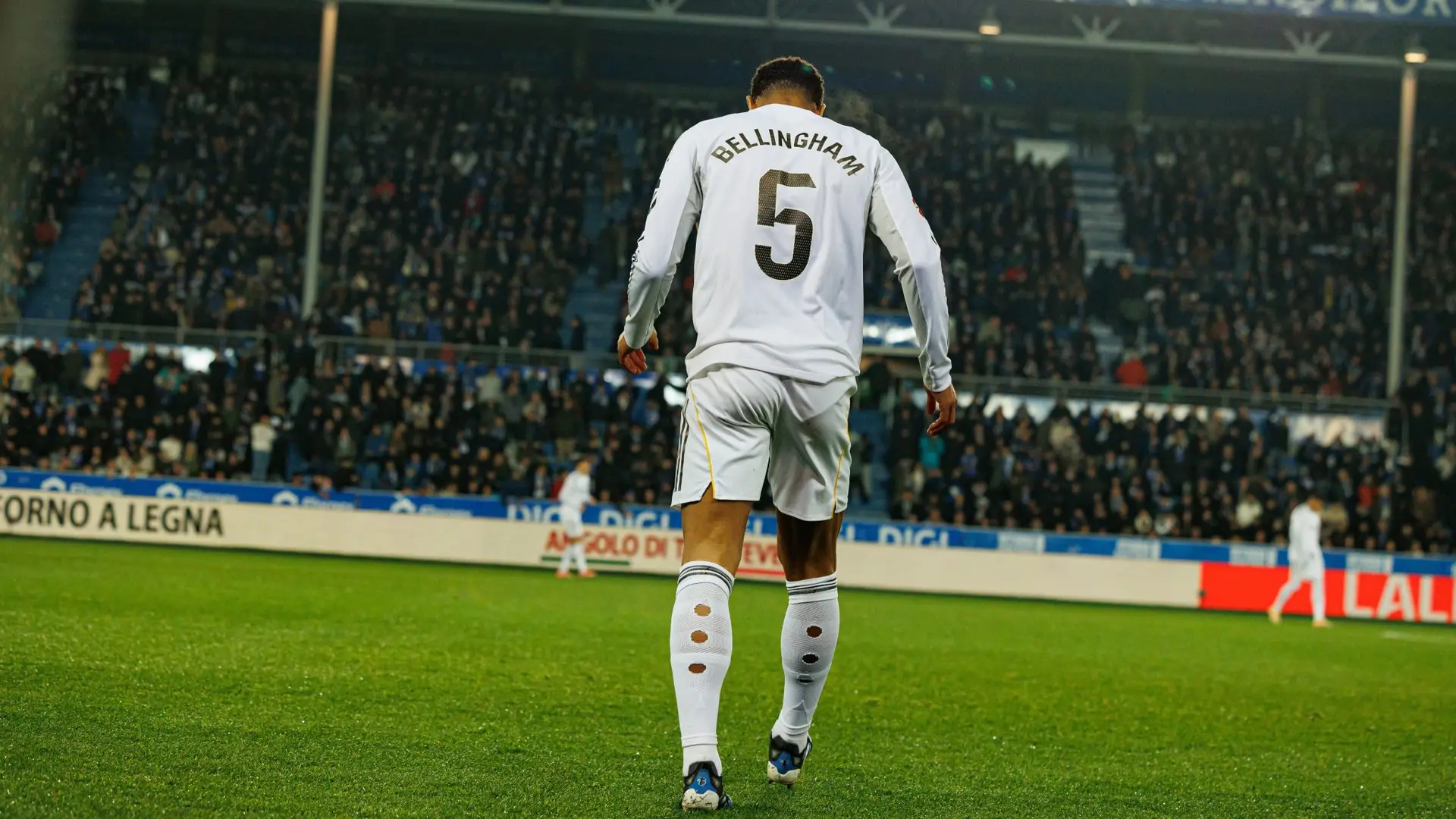
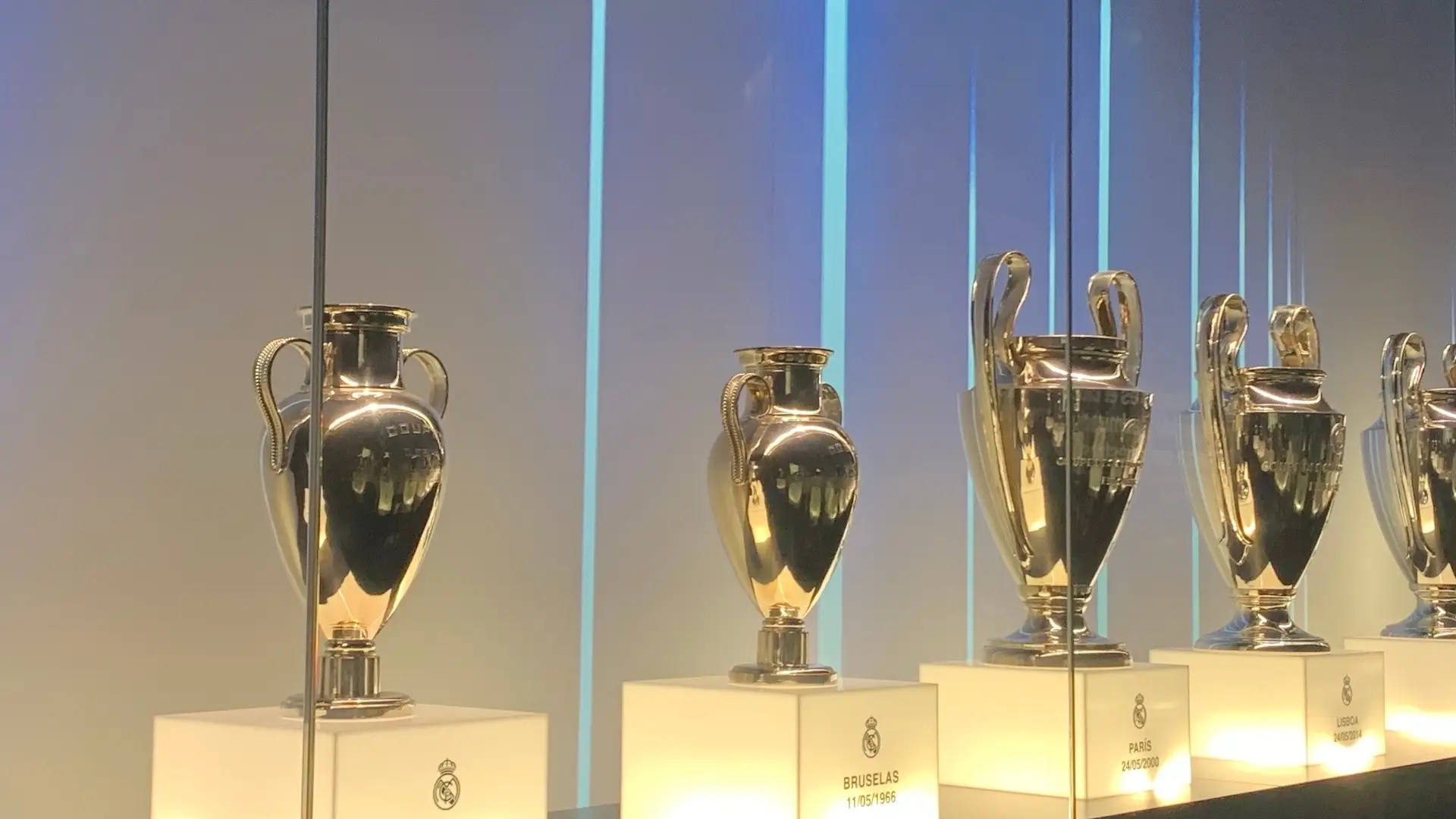
At Real Madrid, a trophy can be an achievement for one generation and a job description for the next. Fifteen European Cups line an arrival route at the Bernabéu, placing the club’s history beside players heading toward the dressing rooms. It’s a display of what has been won, encountered by people who still have a match to play.
Football often gives its history a physical form. The stars above PSG’s crest put European success on a shirt. Madrid’s corridor puts it in the working environment. Admiration is easy when you’re visiting a trophy collection. Playing for the club that owns it brings a different responsibility.
Madrid’s own introduction to the route didn’t cast the viewer as an intimidated opponent. In August 2025, the club shared a video inviting people to imagine entering the Bernabéu as a Madrid player. The following month, arrival images from the Marseille Champions League game showed players from both teams passing the cups. The home side was part of the audience from the beginning.
The visiting team isn’t the only one facing that collection. For a Madrid player, belonging to such a history could feel reassuring or demanding. Those are different psychological experiences, despite the identical surroundings. A display of success needn’t be a source of comfort for everyone wearing the home shirt.
Bill Shankly described Liverpool’s “This is Anfield” sign as a message to both teams. It would “remind our lads who they’re playing for,” he said, and confront the opposition with who they were facing.
When history becomes an expectation
Two Madrid voices captured the tension before the 2022 Champions League semifinal return against Manchester City. Luka Modrić described Madrid as “the most decorated club in the Champions League” and counted that history among the team’s advantages.
Carlo Ancelotti placed the emphasis elsewhere. “I don’t think that history has any part to play,” he said, stressing that City held the advantage and Madrid needed a better performance. Modrić also said the players had to set previous triumphs aside and focus on the new game. Neither was proposing that the past could do the football for them.
Their positions needn’t be contradictory. History can help a player believe a difficult task is possible. It can’t complete the task. The useful version of club pride would support the next decision rather than distract from it: staying available for a pass, recovering position, continuing to compete after a setback.
Research on penalty shootouts suggests that a team’s past can be relevant even to players who weren’t there. In a study published in the British Journal of Psychology in 2012, Geir Jordet and colleagues examined 309 kicks by 260 players at World Cups and European Championships between 1976 and 2006. Takers representing teams with earlier shootout defeats had worse outcomes than those whose teams had previously won, after accounting for team ability and country.
The association extended to players who hadn’t participated in those earlier games. They weren’t simply repeating their own unsuccessful experience. The observational study couldn’t establish that history caused those outcomes. But it complicates the idea that changing the lineup makes a team’s past psychologically irrelevant.
Performance psychologists distinguish between experiencing a demanding situation as a challenge and experiencing it as a threat. Broadly, the difference concerns whether someone believes their resources are sufficient for what they face. A 2025 meta-analysis covering 62 studies and 7,418 participants found better performance under challenge than threat across several domains, including sport. The average effects were small.
Seen through that framework, the potential influence of the corridor would depend on how a player interprets it. A Madrid player might draw confidence from belonging to such a successful institution, or dwell on the risk of failing its standards. A visitor might feel overmatched, or sufficiently prepared to make the occasion an opportunity. The same display needn’t produce the same response.
There’s a third audience, too: the people watching the arrival footage. Madrid’s own video lets supporters imagine the walk before a home game. As an image, the corridor communicates the club’s achievements whether or not it changes a single footballer’s performance. Heritage and promotion can coexist with whatever competitive purpose the display might serve.
Nor does respect for the setting prevent an opponent from enjoying it. In December 2025, Nico O’Reilly scored his first Champions League goal during Manchester City’s 2-1 Bernabéu win. Afterward, he acknowledged the difficulty of playing there and said: “This goal will be with me forever.”
O’Reilly was talking about the match, not the trophy display. His words offer a useful answer to the assumption that an illustrious setting can only diminish a visitor: it can become the place where that visitor makes a memory of his own.
The trophies belong to Madrid. The next memory doesn’t have to.