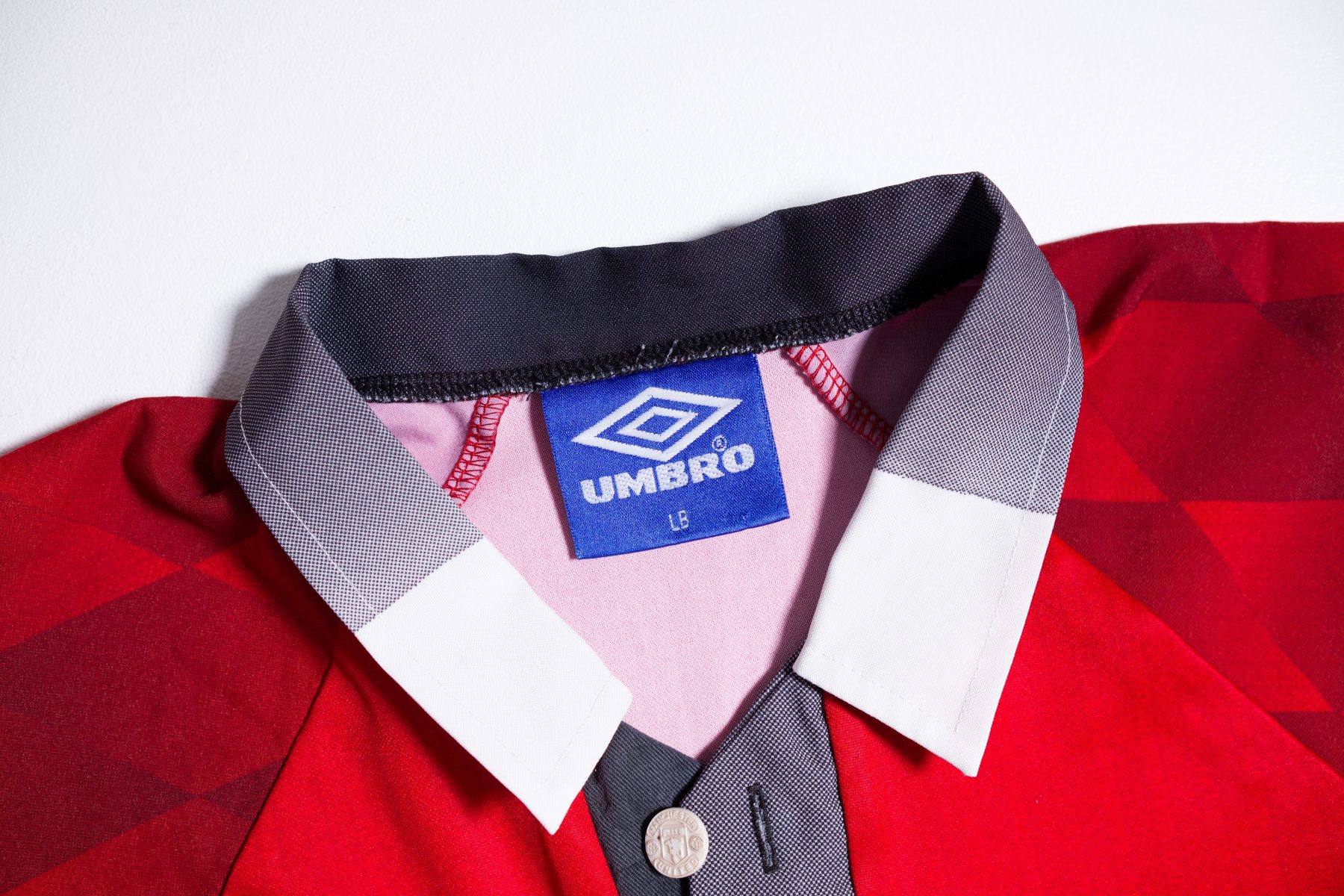
When the Premier League began in 1992, Umbro supplied 11 of its 22 clubs. Manchester United wore it. So did Manchester City, Chelsea, Tottenham and Everton. Nike didn’t supply a single team. The double diamond wasn’t a reference to football’s past. It occupied half the new league.
The modern business of football shirts sells club identity through premium editions and international retail networks. Umbro had been helping to make that identity wearable for decades. Its shirts accompanied England’s World Cup win in 1966, Brazil’s in 1994 and Manchester United’s treble in 1999.
Harold and Wallace Humphreys founded the company in Cheshire in 1924, combining fragments of the family name and “brothers” to create Umbro. Within a decade, both teams in the 1934 FA Cup final, Manchester City and Portsmouth, were wearing its clothing.
Its ambitions extended beyond the players. Umbro’s own history dates its children’s Christmas packs to 1955: a jersey, shorts and socks in club colors. The product offered something a scarf couldn’t. A young supporter could dress for the game they’d been imagining, wearing an outfit like the one their heroes wore.
That closeness to football didn’t produce one fixed style. David Seaman’s Euro 1996 goalkeeper shirt combined bright panels with England motifs. The 2009 England kit moved toward a restrained, tailored look. Umbro could make something exuberant or something deliberately understated. Its difficulty wasn’t a simple inability to imagine another shirt.
When a kit deal became bigger than the kit
The major departures began before Nike owned the company. Brazil joined Nike in 1996. Manchester United’s Nike deal began in 2002. Two teams associated with some of Umbro’s most recognizable triumphs had already moved elsewhere.
Nike announced its purchase agreement in 2007, valuing Umbro at about $582 million, and completed the acquisition in March 2008. The plan was to operate it as a stand-alone affiliate with access to Nike’s resources. “We are fully committed to helping Umbro reach its full potential,” Nike chief executive Mark Parker said.
The tailored England shirt appeared during that ownership, not before it. So did Aitor Throup’s 2011 Archive Research Project, which revisited Umbro’s sporting heritage through experimental design. A period that would end with the brand losing major customers still contained work that explored what made it distinctive.
In 2012, Manchester City announced it would switch to Nike for the 2013–14 season. England announced its own Nike move for 2013. In October 2012, Nike agreed to sell Umbro to Iconix for $225 million. Both teams had announced their moves to the parent company’s label before that sale agreement.
City’s public explanation pointed toward the scale of the business behind the shirt. The club emphasized international retail reach and marketing, alongside Nike’s research capabilities. Those resources offered a way to reach customers around the world. The agreement concerned how the club would expand commercially, as well as what its players would wear.
Nike’s own explanation had shifted. Its sale announcement emphasized other growth priorities and the ability of Nike Football to serve players away from the field as well as on it. The earlier promise of two complementary football brands had become a decision to concentrate resources elsewhere.
Yet the company didn’t disappear from the Premier League. In 2023–24, Umbro supplied Bournemouth, Brentford, Burnley, Luton Town and West Ham. Its five clubs put it ahead of every other manufacturer by team count. That wasn’t a restoration of its 1992 position, but it complicates the idea of an uninterrupted collapse. Losing flagship accounts hadn’t ended its ability to win business.
Its relationship with fashion also predated the centenary celebrations. Paul Smith collaborated with Umbro in 2002, and later collaborations included Supreme and Palace. These projects offered another use for a name whose meaning had been built through football, rather than replacing that history with an unrelated identity.
As clubs revisit their 1990s kits for new releases, Umbro’s clothing is also being preserved as design history. The Westminster Menswear Archive’s 2024 exhibition assembled more than 120 objects spanning its development. The garments could be examined for their construction and cultural influence, away from the contracts that originally put them on the field.
An old Umbro shirt can now sit in a museum or supply the starting point for a new collection. Neither requires the brand to win back Manchester United or England. The contracts decide what a team wears next. They don’t erase what it wore when it made history.