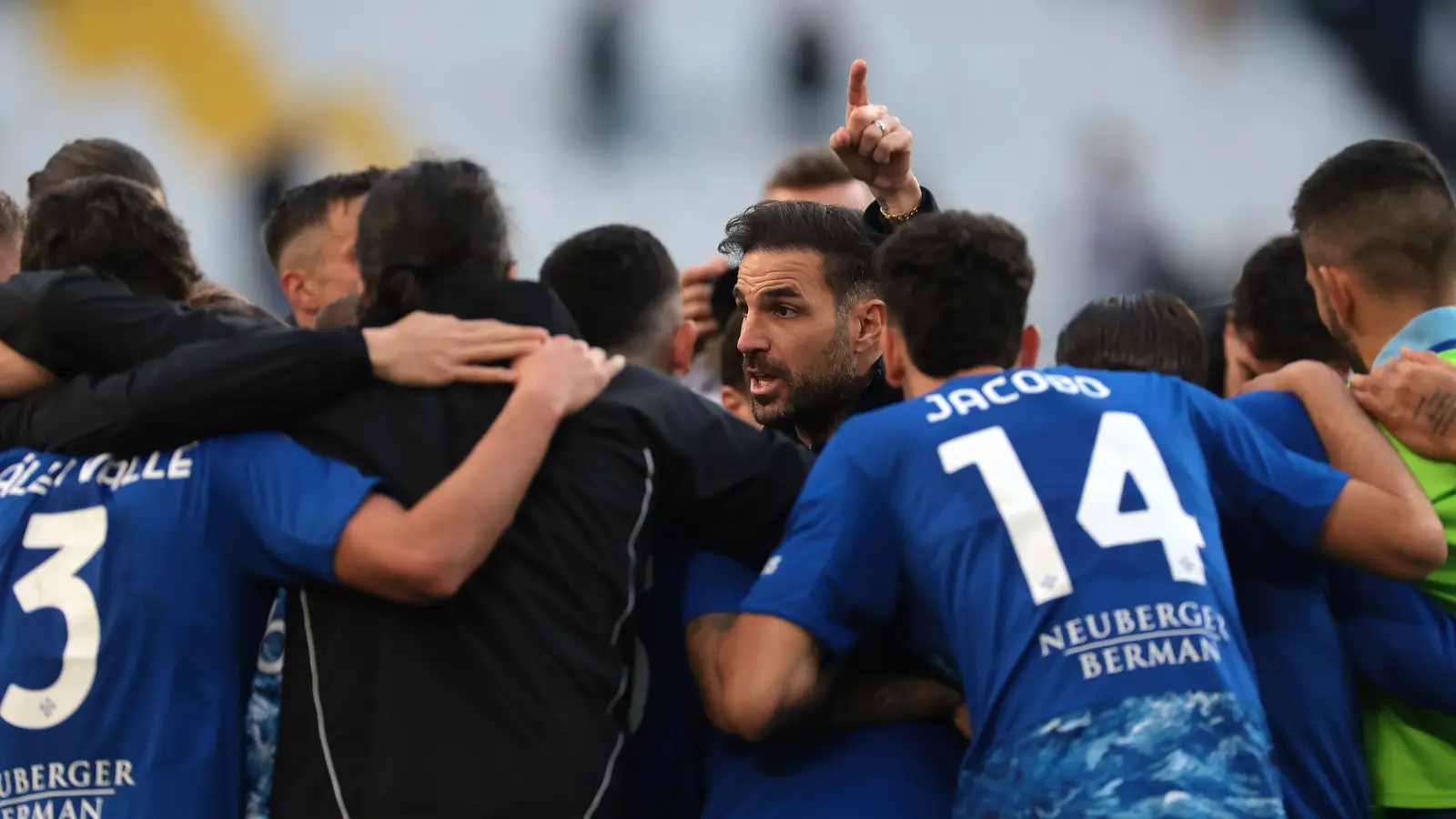
At 3–1, Cesc Fàbregas took off the player who’d scored Como’s first Champions League goal and sent on another center back. Martin Baturina had helped dismantle RB Leipzig. Now Marc-Oliver Kempf was needed to help contain them. Even on a debut that ended in a 4–1 victory, there was work to do beyond producing the next beautiful attack.
The September 10 win at the Stadio Giuseppe Sinigaglia carried Como’s rise through Italian football into a competition the club had never played before. Their attacking combinations supplied the spectacle. Fàbregas’s willingness to interrupt that rhythm supplied a different kind of reassurance: his team didn’t have to keep attacking in the same way to remain competitive.
Baturina opened the scoring after 15 minutes, then carried the ball through midfield to create Como’s second through Tasos Douvikas. The third goal belonged to a chain of decisions: Douvikas found Nico Paz, Paz played first time, and Assane Diao ran through to finish across the goalkeeper. Three players, different jobs, each action making the next possible.
Leipzig’s reply exposed the cost of getting those decisions wrong. Como lost possession playing out, Christopher Nkunku recovered the ball, and Andrija Maksimović scored. Fàbregas explained afterward that Leipzig had changed their buildup and were applying more pressure down the flanks. His own players were tiring. At 65 minutes, Kempf, Máximo Perrone and Moise Kean came on as Como moved to a back five.
It wasn’t a rejection of the football that had established the lead. The objective had shifted from opening Leipzig up to denying them a route back. Como could still threaten on the break, and Perrone finished from another Paz assist in the 90th minute. They’d found a way to score again without pretending the match hadn’t changed.
The experience behind Como’s debut
When Como signed Baturina in 2025, he’d already played 165 times for Dinamo Zagreb’s first team, including 38 appearances in UEFA competitions. He’d faced Milan and Monaco in the Champions League. His task at the Sinigaglia was to help a different club negotiate a level he already knew, while continuing his own development.
“He fits exactly the kind of football we’re building here,” Fàbregas said when Baturina joined. Against Leipzig, the fit was visible in both the finish and the pass for Douvikas. The Croatian could take responsibility himself or release someone else. An attack with several players capable of making the decisive choice is harder to reduce to a single individual contest.
Paz didn’t need to dominate possession to influence the result. His role in Como’s attack drew close attention from Leipzig, and he said their marking opened space for teammates. He still supplied two assists. Como benefited from where opponents followed him as well as where he sent the ball.
His presence wasn’t inevitable. Real Madrid, Como and Paz agreed he would remain for 2026/27, with Madrid confirming the arrangement came at the player’s request. Madrid retained a unilateral buyback option for 2027/28. “It was for nights like this that I wanted to stay,” Paz told Sky Sport Italia after the victory. For another season, development at Como and Champions League football no longer required separate decisions.
The recovery that made those choices available began before Fàbregas. Como restarted in Serie D in 2017/18, changed ownership when SENT Entertainment took over in 2019, and reached Serie B in 2021. They were already there when he arrived as a player in 2022. Promotion to Serie A followed in 2024. Fourth place with 71 points two seasons later brought Champions League qualification. He inherited a recovery already underway and helped drive its next stage.
The Hartono family’s backing helped fund that ascent, including the infrastructure needed to stage this game at home. Even the pitch dimensions became part of the preparation. The surface was reportedly widened by two meters and fitted with hybrid grass at Fàbregas’s request to suit his possession game. His concern with space extended beyond where players stood to the field they stood on.
A permanent concrete stand was also reportedly completed in fewer than 90 days. Como confirmed UEFA approval after work on the stand, security and operational facilities. Qualification had earned entry to the competition; the construction work allowed the club to host it at the Sinigaglia rather than the designated backup venue in Reggio Emilia.
The club also made a specific offer to people whose support predated its new ambitions. With the Leipzig match sold out, president Mirwan Suwarso and several directors offered their seats to longstanding supporters born in 1950 or earlier. The announcement asked the community to nominate fans who’d stayed with Como across the divisions. The invitation reached back beyond the current squad and ownership.
“We’re used to disappointment and suffering, so we always keep our feet on the ground,” lifelong supporter Michela Trombetta told UEFA before the competition began. She’d hoped for a top-six finish, not expected a Champions League place. The result against Leipzig arrived after qualification had already exceeded her expectations.
Fàbregas was already looking toward Parma, Como’s next league opponent on September 14. He wanted the same commitment in Serie A, the competition that offers a route back to these evenings. A night Como had never experienced was over. The habits that produced it would be needed again on Monday.