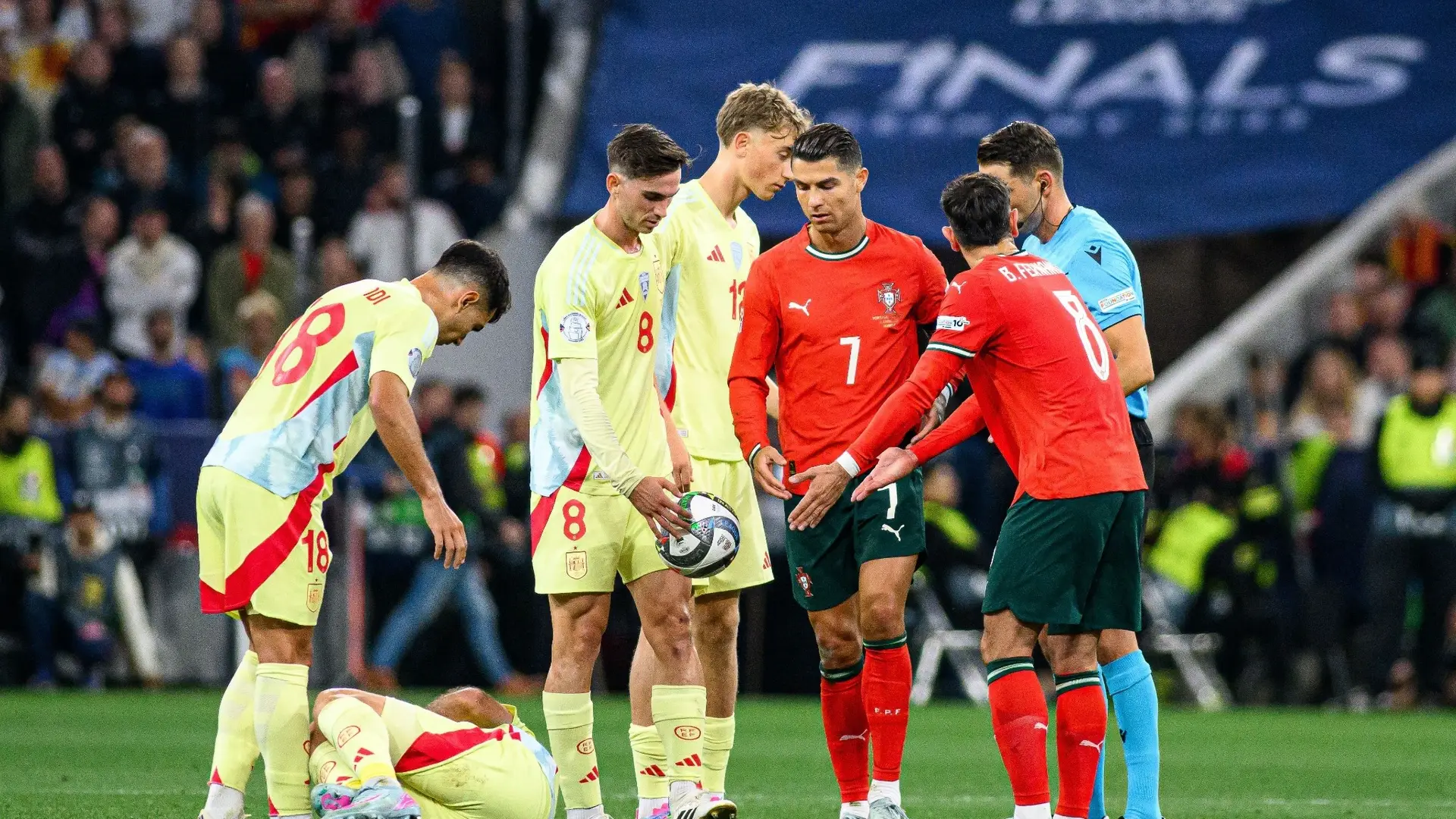
Spain’s World Cup squad landed with a detail Real Madrid could not soften. Luis de la Fuente named 26 players, and none of them play for the club that still presents itself as the center of Spanish football power.
It’s not simply an omission. It’s a measurement of where Madrid’s next era has drifted. The club still has global pull, global stars, and a president whose résumé is almost inseparable from modern European football. But in Spain’s own World Cup squad, Madrid has disappeared.
The official list tells the story without much decoration. David Raya, Joan García and Unai Simón are the goalkeepers. The defense includes Grimaldo, Pau Cubarsí, Marcos Llorente, Pedro Porro, Aymeric Laporte, Marc Cucurella, Marc Pubill and Eric García. The midfield has Mikel Merino, Fabián Ruiz, Gavi, Álex Baena, Rodri, Martín Zubimendi and Pedri. The attack includes Ferran Torres, Borja Iglesias, Dani Olmo, Yeremy Pino, Nico Williams, Lamine Yamal, Mikel Oyarzabal and Víctor Muñoz.
There are Barcelona players, Premier League players, Atlético Madrid players, Athletic Club players, and players from elsewhere in Europe. There is no Dani Carvajal. No Dean Huijsen. No Dani Ceballos. No Raúl Asencio. No, Fran García. No Álvaro Carreras. No Gonzalo García in the final 26.
The story for Madrid may be an uncomfortable one to accept. This was not a coach rejecting a dominant Spanish core at the Bernabéu. There was no dominant Spanish core to reject. Carvajal’s injuries and age made his case harder. Huijsen had not yet made himself unavoidable. Ceballos has long lived between talent and timing. Gonzalo García was close enough to be included among Spain’s supporting players for preparation, but not close enough to take a tournament place.
A club election finds its opening
That absence matters because it arrives during a period when Madrid’s authority feels less automatic. The squad selection alone would have made noise. Combined with a difficult season, questions about planning, and a rare presidential challenge, it becomes part of a larger institutional picture.
Spain’s squad also points toward a different national-team ecosystem. De la Fuente can lean on Barcelona’s midfielders and wide players, with Barcelona’s La Masia academy still producing names that fit the national style. Pedri, Gavi, Cubarsí and Lamine Yamal offer Spain a young spine with familiarity and rhythm. Madrid, by contrast, has built its sporting identity more aggressively around international recruitment.
That strategy can still win. It can win often. But it creates a strange visual when Spain walks into a World Cup without a single Madrid player. A club can be powerful yet absent from the national conversation. Madrid is now facing that contradiction in public.
Enrique Riquelme is trying to exploit the dysfunction at Real Madrid. The businessman has been declared a valid candidate for the Real Madrid presidency, placing him opposite Florentino Pérez in an election set for June 7. His chance of victory remains difficult to judge from the outside, but the timing is clear. He does not need Madrid to be broken. He needs enough Madrid members to believe the club has become too closed, too centralized, or too slow to correct sporting drift.
Riquelme’s profile is not built on football nostalgia alone. He founded Cox Energy in 2014 and serves as chairman of Cox, a company tied to major water and renewable-energy projects across Europe and Latin America. Cox says it completed a $4 billion acquisition of Iberdrola México in April 2026, a deal that expanded its position in a priority market. The better way to frame his wealth is careful and factual. He is not just a rich Madrid fan making noise. He is a businessman whose companies have operated at billion-dollar scale, especially in Latin America and Mexico.
That gives his candidacy a seriousness even if Pérez remains the favorite. Pérez can point to trophies, financial strength and an era of global dominance. He has already argued that criticism around the club has become disproportionate, and he has framed Madrid’s recent problems around a punishing schedule, injuries and the lack of a proper preseason. Those explanations may persuade many members. They may also leave others asking why a club with Madrid’s resources reached this point at all.
The Spain squad sharpens that question because it removes abstraction. Debates about dressing-room mood, coach changes and transfer strategy can get messy. A national-team list is simpler. Madrid looked for representation and found none.
Riquelme’s campaign is unlikely to be decided by De la Fuente’s squad. Real Madrid elections are about power, membership, money, access and trust. Still, this is the kind of football detail that can travel through all those arguments. It touches identity. It touches planning. It touches the idea that Madrid’s greatness should not only be imported, marketed and renewed through one superstar cycle at a time.
For Pérez, the danger is not merely that a challenger has appeared. It’s that the challenger has an easy symbol to hold up. Spain is going to the World Cup. Real Madrid, at least through its Spanish players, is not going with it.