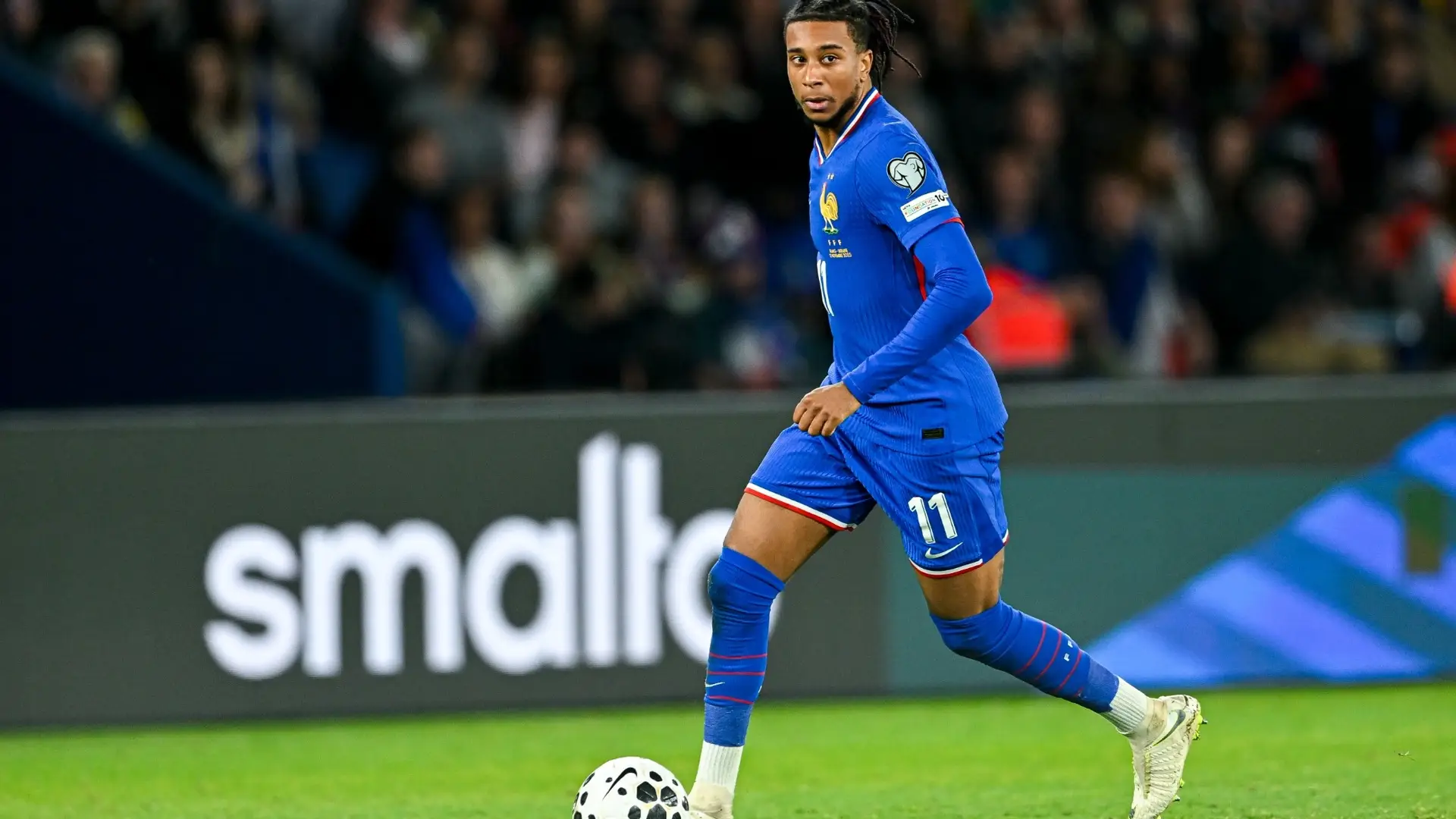
Michael Olise continued his superb form by dropping a hat-trick on Northern Ireland in Lille. The Bayern Munich attacker reassured Deschamps’ side after its slip-up against the Ivory Coast in a World Cup warm-up four days prior.
His first goal came late in the first half, from the kind of loose ball that punishes a defense for only half-clearing danger. Ousmane Dembélé’s shot was blocked, the rebound found Olise, and France had the lead in the 43rd minute. Four minutes after halftime, another clearance fell into his range. He struck it cleanly, and the match began to look less like a test of France’s attack than a study in one player’s timing.
The third goal was different. From the right side, Olise moved inside and bent a left-footed shot off the far side of the goal in the 75th minute. It completed the hat trick, and he celebrated none of it. Mr. Nonchalant notched 22 goals for Bayern Munich this season.
Patrick Kelly’s goal for Northern Ireland in the 64th minute mattered, too. Deschamps will not leave this match thinking France solved everything. Four days after a 2-1 loss to Ivory Coast, another counterattack exposed space behind the team that will soon face Senegal, Iraq, and Norway in Group I.
A different kind of control
Mbappé still stretches the field. Dembélé still gives France width, speed, and disorder. Doué gives them another ball carrier between lines. Olise brings a quieter authority, the sense of a player who can hold the ball long enough for a shape to appear around him. He does not always need the first route forward. Sometimes his value lies in delaying the pass, drawing one defender too close, and making the next decision clearer.
This is the part of Olise’s rise that feels important for Deschamps’s last tournament. France have often been at their best under him when talent accepted structure. Antoine Griezmann became a midfielder in Qatar. N’Golo Kanté made risk look recoverable. Olise’s case is different—he’s a quiet, dependable creator; he’s scored as many goals (7) in 42 fewer games than Dembele.
Olise was built across different football ecosystems: English academies, Reading, Crystal Palace, and then Bayern Munich. At Palace, he often looked like a player making sense of the game in his own tempo. At Bayern, he has had to make that tempo useful every week, in a side where control is not a luxury but an expectation.
Olise sits neatly among the players to watch at World Cup 2026. In a team full of obvious threats, Olise may be the one who makes the others easier to use. He integrates and then quietly explodes.