The 2026 World Cup already has an animal cast. Canada has Maple the Moose, Mexico has Zayu the Jaguar and the United States has Clutch the Bald Eagle. Now two living ducks have created a smaller parallel story around the tournament, one in Mexico City and one in Providence, Rhode Island, a city that has unexpectedly become part of the World Cup 2026 in Boston.
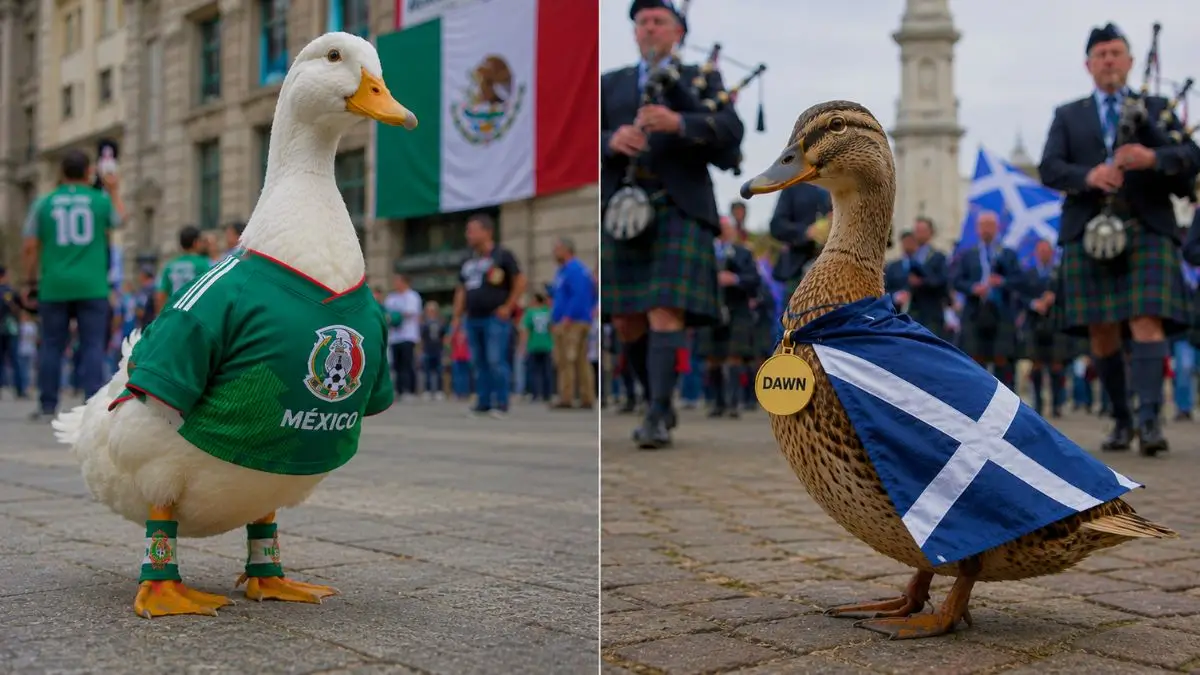
Merlin is the Mexican duck. He is two years old, domesticated, and usually seen in Mexico City with the family that cares for him. His owner, Karla Gomez, is a beverage seller, and her son Christian is part of Merlin’s match-day orbit. During Mexico’s opening 2-0 win over South Africa, Merlin appeared in a miniature Mexico shirt and custom duck socks, turning an ordinary World Cup street scene into one of the tournament’s strangest unofficial mascot moments.
Dawn is the Scottish duck by circumstance rather than passport. Dawn, also known as Dawny, is a Providence rally duck who joined the Tartan Army’s pre-match bagpipe march before Scotland played Morocco. She wore a Scottish flag and the gold medallion already associated with her appearances around Providence.
Scotland’s first two Group C matches were staged at the Boston-area stadium in Foxborough, but Providence became part of the team’s tournament footprint because many Scotland supporters used the Rhode Island city as a base. That gave the World Cup a local character it could not have designed from a branding deck, with a Providence duck moving through a Scottish match-day procession.
FIFA’s official mascots still belong to the tournament’s planned visual system. Maple, Zayu and Clutch are made for merchandise, video games and host-nation storytelling. The same is true of the broader staging around World Cup 2026 fan festivals, where public viewing, city programming and tournament branding are organized in advance.
When mascot culture leaves the costume
Designed mascots still matter. The new U.S. Soccer dog mascot showed months before the tournament how an animal character can make a huge institutional project easier to recognize. Merlin and Dawn are different.
The ducks sit inside a longer tournament habit of giving animals symbolic work. Paul the Octopus did it most famously in 2010 by selecting match winners from an aquarium in Germany and correctly picking Spain to beat the Netherlands in the final. In 2018, Achilles the Cat was part of another World Cup cycle built around animal predictors. In 2026, that tradition has expanded again through Swimbappe, an oranda goldfish in Toronto making daily predictions from a tank built like a soccer pitch.
Mexico City has another animal thread as well. Osito, an eight-year-old rescue poodle mix, appeared around Mexico’s World Cup setting on a cargo bicycle, wearing a Mexico jersey, sunglasses and a cap.
There is a caution inside the charm. Dawn had previously been barred from a Providence arena after a basketball appearance over animal welfare concerns. That detail should keep the story grounded.
The best comparison may be Pickles, the dog who found the stolen World Cup trophy in London in 1966. Pickles was not a mascot in the modern sense, but he remains part of football’s animal fable because his story attached a real creature to a real tournament crisis. Merlin and Dawn are much lighter figures. They don’t solve a theft or predict destiny. They simply show how a vast World Cup can still produce stories small enough to fit on webbed feet.