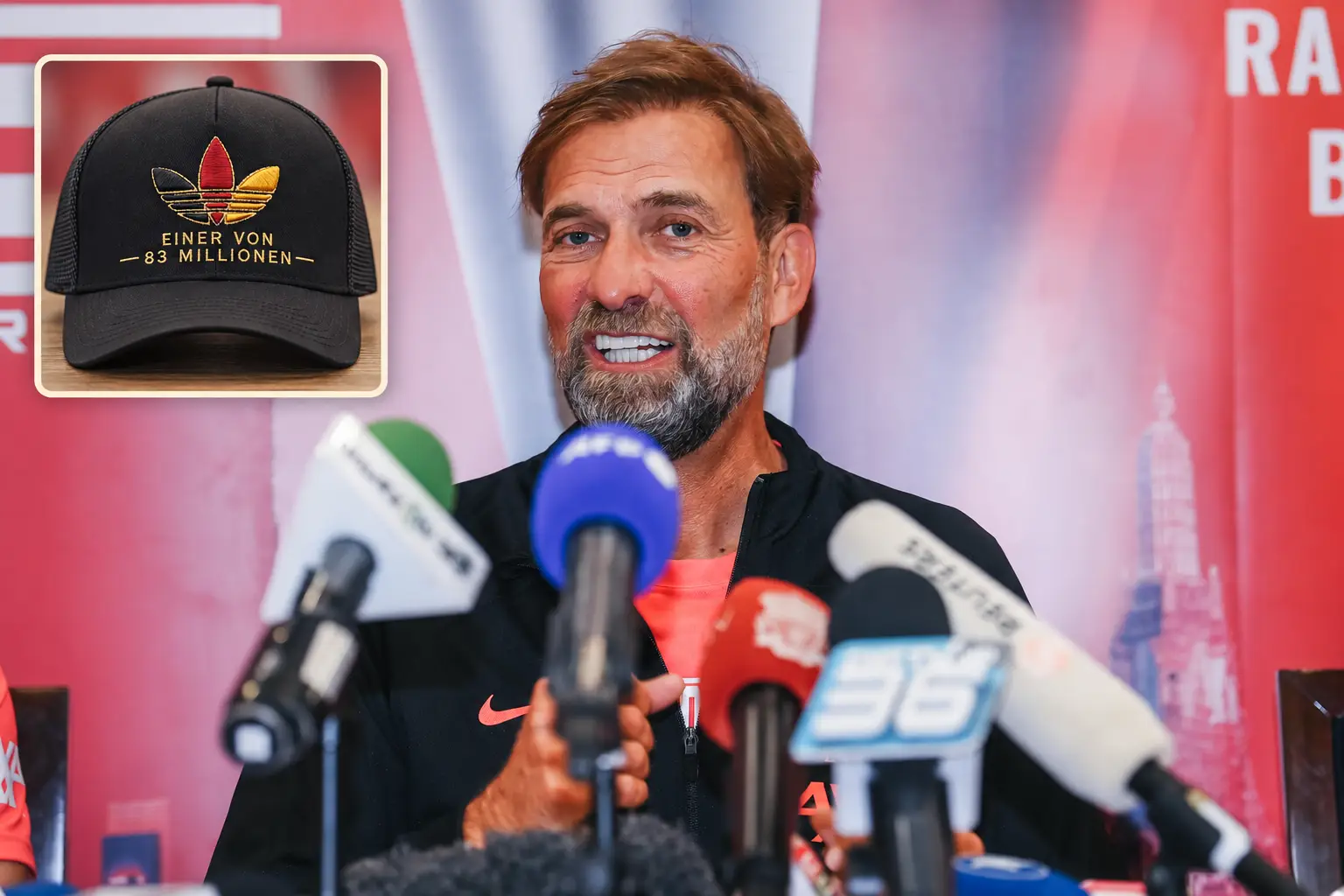
Jürgen Klopp brought a box of caps to his first Germany squad announcement. The black hats carried an Adidas logo in the national colors and a line of German beneath it: “Einer von 83 Millionen,” or “one of 83 million.”
For the man appointed to lead Germany, the number placed him among the people watching. It referenced the country’s approximate population and a familiar football joke: everyone has an opinion about how the national team should be coached. He has the actual job. The cap puts him in the crowd.
The idea came from Klopp rather than a DFB or Adidas marketing campaign, initially offered as a prize for predicting an unexpected selection. When he offered them around at the end, Klopp suggested that taking one brought responsibility for German football.
Klopp’s explanation went beyond the joke. “I don’t want to leave national pride to the wrong people,” he said. He wanted people to be able to wave the German flag without others assuming something was wrong with them, and to express happiness about living in the country.
His first camp is now underway in Herzogenaurach. After leading a small-group session on Monday, September 21, Klopp is scheduled to hold his first full-team practice on Tuesday afternoon, September 22. His debut follows against the Netherlands in Amsterdam on Thursday, September 24. The introduction is giving way to a compressed week of coaching.
A flag, a team and a sense of belonging
Klopp’s description of belonging included people who were born in Germany, grew up there or moved there. Arrival counted alongside birthplace. He also said that pride in being German could coexist with openness, diversity and friendliness. His version of national identification didn’t require everyone to have the same background.
The remarks followed the AfD’s September 6 state-election victory in Saxony-Anhalt. Klopp referred to a recent election during the press conference, but he didn’t name the party.
Black, red and gold have a history connected to civic freedom. The colors appeared at the Hambach Festival in 1832 and became associated with the revolutionary movement of 1848–49. When the Federal Republic adopted them in 1949, it drew on that tradition of unity and freedom.
His approach to leading people has also involved speaking to those outside the dressing room. In his first Liverpool interview in October 2015, Klopp described football as a way to give supporters a break from their everyday problems. He emphasized entertaining them while acknowledging that football managers weren’t doctors saving lives. In his Germany remarks, he again put doctors and nurses ahead of football while describing the game’s capacity to bring people together.
He ended that Liverpool interview with: “We have to change from doubter to believer. Now.” Yet the same conversation contained a practical starting point: a stable defense. Public confidence and the organization of a team weren’t separate subjects for him. The invitation to believe came with work to do on the field.
A country’s population is broader than a club’s following. People can share a nationality without caring about football or agreeing about patriotism. Klopp is addressing a public that won’t necessarily gather around a television when his team plays.
Germany’s next two home games will offer standing tickets, against Greece in Augsburg on September 27 and Serbia in Munich on October 1. The DFB announced the move in August, before the cap press conference, citing supporter demand, fan culture and a less expensive way to attend.
Klopp can choose the players who wear Germany’s shirt. He can’t select the people who feel represented by it. His cap offers an invitation; his first week on the training field begins the job of giving them a team to watch.