The most consequential graphic in a World Cup broadcast takes up roughly two inches of screen. Not the stadium flyover. Not the replay wipe. The scorebug, the compact box carrying time, score and team abbreviations while the match runs, is now doing more design work per pixel than anything else in sports television.
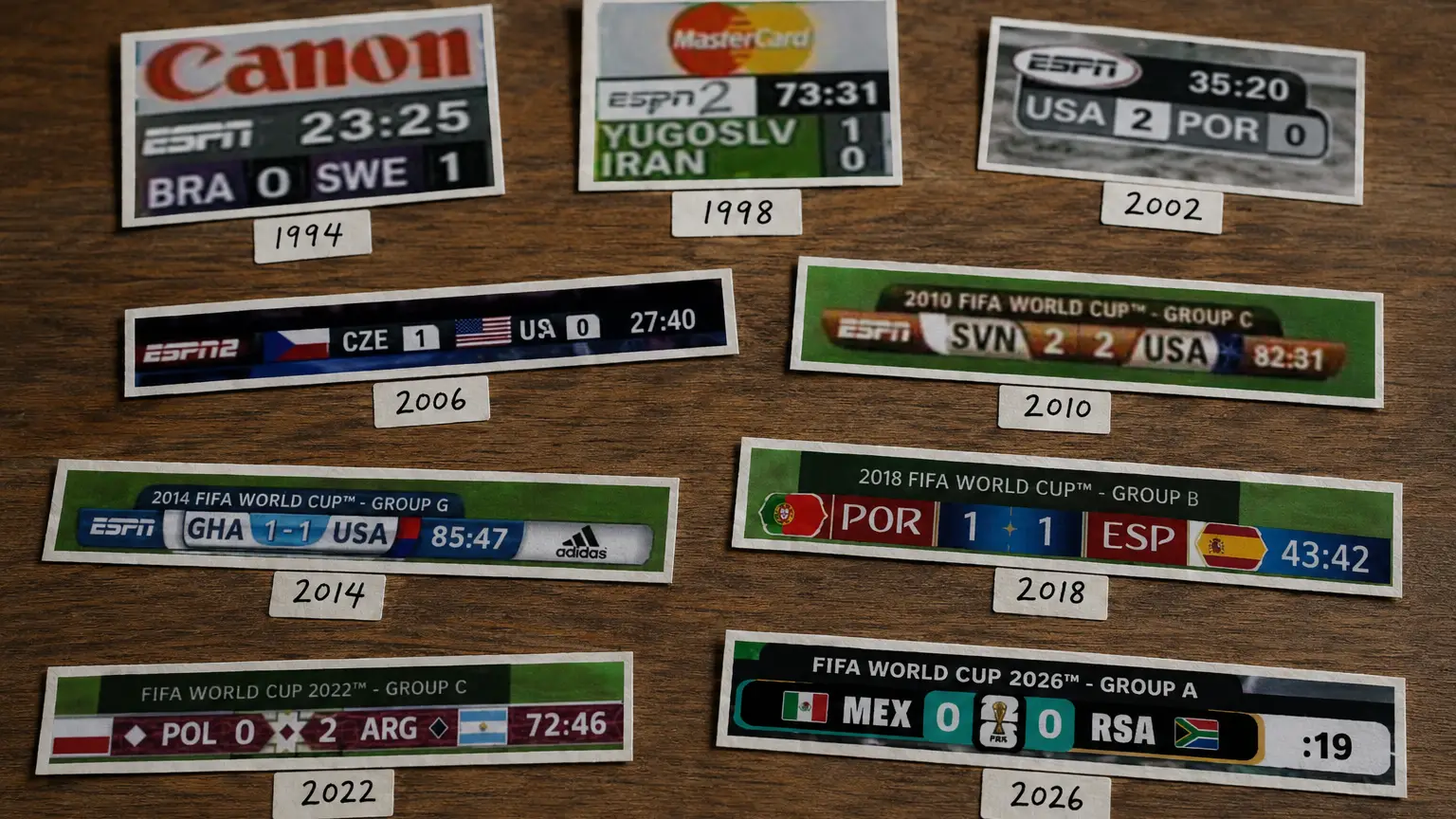
This became clear during the 2026 opener at Azteca. FIFA’s new scorebug pairs a dark pill-shaped structure with offset color shadows, national flags, kit-color indicators and a central 26 mark embedded in the live picture. Every element is doing a job.
Consider the central logo placement. Older scorebugs organized themselves around a hierarchy: clock first, score second, teams third. The 2026 version installs the tournament identity at the center of the graphic, sharing rank with the scoreline. The event is being presented as more than a match. The distinction sounds subtle, but it changes what the viewer is constantly reminded they’re watching.
The kit-color indicators are more quietly brilliant. Flags establish nationality. Abbreviations confirm it. But neither tells a viewer which color to track across the field. A tiny strip of kit color answers that question without adding a panel, a caption or an on-screen sentence. It’s the kind of information design that good designers do and bad designers never think to do: answer the question the viewer hasn’t consciously formed yet.
The challenge behind all of this is survivability. A scorebug has to remain legible across stadium wide shots, tight close-ups, streaming compression, dark shadows, bright grass and cropped mobile clips. It can’t rely on a clean background. It has to survive as a graphic under conditions it doesn’t control. That constraint forces precision. Everything that can’t pull its weight gets cut.
The American context matters here. The continuous scorebug as a fixture of U.S. soccer coverage was essentially an American broadcast invention, introduced during the 1994 World Cup on ABC and ESPN. The sport’s commercial structure demanded it: a game that runs for 45-minute stretches without natural breaks needs a permanent match-state reader. The device that solved that broadcast problem has since evolved into something with its own visual logic and cultural weight.
FOX and Telemundo’s versions demonstrate what localization looks like within a shared global framework. Clock position, score treatment, and substitution display. These differ between the two. They are not cosmetic choices. They determine the speed of a viewer’s eye through the graphic, which in a live match environment is measurable in tenths of a second and in emotional engagement as more than that.
Design work this compressed rarely gets studied because it rarely stays still. The 2026 scorebug is worth the attention. It answers four questions simultaneously: who is playing, what is the score, how much time has passed, which colors matter. It does all of that without stealing a frame from the match itself. That’s harder than it looks. Most design isn’t.