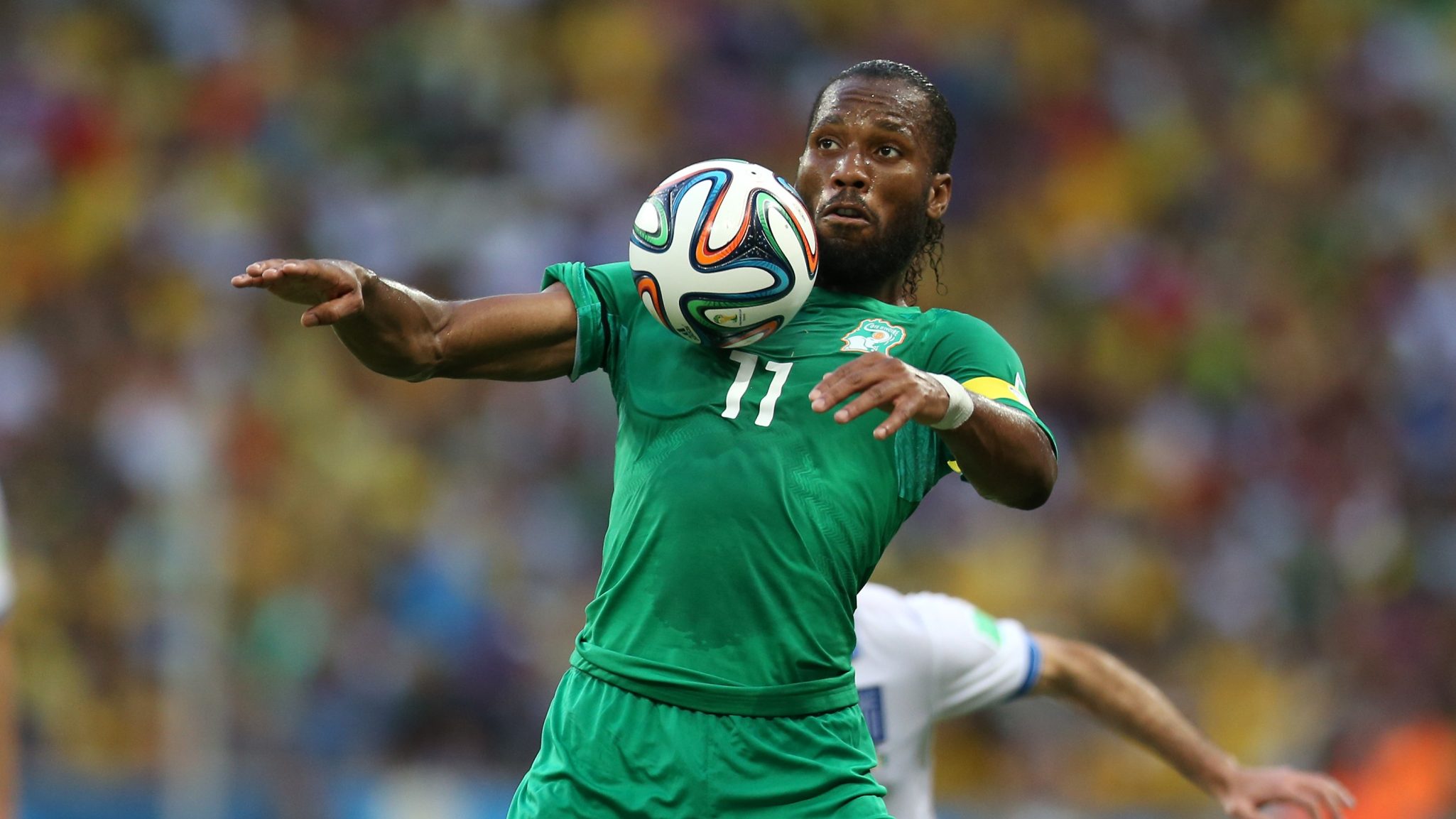
Didier Drogba’s role in Côte d’Ivoire’s peace process is often reduced to a single image: the striker in an orange national-team shirt, hands raised above his head, surrounded by armed men in a packed stadium. The photograph carries a simple force. It also belongs to a larger story, one shaped by war, diplomacy and a national team that briefly gave a divided country a shared public language.
Côte d’Ivoire’s civil war began in 2002 and split the country between a government-held south and a rebel-held north. President Laurent Gbagbo’s government remained based in Abidjan. The New Forces, led by Guillaume Soro, controlled Bouaké, the country’s second city. The conflict exposed political and regional fractures tied to questions of identity, citizenship and power.
Drogba’s first defining intervention came in October 2005, after Côte d’Ivoire qualified for its first World Cup. Inside the dressing room in Sudan, he and his teammates gathered around the television cameras. Drogba dropped to his knees and appealed for the fighting to stop. The message carried weight because it came from a squad made up of players from different regions and communities, wearing the same shirt at a time when the country itself was divided.
The national team did not replace the peace process. It gave that process a visible symbol. The Elephants were not speaking as a government ministry or rebel command. They stood as a rare institution in Ivorian life that could present unity without pretending the divisions had disappeared.
The match in Bouaké
The formal breakthrough came on March 4, 2007, when Gbagbo and Soro signed the Ouagadougou Political Agreement. The accord created a political framework for reunification and placed Soro in the role of prime minister. It was the product of negotiation, not sport. Drogba’s contribution was to help bring the symbolism of peace into public view.
In June 2007, Côte d’Ivoire played Madagascar in an Africa Cup of Nations qualifier in Bouaké. Drogba had pushed for the match to be held there, in the rebel stronghold, rather than in Abidjan. The choice of venue mattered as much as the result. Government troops, rebel forces, political figures and ordinary spectators occupied the same stadium after years of separation.
Côte d’Ivoire won 5-0. Drogba scored the final goal. The match did not end the war by itself, and the goal did not cause instant disarmament. Its importance came from the setting. Bouaké had been a symbol of partition. For one match, it became the stage for a national team built around the idea that Côte d’Ivoire still belonged together.
The photograph from Bouaké captures that tension. Drogba is framed by military uniforms, but he is wearing the national colors. The stadium is full, but the scene is still guarded. The moment feels hopeful without being simple. It shows a country trying to move from an agreement on paper toward trust in public.
The disarmament process remained gradual. In July 2007, Bouaké hosted the Flame of Peace ceremony, where weapons were burned as part of the reconciliation effort. Even after those gestures, Côte d’Ivoire’s peace stayed fragile. Severe post-election violence followed in 2010 and 2011, showing how much unresolved pressure remained beneath the country’s political settlement.
Drogba did not single-handedly end Côte d’Ivoire’s civil war. His role was narrower and more durable. He used his status, his team and the visibility of football to push peace into the center of national attention. In 2005, he turned a national team celebration into an appeal for calm. In 2007, he helped bring that appeal to Bouaké, where football became part of the country’s attempt to reunite.