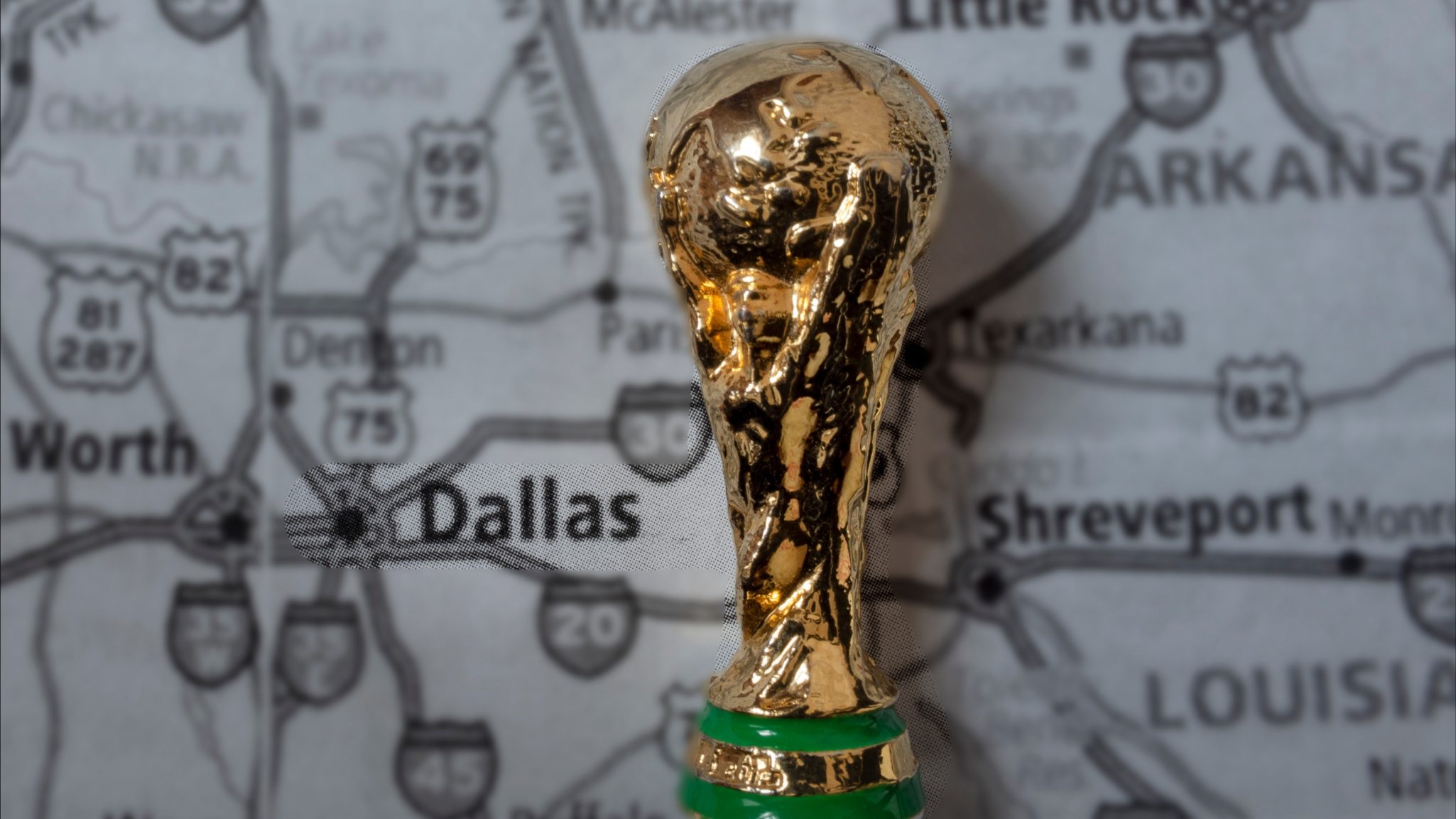
Dallas is a host city by name, but its 2026 World Cup footprint is regional by design. The matches are in Arlington, the public festival is in Fair Park, and the tournament’s broadcast operation sits downtown at the Kay Bailey Hutchison Convention Center. For visitors, the map matters almost as much as the match list.
The tournament venue is Dallas Stadium, the FIFA name for AT&T Stadium in Arlington. The building opened in 2009 and is listed for the World Cup with a capacity of 94,000, making it one of the tournament’s largest sites. It will host nine matches, the highest total for any venue in the 2026 tournament, including a semifinal.
The schedule is now concrete. Dallas Stadium hosts the Netherlands vs. Japan on June 14, England vs. Croatia on June 17, Argentina vs. Austria on June 22, Japan vs. Sweden on June 25, and Jordan vs. Argentina on June 27. The knockout schedule follows with Round of 32 matches on June 30 and July 3, a Round of 16 match on July 6, and a semifinal on July 14.
Downtown Dallas has a different role. The International Broadcast Center will be based at the Kay Bailey Hutchison Convention Center, giving the city a central operational function for the tournament rather than only a matchday role. It’s not a public attraction, but it explains why Dallas’s World Cup activity extends beyond the stadium gates.
Fair Park is the public gathering point. FIFA Fan Festival Dallas will run from June 11 to July 19 at The Pavilion at Fair Park and Lots 9 and 10. The site is planned as roughly 1 million square feet, with capacity for up to 35,000 people at a time. It will be free and open on the tournament’s 34 match days, while closed on the five rest days. Matches that start at 10 p.m. or 11 p.m. local time will not be shown.
How the regional layout changes the trip
Hotel choice becomes a logistics decision. Arlington gives visitors the shortest path to Dallas Stadium. Downtown Dallas puts them closer to Fair Park, the convention center and rail connections. Fort Worth is also more practical now that the official matchday transit plan includes Fort Worth Central Station as a key boarding point.
The main public transit plan for matches sends ticket holders on the Trinity Railway Express to CentrePort Station, then onto complimentary charter buses bound for the stadium area. The recommended boarding points are Victory Station in downtown Dallas and Fort Worth Central Station. Visitors are told to plan for about 90 minutes from downtown to the stadium. Charter service requires a valid match ticket and will operate from five hours before kickoff until three hours after the match.
Driving remains possible, but it won’t work like a normal stadium event. Matchday parking must be pre-purchased, and there will be no on-site parking sales. Rideshare and taxi drop-offs will be directed to the Arlington Esports Stadium lot, about a 10-minute walk from Dallas Stadium.
The airport picture helps explain why the region can support a scattered event. Dallas Fort Worth International Airport connects to downtown Dallas through DART and to Fort Worth through TEXRail. Dallas Love Field connects to the DART system through the Love Link bus at Inwood/Love Field Station. Fair Park is served by DART rail, which gives the Fan Festival a simpler transit profile than the stadium.
The footprint also reaches into preparation. FC Dallas Stadium in Frisco and Mansfield Stadium in Mansfield are listed as team base camps, adding another layer to North Texas’s tournament role. Ticketing has also moved from future planning into the final sales window, with FIFA’s Last-Minute Sales Phase running through July 19, subject to availability. Dallas will not function like a single-site event. It will function like a regional World Cup corridor, with Arlington, Fair Park, downtown Dallas, Frisco and Mansfield each carrying part of the tournament.