
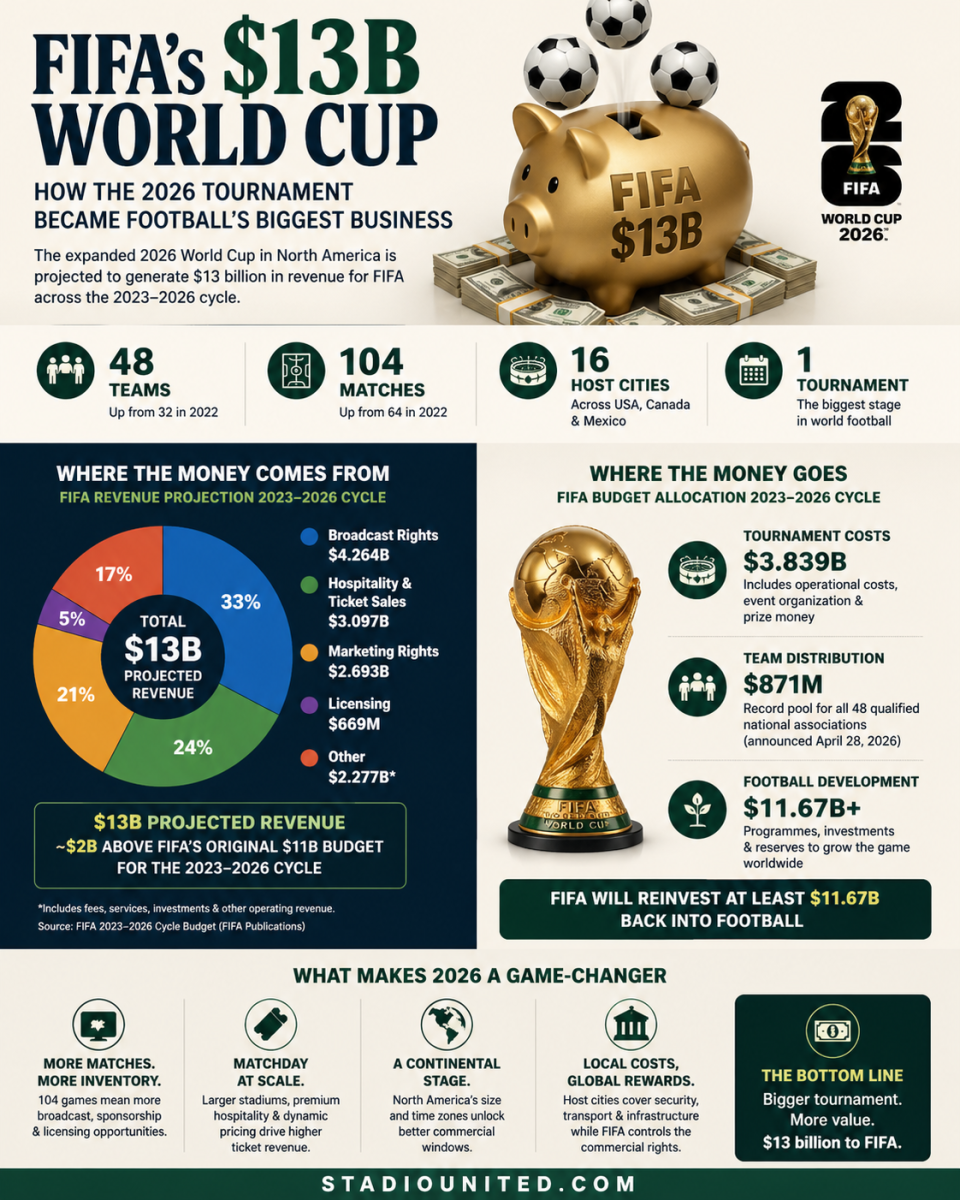
The 2026 World Cup is usually measured by its size: 48 teams, 104 matches, 16 host cities, and three countries. FIFA is measuring it another way. The governing body is projecting $13 billion in revenue for the 2023-2026 cycle, turning the first expanded North American World Cup into the largest commercial event it has ever staged.
That number is not profit. It is total cycle revenue, with almost $9 billion expected in 2026 alone. FIFA has said it will reinvest at least $11.67 billion, while its earlier budget put the 2026 World Cup line at $3.839 billion, covering operational costs and prize money.
The jump is sharp because the previous baseline was already a record. FIFA reported $7.568 billion in revenue for the 2019-2022 cycle. Qatar accounted for $6.314 billion of that, including $929 million from ticket sales and hospitality. For 2026, ticketing and hospitality alone are expected to land around $3 billion.
The commercial machinery is broad. FIFA’s original 2023-2026 budget projected $4.264 billion from television broadcasting rights, $3.097 billion from hospitality and ticket sales, $2.693 billion from marketing rights and $669 million from licensing. The current $13 billion projection is roughly $2 billion above that initial $11 billion budget.
How the 104-game format changes the balance sheet
The expanded 2026 World Cup gives FIFA 40 more matches than Qatar and a longer tournament to sell across broadcast, sponsorship, hospitality and licensing channels. More games mean more inventory. North American stadiums add scale. The time zones also give FIFA a valuable commercial window for major media markets in the Americas and Europe.
Ticketing is the most visible expression of the model. Larger stadiums, premium hospitality infrastructure and dynamic pricing give FIFA room to raise the ceiling without changing the basic product. FIFA’s own budget had already projected hospitality and ticket sales as one of the largest revenue categories of the cycle. In 2026, that category is expected to rise far beyond the level reached in Qatar, turning matchday access into one of the clearest signs of how much the expanded tournament has changed the business.
The local accounting looks different. Host cities gain visibility, visitors and the responsibility of staging a global event, while FIFA controls the most valuable revenue streams. FIFA takes income from broadcasting, sponsorship, ticket sales and some venue services, while host cities are responsible for safety, security and protection. At MetLife Stadium, that tension has already surfaced around transport planning and public cost.
FIFA has also moved to increase payments to participating teams. On April 28, 2026, the FIFA Council raised the distribution pool for all 48 qualified national associations to $871 million, including higher preparation money, higher qualification money and more than $16 million in additional team contributions. This corroborates the scale of FIFA’s top line. The new team distribution accounts for about 6.7 percent of the projected $13 billion in cycle revenue.
So how much is FIFA expected to gain? The clean answer is $13 billion in revenue across the cycle, with almost $9 billion expected in 2026. The more precise answer is that FIFA has created a tournament model where scale compounds across nearly every commercial category. It can sell more matches, more premium seats, more media windows, more sponsorship exposure and more licensing opportunities.
The 2026 World Cup will decide a champion on the field. FIFA’s result is already visible in the accounts. This is not only a larger tournament. It is a continental rights package, a premium ticketing engine and a test of how much value football’s governing body can extract when the world’s most watched sporting event moves into North America.