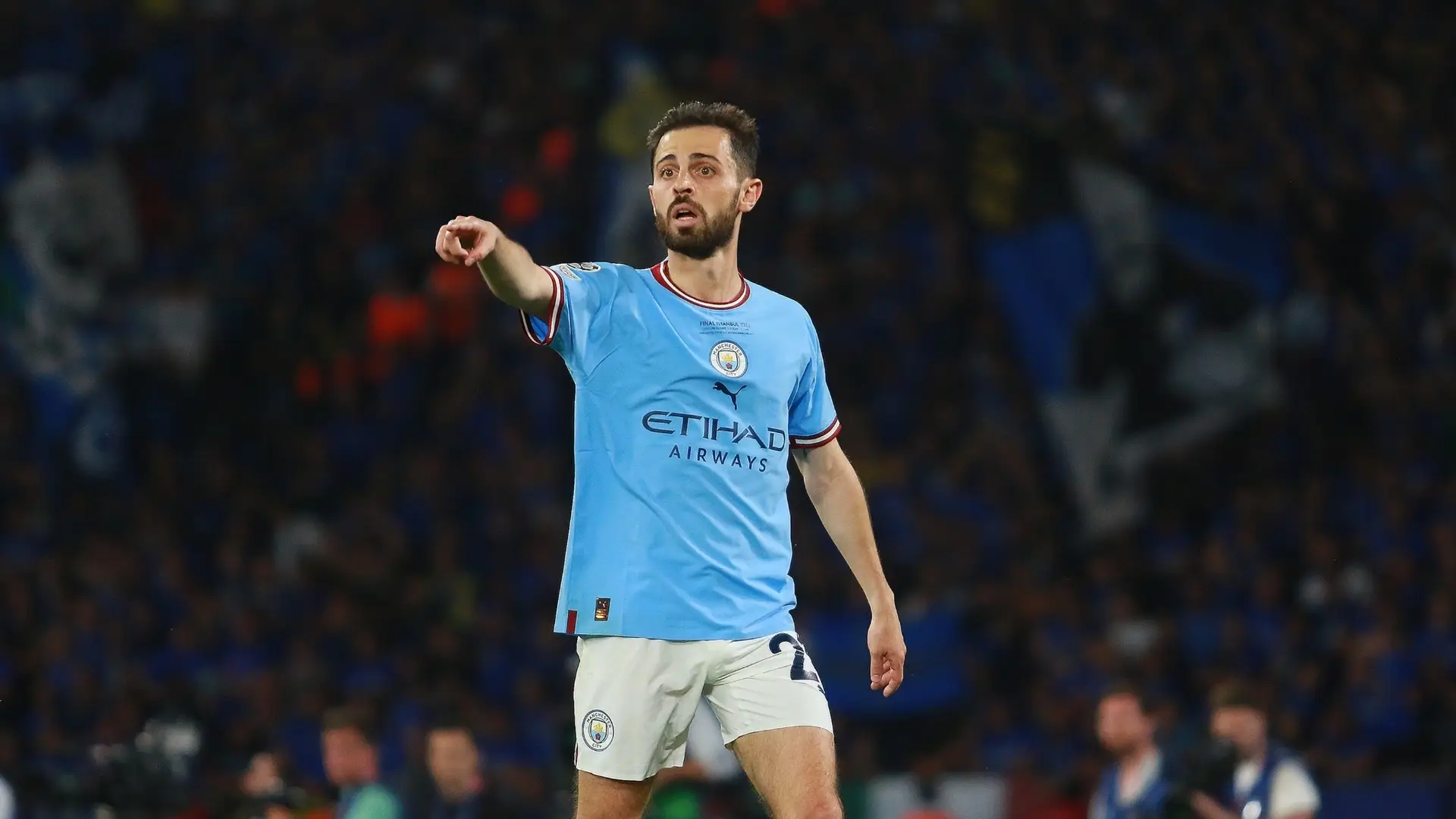
Bernardo Silva’s path out of Manchester City has suddenly become part of something larger than a free-agent market. Real Madrid have appointed José Mourinho on a three-year contract – and the name he wants first isn’t a teenager, isn’t a statement signing, isn’t a declaration of a new cycle. It’s a 31-year-old coming off nine seasons learning the rhythms of Pep Guardiola’s side. For a club already absorbing the weight of Mourinho’s return to Real Madrid, Bernardo would be an unusually precise opening statement.
Manchester City confirmed in April that Bernardo’s summer departure. He arrived in 2017, made 451 appearances, and had won 19 major trophies with the club by the time that announcement came. The numbers outline duration, not the profile.
Bernardo became valuable to City because he could survive almost any version of a match: wide, central, advanced, withdrawn, pressing, pausing, stitching a move back together when the chance for something better had gone. Very few players at that level function across so many states of a game without becoming merely useful.
That versatility explains why this reported pursuit is more than a late-career free transfer. Fabrizio Romano has reported that Real Madrid sent an official proposal to Bernardo, with advanced talks underway and Mourinho pushing for the move. Barcelona and Atletico were also hovering over the player should talks stall.
Mourinho’s logic here isn’t nostalgia – it’s control. Madrid already carries high-end individual threats in Kylian Mbappé, Vinícius Júnior, and Jude Bellingham. What they don’t automatically carry is someone who can hold the ball under pressure, move without turning every possession into an audition, and defend through positioning before the tackle becomes necessary. Those are Bernardo’s qualities. They’re also the qualities Mourinho has consistently valued in the best versions of his teams, from Costinha to Lampard to Xabi Alonso. Find the player who reduces disorder, and the stars around him become easier to manage.
The fit also creates a clear tactical contrast. Bernardo’s last club chapter belonged to Guardiola’s Manchester City, where control wasn’t just a style but a daily demand. Those habits would give Mourinho something he has often chased in transfer windows: a player who can contain a match without requiring the match to run through him.
Why Bernardo fits Madrid now
The practical case is also a structural one. A squad with Mbappé, Vinícius, and Bellingham already has enough players capable of deciding a match individually. What it needs is someone who can govern the spaces between moments of brilliance — who can let Madrid breathe in possession rather than defend their way through stretches when the press comes. Bernardo does that without demanding anything in return.
At 31, he wouldn’t arrive as the next face of a cycle. That may be exactly the point. Free transfers at this level carry hidden costs – wages, squad hierarchy, expectation – but they also offer immediate competence without a fee. Bernardo brings a finished football education into a dressing room that Mourinho is expected to reorder quickly. There’s something almost deliberately quiet about the logic. It’s not a project, not a redemption arc. It’s just a player who knows what he’s doing.
If it happens, Bernardo arrives as a practical correction to a glamorous squad. He doesn’t need the attack built around him. He makes it easier to arrange the players around him. In that sense, a move from City to Madrid would say as much about Mourinho’s priorities as Bernardo’s next chapter. Some managers build a team around the game they want to play.