The gold stripes on Germany’s final Adidas shirt are made from tiny diamonds. Adidas says they stand for the country’s more than 24,000 football clubs. For a farewell design, that’s a revealing choice: the decoration points beyond the national team to the game that supplies it.
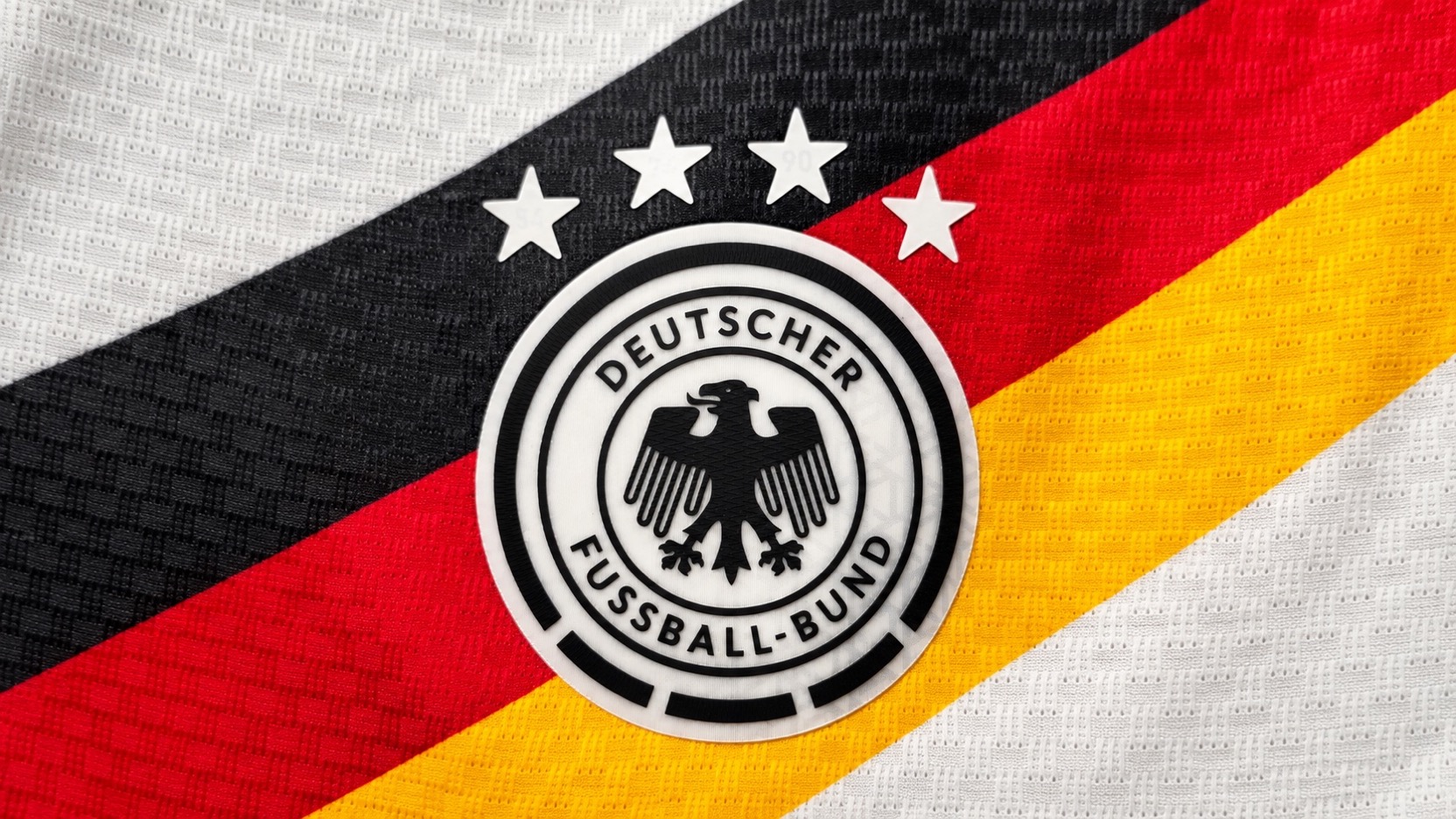
The white Trefoil sits opposite an older DFB crest, while three white stripes run across each shoulder. Adidas has paired that retro logo with modern matchwear elsewhere, including Real Madrid’s green 2026/27 away shirt. Here, it appears on Germany’s final kit before Nike takes over in January 2027.
The black base gives the gold room to show without competing with the badges. White-and-gold edging frames the V-neck and cuffs, while the thin, broken vertical lines keep the body from becoming a blank commemorative top. It’s restrained rather than minimal. Remove the badges and those shoulder stripes would still identify the maker.
View this post on Instagram
Several periods have been folded into one shirt. The DFB emblem recalls the version used from 1978 to 1996, the Trefoil dates to 1972, and a small 1954 mark near the hem points further back. It isn’t a replica of one winning team’s kit. It assembles references from across the relationship.
The DFB chose the September 24 Nations League match against the Netherlands in Amsterdam for the shirt’s debut. Adidas’s German store lists a September 26 release. With the existing supply agreement running through December 31, this is a playing kit for the partnership’s closing months, not a souvenir arriving after the players have moved on.
How Adidas became part of Germany’s football identity
The connection begins with footwear. When West Germany beat Hungary in the 1954 World Cup final, Adi Dassler’s lightweight boots and adjustable screw-in studs helped establish Adidas’s reputation. The company, founded in Herzogenaurach five years earlier, now had a place in the story of Germany’s first World Cup. As the Adidas and Puma rivalry expanded across world football, the national team gave Adidas a connection rooted at home.
Yet Germany’s relationship with Adidas is older than its uninterrupted use of Adidas shirts. The 1954 tops were made by Leuzela. Umbro supplied shirts at the 1970 World Cup, and Erima dressed the 1974 winners. Adidas bought Erima in 1976; West Germany wore Erima in the group stage of Euro 1980 before appearing in Adidas shirts for the final.
Umbro’s involvement means Nike won’t be the first foreign manufacturer to make Germany’s shirts. The break is with a long-established association, not an unbroken record of German kit suppliers. Boots, training clothes and match shirts have different histories, even when a farewell campaign gathers them into one.
Adidas’s campaign makes that history conversational. A promotional film brings figures including Jürgen Klinsmann, Philipp Lahm and Per Mertesacker together with current players to debate the best Germany shirt. The product becomes a reason to argue about football memories, with different generations bringing their own candidates to the table.
When the Nike deal was announced in March 2024, then-Vice Chancellor Robert Habeck described the association in national rather than commercial terms: “Adidas and black-red-gold always belonged together for me, a piece of German identity.”
Why the DFB chose Nike
The DFB’s argument concerned its wider obligations. Nike’s eight-year agreement covers all its national teams from January 1, 2027, through December 31, 2034. The federation said Nike delivered the strongest financial bid and commitments to amateur and grassroots football, alongside the development of the women’s game. It presented the switch as a way to support football beyond the senior men’s team.
Nike reportedly agreed to pay around twice Adidas’s existing annual fee. The DFB hasn’t disclosed the contract’s financial terms. Adidas’s farewell shirt is a commercial product too, offered for sale with the history of the partnership built into its design. Nostalgia and revenue aren’t confined to opposite sides of this agreement.
In explaining the deal, the DFB pointed to the work its associations support away from international football: organizing competitions, training club staff, developing young players and helping clubs operate. Those services formed part of its answer to objections about changing suppliers.
The same amateur game appears on both sides of the handover. Adidas has put it into the pattern of the farewell shirt. The DFB has put it into its case for changing suppliers. One is a tribute supporters can wear. The other is a promise whose value will be measured after Nike’s kits arrive.
Nike has secured Germany’s kit contract through 2034. Adidas’s place in the old photographs isn’t part of the sale.