
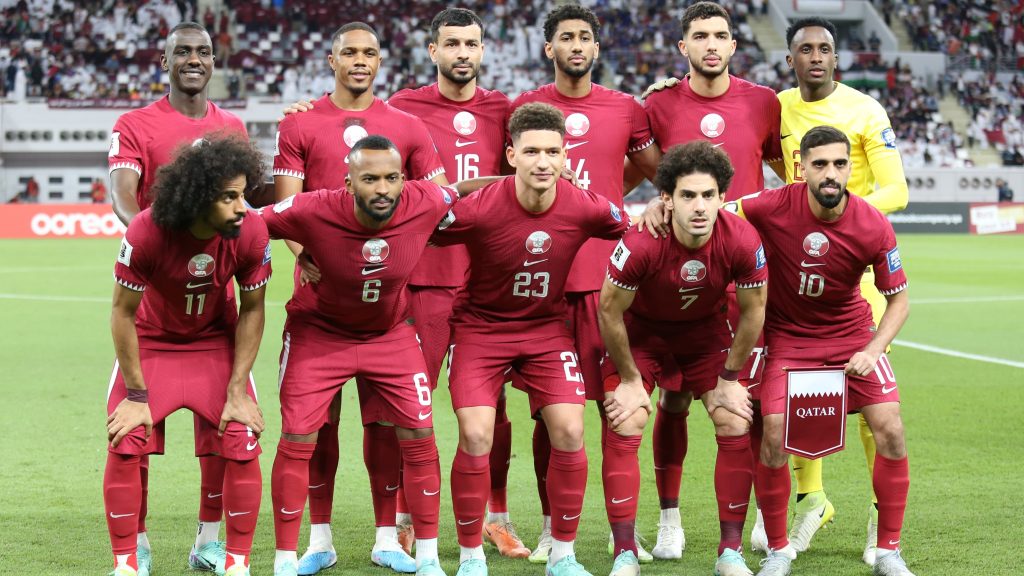
Qatar heads to 2026 with qualification, not hosting
Qatar secured their spot at the 2026 World Cup on one night in October 2025, beating the United Arab Emirates 2–1 to finish Asian qualifying. Boualem Khoukhi and Pedro Miguel both scored headers in the second half, set up by Akram Afif, sending Qatar to the tournament in North America.
This will be Qatar’s second appearance at the men’s World Cup. The first was as hosts in 2022, but this time they qualified on merit. That difference matters in football, as it affects how teams are judged before the tournament begins.
The 2022 World Cup still lingers for Qatar because of their results. They were the first host nation to lose all three group matches. Hosting brought attention and high expectations, but it also made clear the difference between their regional success and the global stage.
Since then, Qatar have built a clearer record. In 2024, they defended their AFC Asian Cup title by beating Jordan 3–1 in the final at Lusail Stadium, with Afif scoring three penalties. Winning two continental titles in a row does not guarantee World Cup success, but it shows they know how to compete in their region.
Qatar is set to play in Group B with Canada, Switzerland, and the winner of UEFA Playoff Path A. All their group matches will be on the West Coast. They start against Switzerland on June 13, 2026, at Levi’s Stadium in Santa Clara, face Canada on June 18 at BC Place in Vancouver, and finish the group on June 24 at Lumen Field in Seattle against the playoff winner.
Playing all their group matches on the West Coast gives Qatar a straightforward path in the tournament.
That geography gives Qatar one practical advantage before the tournament even starts: followability. Three matches in one corridor, across a tight band of time zones, makes it easier to track the team closely. For traveling supporters it reduces the usual World Cup friction, and for viewers it turns the group into a straightforward sequence of dates rather than a logistical puzzle.
However, the group will not be easy. Canada is a co-host, and Switzerland is known for being organized and making games close. The last team will be decided by the UEFA playoff, adding some uncertainty that could change the group’s dynamics.
The big question for Qatar is whether they can play as well against stronger teams as they do in Asia. This is where coach Julen Lopetegui comes in. By choosing him, Qatar shows they want structure and discipline. In a World Cup, where there is little time and mistakes matter, a coach known for organization can make a difference even without changing the players.
It also helps to understand how Qatar have tried to build continuity. The team’s modern cycle has been closely associated with development infrastructure, including the Aspire Academy pipeline. FIFA has previously highlighted Aspire’s role in producing a significant share of Qatar’s 2022 World Cup squad, which is one reason the team’s strongest phases often look cohesive. Even when results swing, the connective tissue between players is less accidental than it can be for national teams that assemblTo understand Qatar in 2026, focus on Akram Afif. He is the key player, not just for one moment, but because many of Qatar’s important plays start with him. In the qualifier that secured their spot, he set up both goals. In the 2024 Asian Cup final, he scored all three goals. For casual fans, Afif is the player who makes Qatar’s style clear: when he controls the game and delivers good passes, Qatar can score from few chances.ar can turn limited chances into goals.
The next layer is finishing and tournament memory. Almoez Ali remains one of the defining attackers of this era, and Qatari media have described him as the national team’s all-time leading scorer, with tallies reported around 60 international goals in 2025 coverage. The exact number will change with every cap. The point for 2026 is role and profile. In matches where Qatar may not create many chances, a forward who can convert one or two moments matters.
The clinching match against the UAE offered another useful clue about how Qatar may try to win games against evenly matched opponents. Two headers from set pieces suggest intent as much as opportunity, especially for teams that expect open-play chances to be scarce. That same match also included a late red card that forced Qatar to close with 10 men. It does not prove toughness as a personality trait, and it does not predict future discipline, but it does show the team can protect a result in a high-stakes setting.
Qatar is also seeing a change in leadership. Hassan Al-Haydos, the longtime captain, retired from international football in March 2024. For those who last watched in 2019 or 2022, this is a big change. The 2026 team will not be exactly the same as before. New players will step up, even if many familiar faces remain.
The national team is often called Al Annabi, or “The Maroons,” which matches their kit color and the federation’s public identity. This nickname is more than trivia—it appears in official updates, roster announcements, and tournament messages, especially in English-language channels.
Another part of the team’s identity is the unofficial anthem “Shoomilah, Shoomilah,” often mentioned in local coverage. This is not something every match will feature, but it is a reference you might see in background stories, broadcasts, or federation content.
Place is also important. During big tournaments in Qatar, Souq Waqif often appears in coverage as a key spot for fans and public gatherings. While this may not carry over to North America in 2026, it shows how football events are celebrated in Doha when the national team is involved.
For Qatar, rivalries are shaped by recent important matches, not old stories. The qualifier against the UAE is a good example. Even if they do not face the UAE in 2026, that game shows how Qatar handles high-pressure situations and gives a sense of the close margins they will face at the World Cup.
To follow Qatar during the tournament, focus on their Group B schedule and pay attention to set pieces. World Cups are often decided by free kicks, penalties, and a few key plays. Qatar’s recent results, from the Asian Cup final to the qualifying win, show they can take advantage of these moments when they execute well.
This is the challenge for Qatar in 2026. They no longer have the advantage of being hosts and come with a history of both regional success and a tough World Cup. The tournament will be on neutral ground, far from Doha, against teams focused only on winning. Qualifying was the first step. The real test is proving themselves over three games in Santa Clara, Vancouver, and Seattle, and seeing if they can go further.