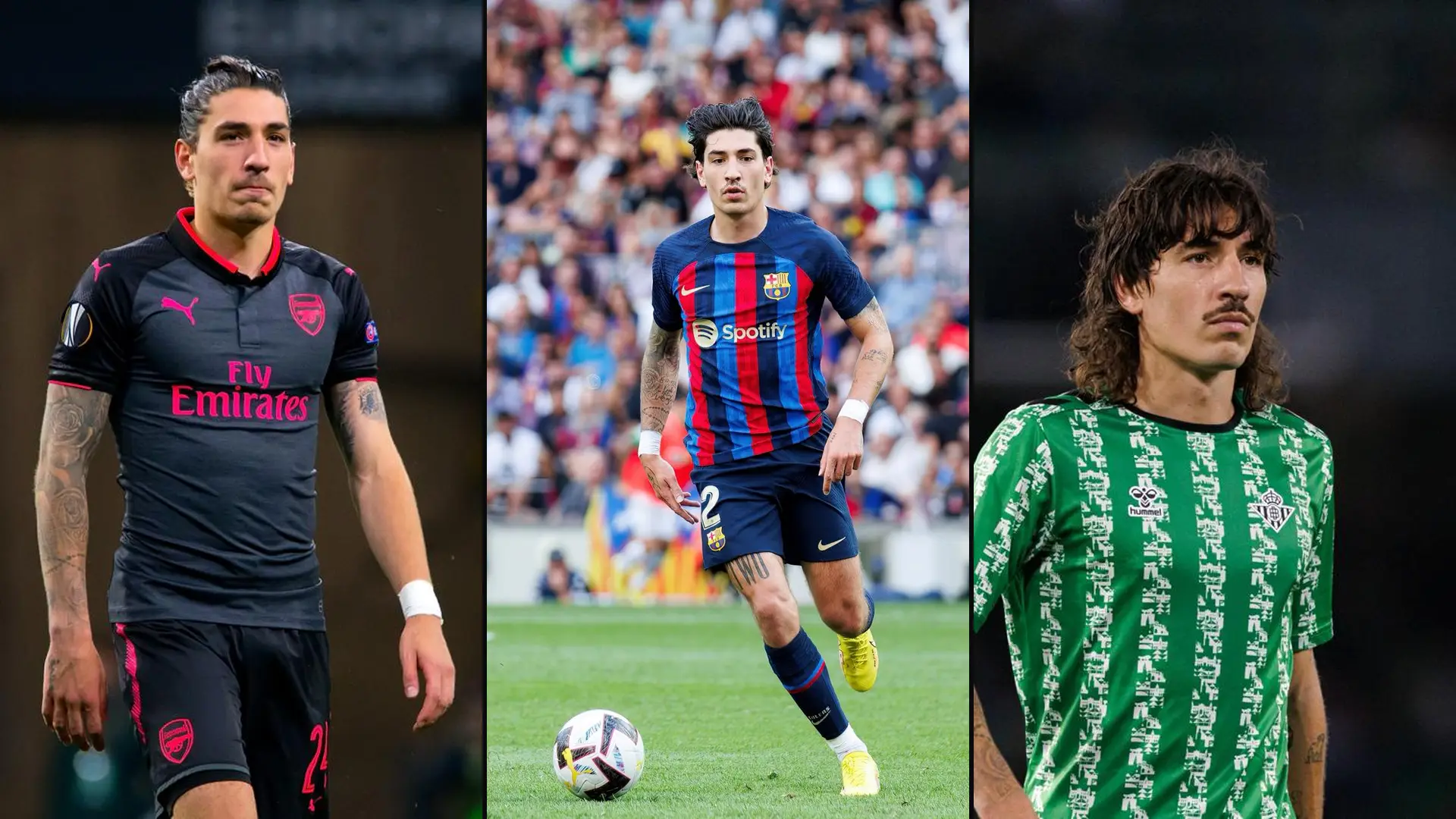
When Héctor Bellerín started for Real Betis at Dublin’s Aviva Stadium, he faced Arsenal for the first time in his career. Betis won the preseason friendly 3-1. Across from him were the reigning Premier League champions, but the clearest contrast was between Bellerín at 31 and the teenager who had established himself in Arsenal’s first team more than a decade earlier.
His hair now falls in long curls shaped into a mullet. A dated sequence of photographs places that look beside the clipped sides and structured quiff he wore in September 2014. Topknots, braids, headbands, ponytails, center-parted waves and a buzz cut fill the years between them. The photographs aren’t a complete catalog, but they form a visual timeline spanning 12 years.
Bellerín joined Arsenal from Barcelona’s youth system at 16 in 2011. He made his competitive first-team debut in 2013 and became a regular during the 2014-15 season. By the time he left in 2022, the right back had made 239 appearances and won three FA Cups. His early photographs show a conventional academy-era look, with short sides and carefully raised hair on top.
By 2017, the hair had grown longer. Bellerín tied it back, wore braids and played with a headband. He later disclosed that he received homophobic abuse connected to his long hair and appearance. Visible difference, even something as personal as a haircut, had made him a target within professional football’s restrictive masculine culture.
His interest in clothing began well before his fashion profiles. Bellerín’s grandparents operated a small clothing business and made their own garments, while his mother later joined them. In 2019, during his rehabilitation from a torn anterior cruciate ligament, he walked in Virgil Abloh’s Louis Vuitton Spring/Summer 2020 show in Paris. Fashion had become part of his working life, not simply an interest pursued away from football.
From the buzz cut to Betis
The sharpest break in the sequence arrived in March 2020. Bellerín removed the long hair and replaced it with a buzz cut during the opening weeks of pandemic restrictions. The abrupt change separated two of his most recognizable Arsenal looks.
His club career soon began moving as well. Bellerín joined Betis on loan in 2021 and helped the club win the Copa del Rey. He returned to Barcelona in 2022, transferred to Sporting CP in January 2023 and signed permanently with Betis that summer. Across those moves, the visual record passes through curtains, waves, shorter crops, a mustache and the longer curls he wears now.
There’s no reliable one-to-one relationship between those hairstyles and his football. A haircut can’t explain an injury, transfer or change in form. The sequence instead shows how Bellerín presented himself while his teams, cities and responsibilities changed around him.
In a June 2026 television interview, Bellerín said he had worn his hair in nearly every possible way. He also described reducing his use of bottled shampoo because of plastic waste, usually rinsing his hair with water and using shampoo only occasionally. It was an account of his personal routine, not hair-care guidance for others.
Betis operates the Forever Green environmental platform and has also experimented with player-led fashion projects, including Antony’s Iluminado clothing line. Those initiatives don’t explain Bellerín’s appearance, but they place his interests in sustainability, clothing and football inside a club already working across the same areas.
The Arsenal reunion supplied a direct before-and-after. The short-haired teenager had become a Betis veteran after stops in Barcelona, Lisbon and Seville. His hairstyles don’t measure that journey, but they preserve its different stages with unusual clarity.