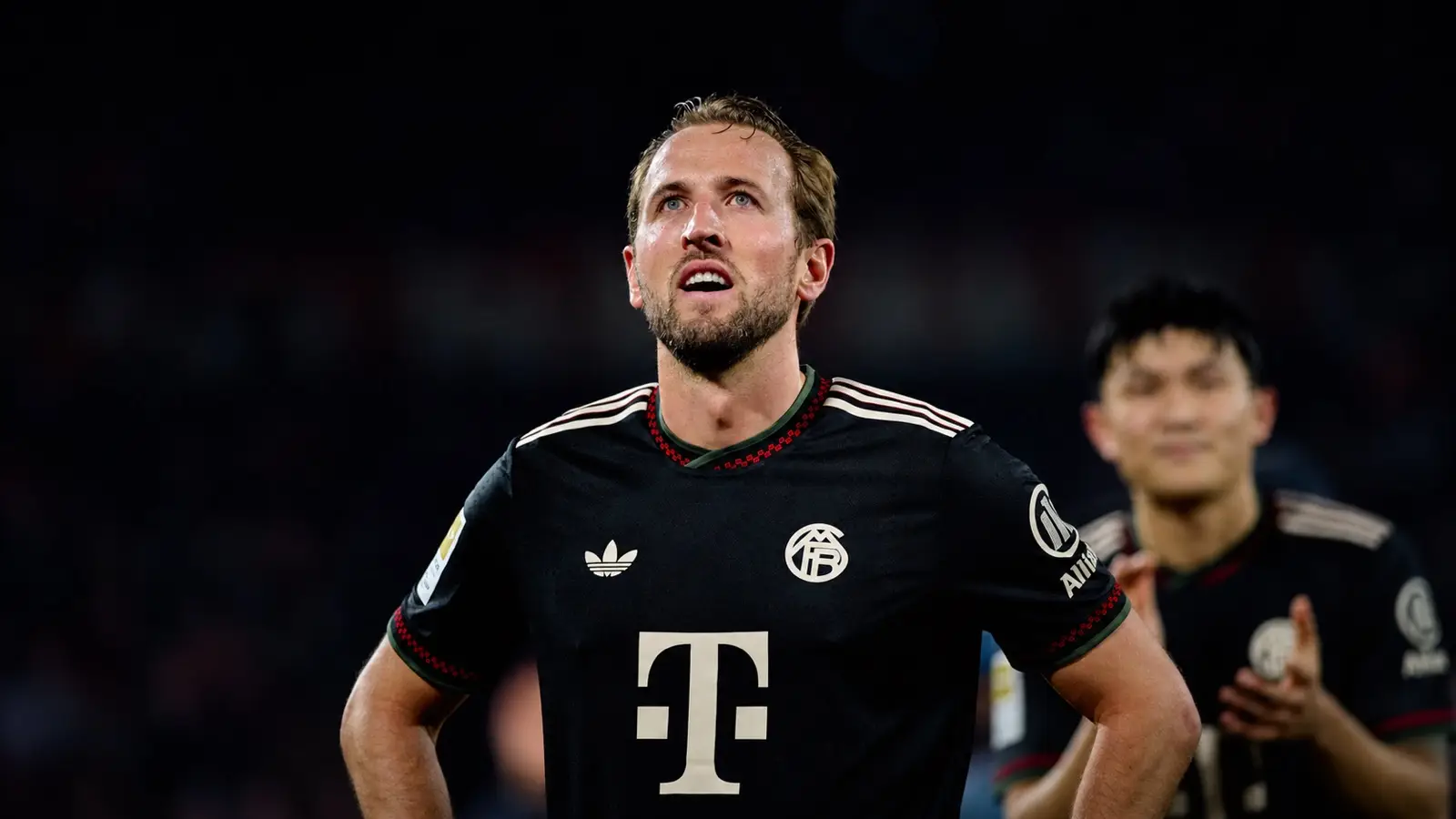
Harry Kane has become the first player to win the Ballon d’Or and miss the corresponding FIFPRO World 11. Journalists placed him first in the world. Professional players placed four forwards ahead of him.
Two ballots, two ways to count support
The split begins with how the Ballon d’Or is decided. One journalist from each of the top 100 nations in FIFA’s men’s ranking submitted a top 10. First place was worth 15 points, but every position down to tenth added to a player’s total. Kane won with 1,055 points, collected 40 first-place votes and appeared in the top 10 on 98 of 100 ballots. The format rewarded both strong support at the top and broad recognition lower down.
FIFPRO asked a narrower question. Each of 19,806 professional footballers selected three players in every position. The leading goalkeeper, three defenders, three midfielders and three forwards qualified automatically, then the highest-ranked remaining outfield player took the final place. Kylian Mbappé, Lamine Yamal and Lionel Messi filled the three forward slots. Erling Haaland then claimed the flexible 11th place.
Kane appeared on 27.6 percent of ballots, just behind Haaland’s 28.4 percent. Applied to the men’s electorate, that 0.8 percentage-point gap is roughly 160 selections, although the exact margin can’t be calculated because FIFPRO published rounded percentages rather than both raw totals. That percentage isn’t a head-to-head rejection. Every voter could choose three forwards, and Kane fell just below the cutoff for the flexible final place.
The same season, a different cutoff
The awards weren’t judging different campaigns. The Ballon d’Or covered performances from August 3, 2025, through July 19, 2026. FIFPRO’s period began one day later and ended on the same date. Both included the same club season and the 2026 World Cup, so the discrepancy can’t be explained by a different tournament or a late run of form.
The decisive difference was what happened to support outside the leading places. A Ballon d’Or voter who ranked Kane fourth still gave him eight points. A player who considered him the fourth-best forward gave him nothing, because the FIFPRO ballot stopped at three names in that position. Kane could therefore be a near-universal top-10 choice across all positions while falling just outside enough forward-only ballots to miss the team.
The season behind the result was extraordinary. Kane scored 73 goals in 65 appearances for Bayern Munich and England, including 61 for his club, 36 in the Bundesliga and 14 in the Champions League. Bayern won the Bundesliga and German Cup, while England finished third at the World Cup with Kane scoring six times. Those numbers were why he topped Stadio’s 2026 Ballon d’Or rankings. A World 11 ballot, however, isn’t a ranking of the world’s 30 best players. It is a position-limited team-selection exercise.
That also explains how Haaland could finish eighth in the Ballon d’Or and still edge Kane in the FIFPRO vote. Journalists could spread points across players and positions. Professionals had to choose three forwards, and a small shift at the cutoff produced a large symbolic result: one striker held the Ballon d’Or, while the other took the last place in the player-voted XI.
What the numbers can’t tell us
The published figures don’t explain why individual players voted as they did. FIFPRO’s published breakdown doesn’t include ballot-level splits by league, country or voter. Claims that players favored Messi’s reputation, discounted the Bundesliga or simply respected Haaland more remain speculation. The supported conclusion is narrower: Mbappé and Yamal led the forward vote, while Messi, Haaland and Kane were separated by only 1.9 percentage points.
The timing also needs care. FIFPRO voting opened on August 24, two months before Kane received the Ballon d’Or on October 26, but its voting explainer didn’t publish a closing date. Some players may have submitted their teams before Kane lifted the trophy, and the two awards were conducted independently. The result is better understood as two electorates reaching different conclusions about the same season, not players responding to Kane’s win with a deliberate snub.
Since the World 11 was introduced in 2005, every previous men’s Ballon d’Or winner had appeared in the corresponding FIFPRO team. Kane had also been nominated for the World 11 five times without earning a place. His sixth finalist appearance ended the same way, even after he had won football’s most famous individual award.
The contradiction disappears once the ballots are understood. Kane’s Ballon d’Or reflected deep, broad support in a weighted ranking. His World 11 omission came from three guaranteed forward spots, one flexible outfield place and a margin of roughly 160 selections. A small shift at the cutoff could have put him in both, without changing a single performance.
Get more Stadio United on Google.