Alfredo Di Stéfano scored in each of Real Madrid’s first five European Cup final victories. His claim to the central place between Lionel Messi and Cristiano Ronaldo in our El Clásico all-time XI also rests on the breadth of his game: he could shape an attack long before the ball reached the penalty area.
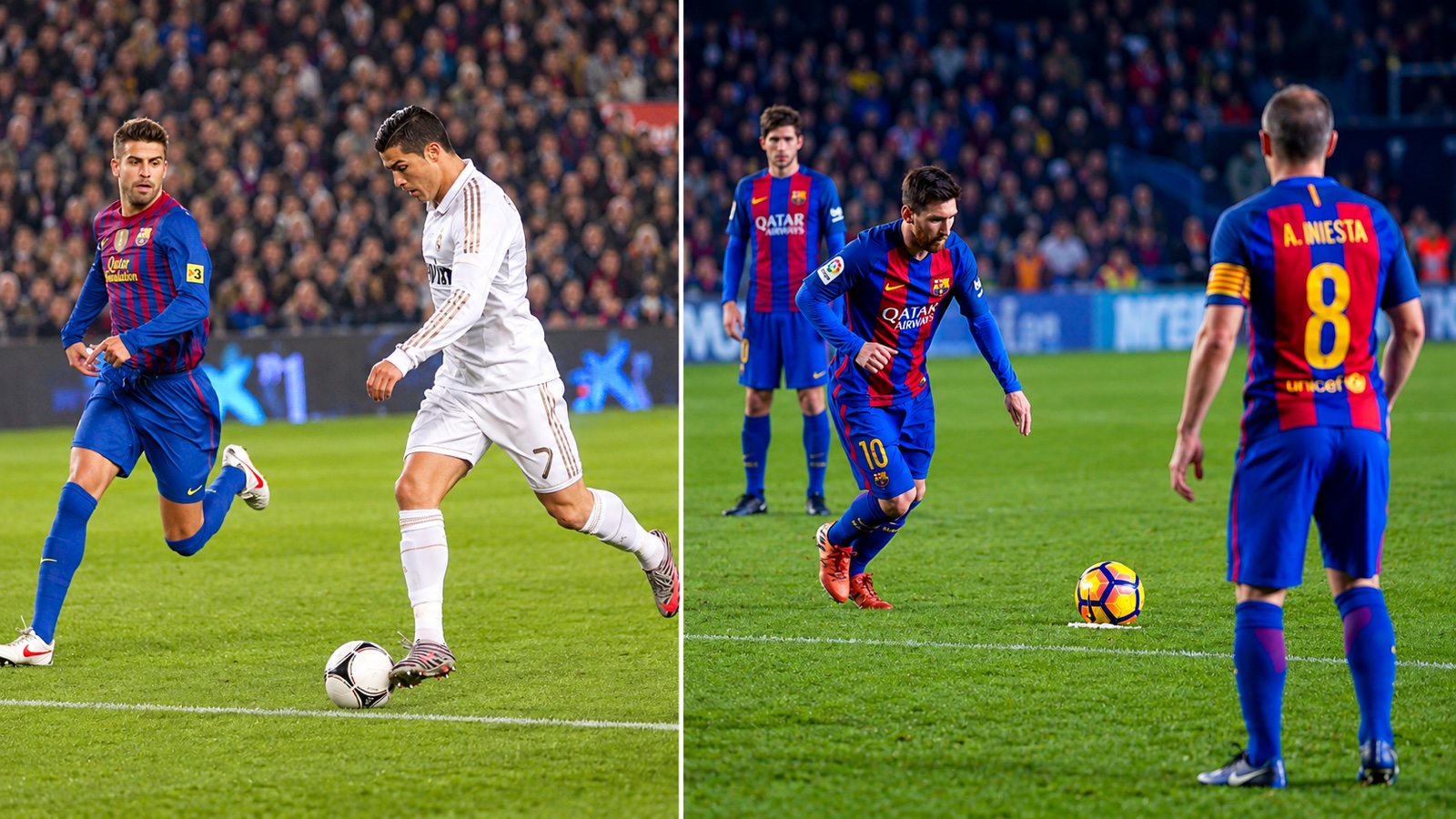
Messi’s 672 goals for Barcelona and Ronaldo’s status as Madrid’s record scorer make their places difficult to challenge. Choosing Busquets, Xavi and Iniesta means leaving Luka Modrić and Zinedine Zidane outside the midfield.
How we selected the El Clásico all-time XI
Selection rests on peak level, sustained contribution at these clubs, standing within a player’s own era and a credible position. Both spells count for anyone who represented both teams. International success, achievements elsewhere and coaching careers don’t enter the calculation. Performances across their club careers count, beyond Clásicos alone.
The 4-3-3 is Iker Casillas; Dani Alves, Sergio Ramos, Carles Puyol, Roberto Carlos; Sergio Busquets, Xavi, Andrés Iniesta; Lionel Messi, Alfredo Di Stéfano, Cristiano Ronaldo. Six Barcelona players and five from Madrid, with no quota deciding the split.
Midfield: Busquets, Xavi and Iniesta
Casemiro’s defensive coverage and five Madrid European Cups make him the strongest challenge at the base of midfield. Busquets earns our choice because we want the holder directing buildup as well as anticipating danger. His reading of the next pass shaped Barcelona’s possession across 722 competitive appearances.
Xavi becomes the principal organizer farther forward. His movement continually renewed passing options, helping teammates retain the ball without standing still. That control endured across 767 Barcelona games. He was also player of the match in the 2009 Champions League final, supplying the cross for Messi’s header against Manchester United.
Iniesta gets the left interior role for his ability to escape a challenge and advance toward the forwards. His 674 Barcelona appearances and four Champions League titles establish the sustained contribution; player-of-the-match honors in the 2015 final underline his influence at the highest level. He gives this midfield another way through a crowded defense.
Barcelona’s retirement tribute offers a look back at Iniesta’s years in the club’s midfield.
View this post on X
Modrić could control, carry and create, too. His six European Cups and 597 Madrid appearances make this the narrowest omission. Consecutive Champions League midfielder awards in 2017 and 2018 also establish the peak. Xavi gets the edge for his constant organization around the ball; Iniesta for the threat he offers receiving farther forward on the left. Choosing that division of responsibilities leaves out a player capable of excelling in either role.
Zidane supplied the 2002 Champions League final winner and extraordinary invention. His five Madrid seasons offer less sustained playing influence than the selected interiors. Neither his France career nor his later success as Madrid’s coach can enlarge that playing record.
Attack: Messi, Di Stéfano and Cristiano Ronaldo
Di Stéfano’s 308 goals in 396 Madrid games come with the freedom to drop into midfield and connect the attack. Ferenc Puskás scored more goals per appearance, with 242 in 262. Di Stéfano wins the central place for the reach of his contribution across the field, alongside his scoring and longevity.
View this post on X
Ronaldo Nazário’s extraordinary Barcelona season and his Madrid years both count. Johan Cruyff transformed Barcelona as a player before returning as a coach; Ronaldinho supplied another transformative peak. The selected front three combine exceptional peaks with longer, sustained influence at these clubs. László Kubala’s decade at Barcelona and 194 competitive goals make him a different challenge: longevity alone cannot settle his omission. Di Stéfano’s wider involvement and the selected wide forwards’ scoring earn our preference.
Di Stéfano dropping toward the ball would open a route for Cristiano to run beyond him. Messi could approach from the right and choose between combining with the center forward or finding Ronaldo’s run. Those movements can change: Messi remains a scorer, while Cristiano can create space and chances for others.
View this post on X
Defense: Alves, Ramos, Puyol and Roberto Carlos
Alves and Messi exchanged 35 passes in the 2015 Champions League final, more than any other pair. That performance illustrates the additional playmaker Alves could become from right back. Dani Carvajal offers defensive discipline and decisive attacking contributions across six European Cup wins. We narrowly favor Alves’ creative influence, sustained across 408 competitive Barcelona appearances.
Roberto Carlos supplies a more direct route up the opposite flank. Marcelo has more Madrid appearances and European Cups, plus an established understanding with Cristiano. The choice is close: Carlos’ pace and direct running outside the attack add something different when Alves and the midfield already provide so much short combination play. His 527 Madrid games establish the longevity.
Puyol’s recovery tackling and ability to defend wide areas earn one center-back place. Across 593 competitive Barça games, he won three European Cups and the 2006 UEFA Club Defender of the Year award. Ramos supplies aerial strength and ambitious passing, backed by 671 Madrid appearances and four European Cups. Both are proactive defenders who’d need to coordinate their challenges. Gerard Piqué, Fernando Hierro and Ronald Koeman offer compelling alternatives in possession, while José Emilio Santamaría’s four European Cups demand consideration across eras.
Ramos’ two goals against Bayern in the 2014 semifinals show the attacking value of that aerial strength.
View this post on X
Goalkeeper: Iker Casillas
Casillas takes the gloves for an elite Madrid career spanning 725 appearances and three European Cups, including decisive saves in the 2002 final. Thibaut Courtois’ 2021/22 campaign, crowned by nine saves in the final, makes the peak-level argument extremely close. Víctor Valdés offers an excellent alternative for buildup, with three Champions League titles himself. Casillas wins our preference for his shot stopping sustained across different Madrid teams.
UEFA’s footage of Casillas against Leverkusen in the 2002 final puts those reflexes in view.
View this post on X
How our El Clásico all-time XI would work
When Alves advances, Roberto Carlos would hold alongside the center backs, and vice versa. Busquets protects the space in front. Those restrictions cost some attacking freedom, but they leave Messi, Di Stéfano and Ronaldo with both support and a team behind them.