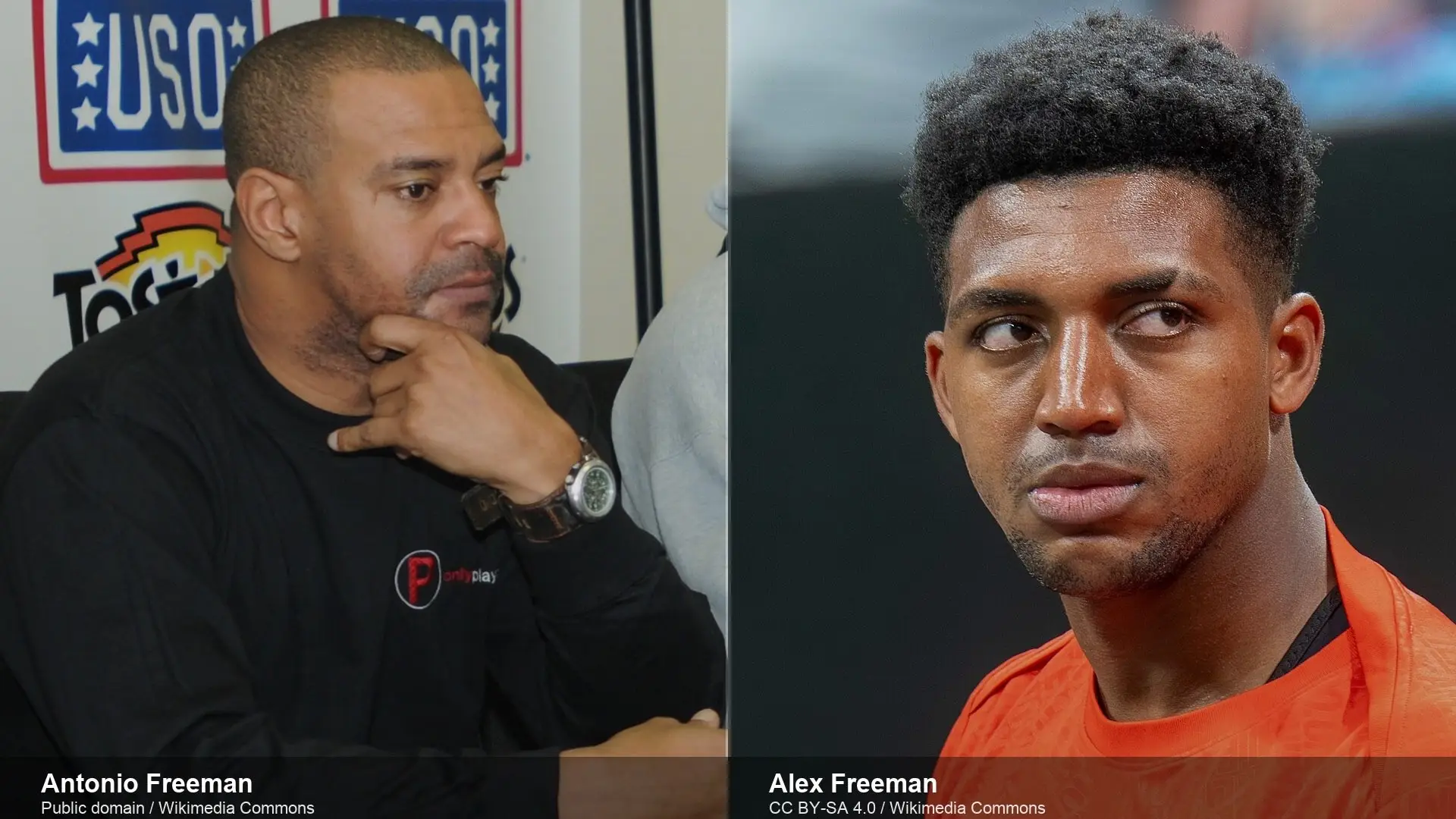
When Alex Freeman rose at the back post in Seattle, the name on the scoresheet already carried history in another American game. The header gave the United States a 2-0 halftime lead over Australia. It also gave Freeman, 21, his first World Cup goal, on a stage his father reached only through a different kind of football.
By the end, the USMNT beat Australia to reach knockouts with a game to spare, moved to six points from two Group D matches, and did it without Christian Pulisic, who missed the match because of a calf injury. The opening goal came when Folarin Balogun’s ball forced Cameron Burgess into an own goal. Freeman’s header made the scoreline feel less like survival and more like control.
Antonio Freeman’s football résumé is not a footnote. He was an AP All-Pro and Pro Bowl wide receiver for the Green Bay Packers in 1998, a member of the franchise’s Hall of Fame, and one of the defining offensive players of Green Bay’s Brett Favre era. In Super Bowl XXXI, he caught an 81-yard touchdown against New England, then the longest pass play in Super Bowl history, as the Packers won 35-21.
Alex Freeman’s route has been more circuitous and more revealing. Born in Baltimore and raised in Plantation, Florida, he grew up with a father whose career belonged to the NFL and a mother, Rochelle, whose soccer lens included Liverpool. His stepfather, Jake Hinkle, served as his first soccer coach.
That choice hardened into a professional pathway at Orlando City. Freeman joined the academy from Weston FC, signed as a homegrown player, and spent much of his early career with Orlando City B before the first team opened for him. By 2025, he had moved from prospect to starter, giving the U.S. pool a right-sided defender with size, range and a habit of arriving in attacking spaces.
From Orlando to Villarreal
His breakout season moved quickly. Orlando City said Freeman made 42 appearances across all competitions in 2025, with six goals and seven assists, and became the first player in club history to win MLS Young Player of the Year. He was also selected to the MLS All-Star team and MLS Best XI. Those are not small markers for a defender whose first MLS start had come only months earlier.
The next step was Spain. In January 2026, Orlando City transferred Freeman to Villarreal in a club-record homegrown move. Villarreal announced an agreement through June 2032, putting him in La Liga during the final months before a home World Cup. For a young American defender, the move carried risk. It also placed his daily work in one of Europe’s strongest leagues before the national team needed to trim its squad.
Freeman did not enter the World Cup as a late novelty. He debuted for the senior national team on June 7, 2025, started all six matches at the 2025 Concacaf Gold Cup, and scored twice in a 5-1 friendly win over Uruguay that November. Against Paraguay in the 2026 World Cup opener, he started in defense and fed Gio Reyna’s stoppage-time goal in a 4-1 win.
The Australia goal brought the story into sharper focus because of its simplicity. Sergiño Dest’s blocked shot looped toward goal, Patrick Beach was stranded, and Freeman was waiting. The header was first ruled out for offside, then awarded after review. The opener belonged to the tournament’s growing list of 2026 World Cup own goals. Freeman’s goal was different, a defender finishing an attacking sequence that confirmed the U.S. had more than one path to a result.
There is no need to frame Alex Freeman as a rebellion against American football. His father’s game is part of the biography, not the whole of it. Antonio Freeman once gave Green Bay a Super Bowl play that remains attached to his name. Alex Freeman has now put his own name into a World Cup box score for the United States. Same surname, different sport, and a legacy that no longer has to borrow its shape from the one before it.