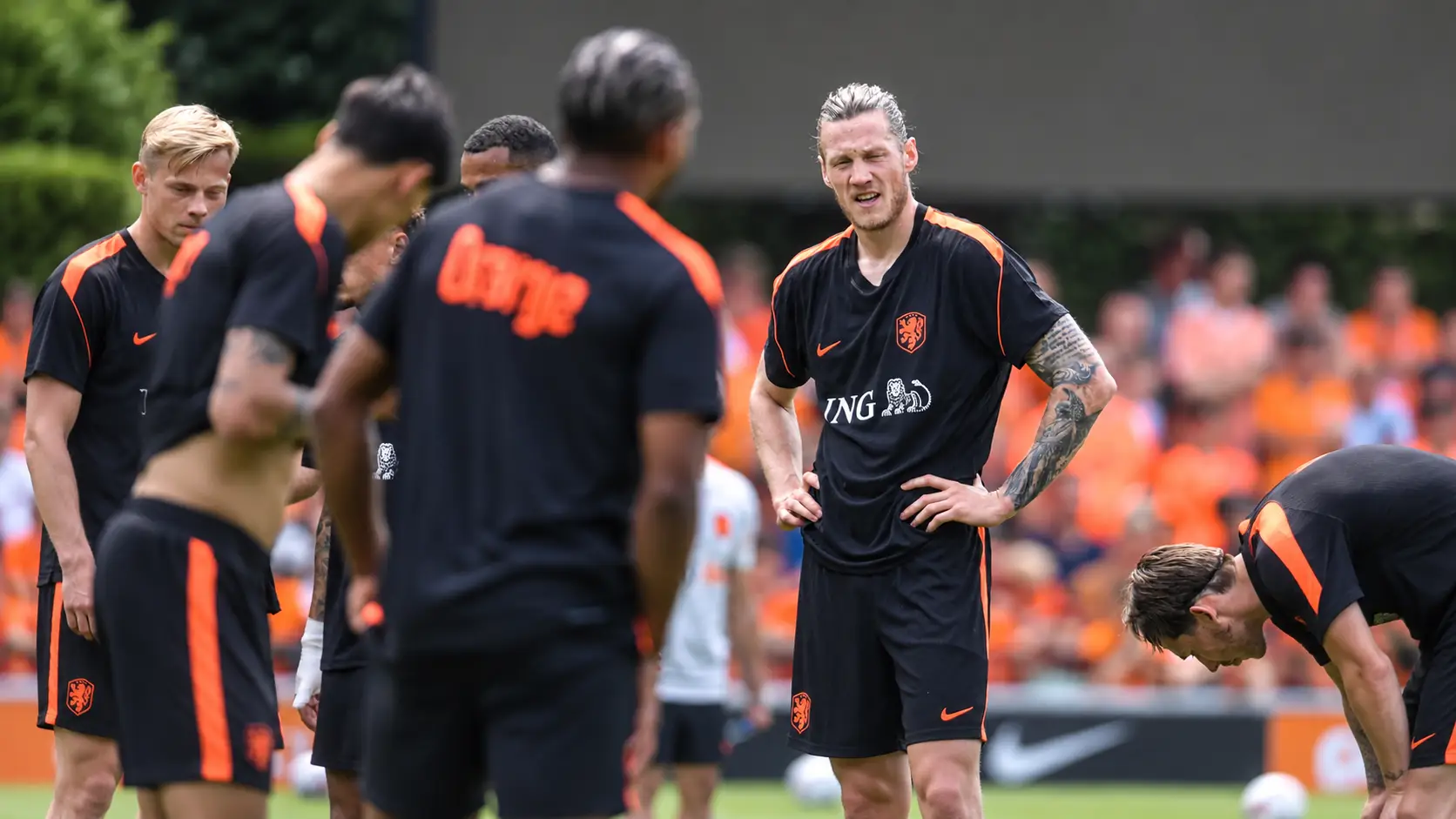
Wout Weghorst had a second half to prepare for and was starting with his hands. Before FC Twente resumed against PSV, he worked through a sequence of finger gestures, clapped and swung his arms. The home side trailed 2–1. There was a game to recover.
Unlike a World Cup penalty shootout, where the taker can settle over one defined action, open play doesn’t wait for a striker to get comfortable. The ball moves, defenders move and a good option can disappear. Any useful preparation has to survive that uncertainty.
The footage circulated with a confident explanation: these were neurological exercises to sharpen his reactions for the next 45 minutes. It’s an appealing proposition. Concentration becomes something a player can warm up alongside his muscles, rather than simply summon when the referee blows.
Neuropsychologist Erik Scherder offered a more tentative interpretation. Asked about the footage, he suggested the coordinated movements could be a way of making himself more alert. He didn’t recognize the sequence as an established football exercise, however, and wasn’t reporting tests conducted on Weghorst.
An alertness cue makes sense as a hypothesis, not a verdict. A player might find a sequence useful without it being a special neurological technique. Equally, the fact that it looks unfamiliar says nothing about whether it helps.
What a mental warmup can do
There’s substantial research behind taking preparation seriously. A meta-analysis by Anton Rupprecht, Ulrich Tran and Peter Gröpel combined 112 estimates of effects from studies of pre-performance routines. It found benefits for sporting execution, including under pressure. The routines included sequences of actions and thoughts relevant to the task ahead.
But most of the tested skills gave athletes considerable control over when to act: a golfer setting up a putt, for example, or a basketball player taking a free throw. The researchers explicitly said they lacked evidence about whether those benefits extended to skills whose timing is imposed from outside. A successful putting routine doesn’t automatically explain how to prepare for a second half.
Even hand exercises have a research history. Some studies in that analysis involved gripping with one hand before performing a skill. That doesn’t make every finger movement the same intervention. The action, the setting and the outcome being tested still need to match.
More recent experiments have brought mental tasks into physical warmups. In a 2025 study involving 31 padel players, researchers interspersed cognitive exercises with physical preparation. The shorter and intermediate versions improved subsequent padel and color-word test performance compared with physical preparation alone, both after normal sleep and after sleep restriction.
Those players weren’t performing Weghorst’s finger sequence. They were following a structured protocol involving a different task in a different sport. The result supports investigating combined warmups, not assigning their benefits to any movement that looks mentally demanding.
A 2026 experiment with 25 recreational runners offers another example. Warmups incorporating four three-minute cognitive tasks helped participants complete the study’s mile time trial eight to 11 seconds faster than physical preparation alone. They also reported feeling more ready. That’s a useful finding about a particular running protocol, not a measurement of a striker’s reaction speed or decision-making.
The broader language of brain training can obscure these differences. Michael Olise’s account of improvement connects his interest in gradual progress with a description of football as instinctive and rooted in muscle memory. Building a skill over time and getting ready to use it are different jobs. A brief routine shouldn’t receive credit for everything that follows it.
To establish a football benefit, the relevant comparison would be how a player performs with and without the routine across repeated attempts, not whether he scores on one afternoon. Even then, a test of reaction speed wouldn’t necessarily show better choices against a moving defense.
At De Grolsch Veste, Twente did get their comeback. Weghorst equalized in the 79th minute, and Daouda Weidmann scored four minutes later to complete a 3–2 win.
Weghorst’s own account of his finish was more specific. He initially intended to lob the goalkeeper. When he saw the goalkeeper stay put, he changed his choice and shot past him instead.
Whatever he’d done to get ready, he still had to change his mind.