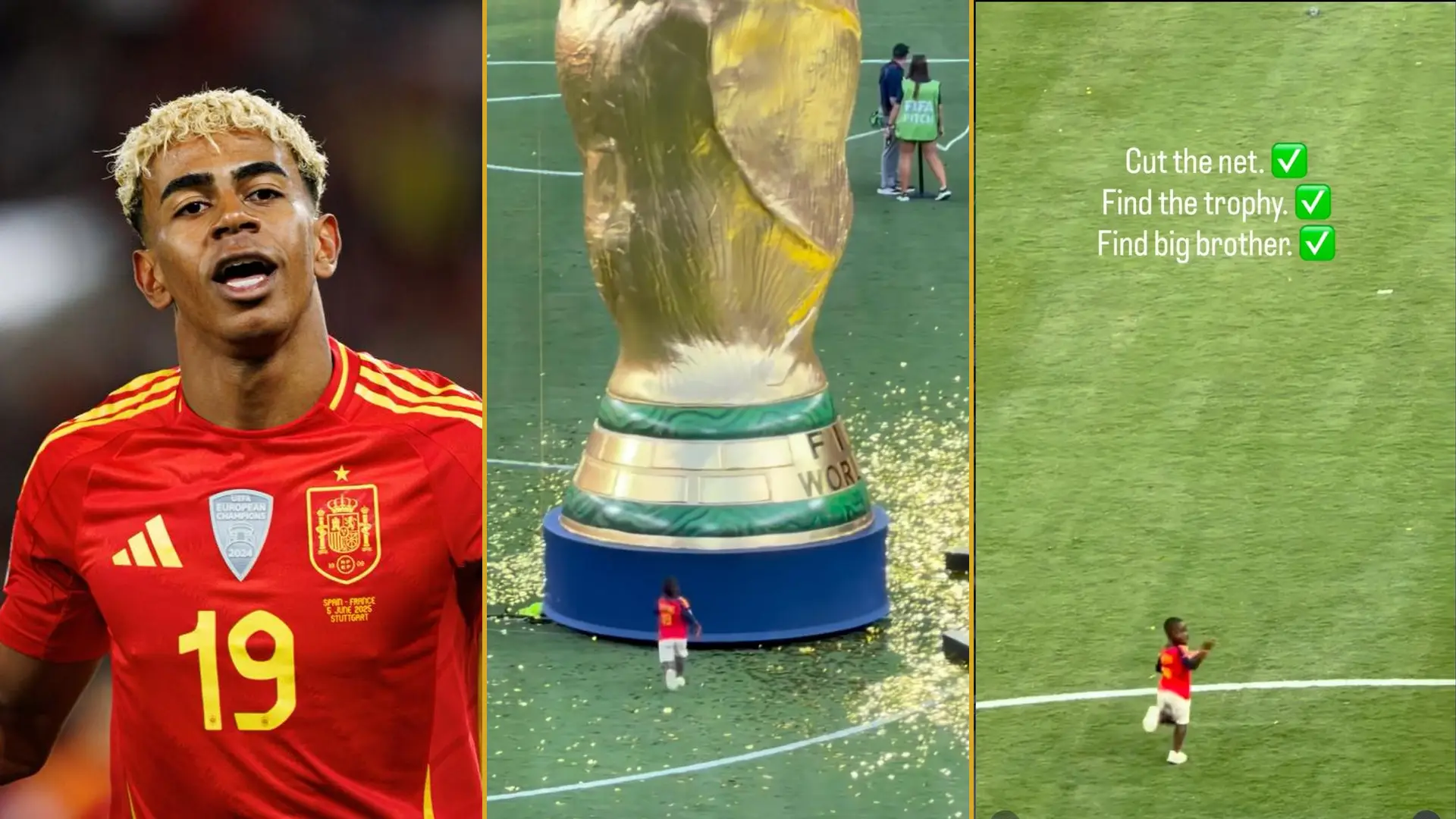
When Spain won the 2026 World Cup, Keyne crossed the field in East Rutherford carrying a piece of the goal net. He wore a red Spain jersey, clapped as he ran and headed toward his older brother. Lamine Yamal lifted him and held him. The match had ended 1-0 after extra time. Keyne, three, had appeared beside Lamine at major celebrations before. By the final, broadcasters were identifying him by name.
Keyne’s place alongside Lamine predated the World Cup. He was on the field after Spain won Euro 2024, attended the 2024 Ballon d’Or ceremony in Paris and appeared in family videos posted online. Born in September 2022, he is one of Lamine’s two half-siblings. He and Lamine share the same mother, Sheila Ebana. Before the 2026 tournament, those appearances were scattered across milestones. The World Cup turned them into a sequence.
After Spain’s 3-0 round-of-32 win over Austria, Keyne celebrated the third goal while wrapped in Spanish colors. Following the quarterfinal victory over Belgium, cameras showed him making faces and sticking out his tongue on the stadium screen. Lamine looked up and laughed. “I was at physio and he called me, using my mum’s phone, and told me that he was going to stick his tongue out tomorrow,” Lamine said. Keyne had explained the joke a day before carrying it out.
The phone call gives the scene a private origin. Keyne had told Lamine what he planned to do, and the stadium screen carried the joke back to him. The broadcast widened the audience, but the exchange still belonged to the brothers.
After Spain beat France in the semifinal, the cameras found the brothers again. Keyne ran through the stands with his arms extended. Lamine picked him up and held him as they moved away together. SportsCenter published the clip and identified Keyne by name. Five days later, FOX Sports did the same after the final. By July 21, publications including The Guardian, People and The Washington Post had published coverage centered on him. The relationship remained the reason for his presence, but the coverage increasingly treated him as a subject rather than a background detail.
The bond behind Keyne’s new visibility
Keyne’s new visibility depends on contrast. Lamine operates inside the controlled environment of elite soccer, with its training plans, tactical demands and constant scrutiny. Keyne enters the same frame as a three-year-old whom Lamine says doesn’t yet understand the attention. He runs, waves and makes faces. “I don’t think he’s realized,” Lamine said. “He does what he does at home and when the camera is on him, he does something goofy.”
That lack of awareness gives Keyne his on-camera distinctiveness, but it also calls for precision. He is three. He hasn’t chosen a public role or built a persona. His stardom consists of repeated media visibility around his family, not an independent career. He became a figure in the coverage, not a participant in the competition.
For Lamine, the relationship isn’t a side detail. After the victory over Austria, he connected his brother’s presence to the family’s changed circumstances. “It moves me to see my mother and little brother living the life they have always dreamed of,” he said. He has also compared his feelings for Keyne to those of a parent.
Lamine’s comments link Keyne’s childhood to his own upbringing. He has described growing up in a home where the kitchen and bedroom occupied the same space, and he has said that seeing Keyne have the childhood he wanted for himself brings him happiness. Keyne’s presence at the Euro 2024 celebration, the Ballon d’Or and the World Cup is more than proximity to a famous brother. In Lamine’s account, it is part of what his success has made possible for his family.
Keyne’s identity in the coverage became distinct without becoming separate from Lamine. Broadcasters named him. Cameras followed his movement rather than leaving him in the background. Publications built stories around his appearances. The continuity came from one relationship, repeated at increasingly important stages of the tournament.
The final reduced the story to a few seconds: netting in Keyne’s hands, the run across the field, then Lamine lifting him. Keyne’s public story remained inseparable from his brother, but he no longer functioned as a background detail in the frame. At the end, he did what he had done after the semifinal. He found Lamine.