Spain’s World Cup final ended in New Jersey. Its second star began its public life in Madrid. Rodri carried the trophy off the plane at Barajas at 2:30 p.m. Monday, opening a day that would take the 26-player squad to Zarzuela Palace, then Moncloa and through the capital on an open-top bus. The cup followed protocol. The star traveled differently.
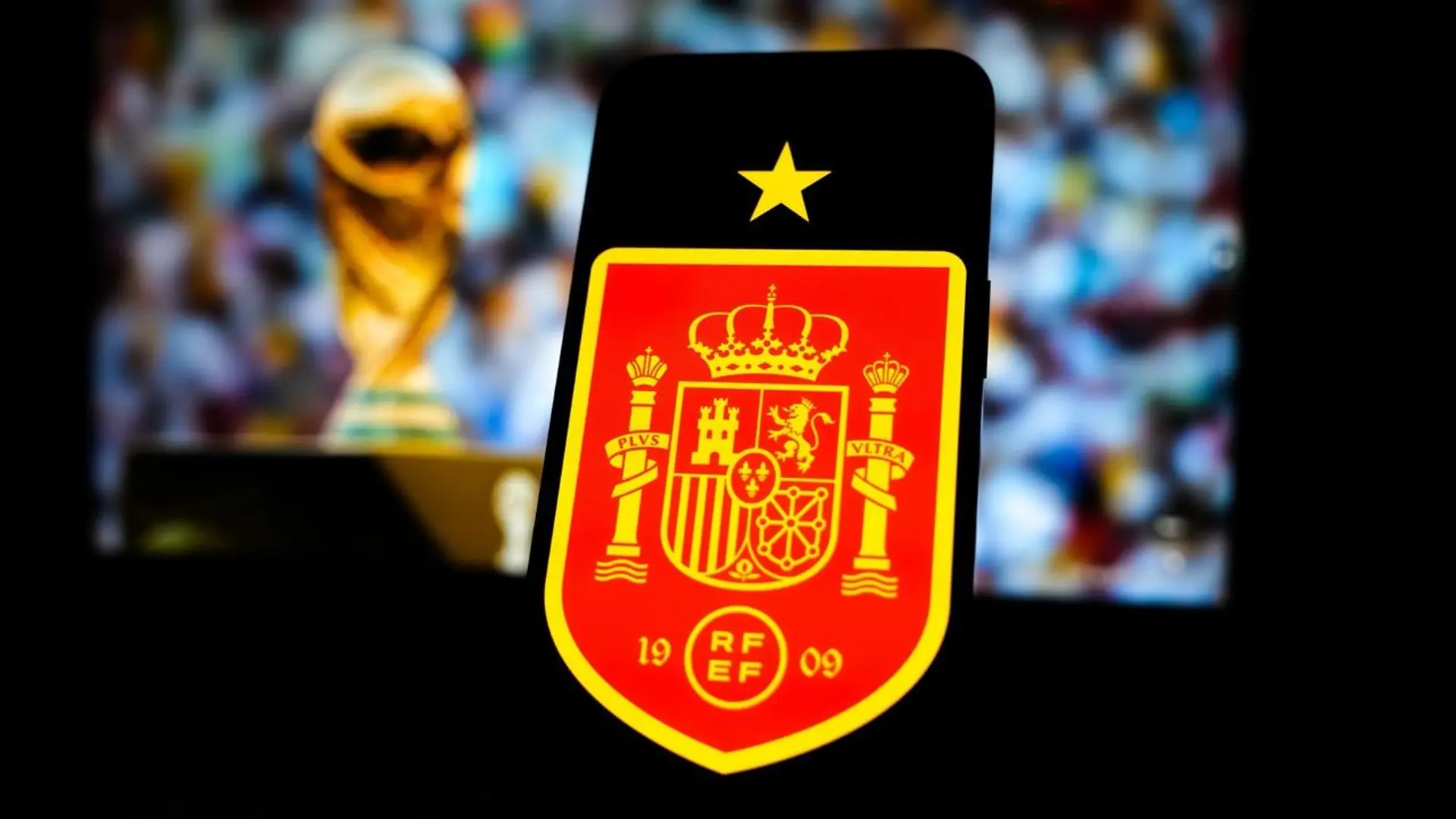
Before the parade began, Madrid Mayor José Luis Martínez-Almeida placed a second star above Spain’s crest on an EMT city bus. The vehicle had been running on line 27, between Embajadores and Plaza de Castilla, since the tournament began. It wasn’t a ceremonial prop brought out for the homecoming. It belonged to the daily transport network.
Across the system, buses on the main routes carried Spanish flags, while interior screens showed the federation’s official victory video. Correos issued a commemorative stamp bearing the two-star crest in a print run of 2,500. These were modest administrative decisions, but together they defined the homecoming. The trophy remained one object, carried from stop to stop. The star could be printed, displayed and returned to circulation.
The first formal reception took place at Zarzuela, where King Felipe VI, Queen Letizia, Princess Leonor and Infanta Sofía received the team. The squad then went to Moncloa for a reception with Prime Minister Pedro Sánchez. The official parade route connected Moncloa to Cibeles Palace through central Madrid, passing Serrano and the Puerta de Alcalá before reaching Calle Montalbán.
A star enters the city
The sequence gave the day a clear civic order: monarchy, government, city. Madrid didn’t merely provide a backdrop. Its institutions, avenues and public services supplied the machinery that converted a tournament result into a visible public mark.
The Puerta de Alcalá sharpened that meaning. Erected in 1778 as a main entrance to Madrid, the neoclassical triumphal gate once marked the passage into the city. Spain’s champions traveled past it on the way to Cibeles, placing a modern sporting procession inside an older piece of Madrid’s ceremonial geography.
Spain’s first men’s title came through Andrés Iniesta’s goal in the 2010 World Cup final. The main public celebration that year took place at Puente del Rey. That victory had no Spanish World Cup predecessor. Sixteen years later, the second star entered a capital with an established language for football occasions. The destination shifted to Cibeles, a square already tied to Real Madrid’s trophy celebrations and now assigned to the national team’s return.
The building beside the fountain added a quieter connection. Cibeles Palace opened in 1909 as the headquarters of the Spanish Post Office and has served as Madrid City Hall since 2007. The parade route ended beside that former communications palace on the same day Correos issued its two-star stamp. One institution had moved out of the building. Its new emblem had arrived back at the square in miniature.
The second star has a precise meaning. It marks the men’s national team’s second World Cup, after 2010. Spain also holds the women’s title won in 2023, making it the first country to hold both senior World Cups at the same time. Those championships belong to different teams and tournaments, but their overlap widens the setting of Madrid’s ceremony.
A World Cup trophy can appear in only one place at a time. A star has no such limit. By Monday evening, the new mark had appeared on a city bus and a commemorative stamp, while transit screens carried the federation’s victory film and the trophy moved toward Cibeles. The trophy followed one official route. The symbol had already entered Madrid’s daily life.