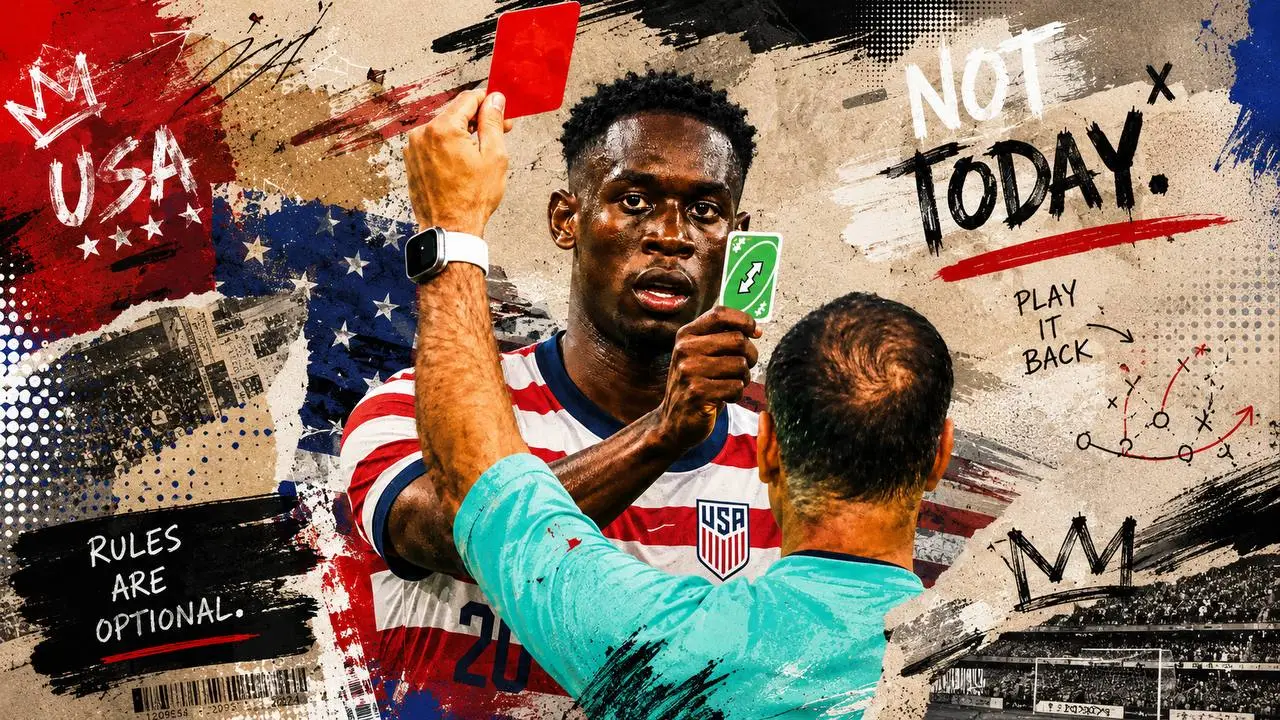
Folarin Balogun is available for the United States again, less than 24 hours before a World Cup match in which one selection choice can change the shape of the tournament. FIFA’s Disciplinary Committee has suspended the implementation of his automatic one-match ban, clearing the striker for Monday’s Round of 16 game against Belgium at Seattle Stadium.
The decision changes the fallout from the USMNT’s 2-0 win over Bosnia and Herzegovina. Balogun scored before halftime, then was sent off in the 64th minute after a VAR review deemed his challenge on Tarik Muharemovic a serious foul.
At first, the implication was straightforward. Balogun would sit, and the U.S. would prepare for Belgium without its top scorer at this World Cup. U.S. Soccer had already framed the matchup that way, with Ricardo Pepi and Haji Wright standing as the obvious center-forward alternatives.
That plan no longer has to be the default. Balogun’s availability restores a forward who has given the U.S. both finishing and pressure from the middle of the attack. It also gives Mauricio Pochettino a choice instead of a workaround. In a single-elimination match, that distinction carries real weight.
What the ruling changes for the U.S.
Article 27 is the hinge. FIFA’s Disciplinary Code allows a judicial body to fully or partially suspend the implementation of a disciplinary measure. In Balogun’s case, the sanction is subject to a one-year probationary period. A similar infringement during that period could revoke the suspension and bring the punishment back into force.
That nuance is important. The ruling does not wipe away the incident. The operative fact for the U.S. is narrower and more immediate: Balogun can be selected against Belgium. The disciplinary file still carries a condition beyond Monday.
The timing sharpens the story. Balogun had scored his third goal of the tournament before the red card, tying Landon Donovan for the second-most goals by a USMNT player at a single World Cup. His earlier tournament included a second goal against Paraguay that sat among the best goals of the 2026 World Cup so far. He has been one of the few U.S. attackers whose threat has carried from match to match.
The U.S. has already shown it can absorb an absence. The USMNT beat Australia to reach the knockouts without Christian Pulisic, then played the final stretch against Bosnia with 10 men. Balogun’s return does not solve Belgium by itself, but it removes the need to start the night with the forward line reshaped by suspension.
Belgium presents a different problem. The Red Devils are ranked ninth in the FIFA/Coca-Cola Men’s World Rankings and entered this tie unbeaten since March 2025. Their tournament has also gathered speed, from a slow Group G start to a 3-2 extra-time comeback against Senegal in the Round of 32 at Seattle Stadium.
The matchup carries a long memory. The U.S. beat Belgium at the 1930 World Cup, then lost the next six meetings, including the 2014 Round of 16 match remembered for Tim Howard’s 16-save performance. History does not pick Monday’s lineup, but it explains why every personnel decision feels heavier around this fixture.
Balogun’s clearance gives Pochettino the stronger version of a choice he was not supposed to have. He can start Balogun, use Pepi or Wright, or hold one striker back for the final phase. The key change is control. The U.S. no longer has to treat its leading scorer as unavailable on the eve of its most important match of the tournament.