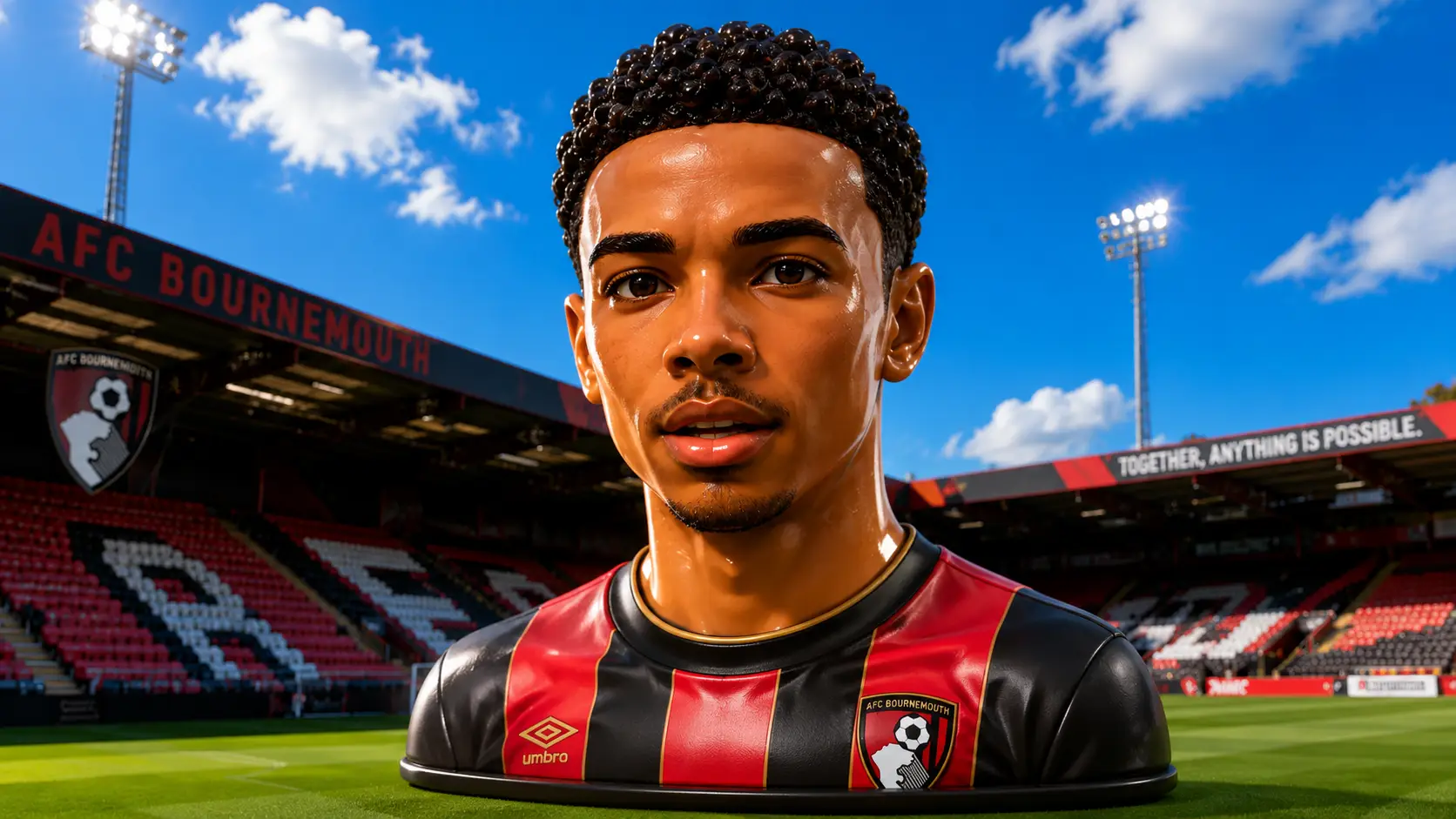
Junior Kroupi’s 13th Premier League goal did more than move Bournemouth in front of Manchester City (albeit temporarily). It pushed a 19-year-old forward past Robbie Fowler and Robbie Keane on one of the league’s more specific historical lists, and it arrived in a match that helped settle the Premier League title race.
The record had been sitting in familiar company. Fowler scored 12 for Liverpool in 1993/94, when his finishing first began to look like a long-term Premier League problem for defenders. Keane matched that number for Coventry City in 1999/00, a season that confirmed his sharpness had traveled cleanly into England’s top division. Kroupi had already joined them. Against Manchester City, he moved clear.
This is not simply a ranking of players who began a debut Premier League season as teenagers. It is about goals scored while still a teenager in that debut campaign. By that measure, the top five now reads: Kroupi with 13 for Bournemouth in 2025/26, Fowler with 12 for Liverpool in 1993/94, Keane with 12 for Coventry in 1999/00, Kevin Gallen with 10 for QPR in 1994/95, and Ryan Giggs with nine for Manchester United in 1992/93.
That list gives Kroupi’s season its shape. Fowler and Keane became enduring Premier League names. Gallen and Giggs came from the competition’s early years, when the league itself was still forming its identity. Kroupi’s name now sits above all of them, not as a projection or a promise, but as a completed statistical achievement.
Why this record travels beyond Bournemouth
Kroupi’s record-breaking goal carried extra weight because of the match around it. Manchester City needed to beat Bournemouth to keep the title race alive. The final score was 1-1, and Arsenal were left out of reach with one match remaining. Kroupi’s finish became part of two records at once: his own teenage scoring mark, and the night Arsenal’s long wait for another league title ended.
For Bournemouth, the record lands differently than it would at a club used to dominating the league’s individual leaderboards. Kroupi has done this outside the usual gravitational pull of a title favorite, in a side where chances are not assumed and rhythm has to be earned. The club has already shown it can give young players room to grow, with other prospects having stood out at Bournemouth, but a teenage forward leading this particular Premier League list gives the season a harder edge.
Kroupi is not being measured against other teenagers alone. He is being measured against the demands of a league that rarely gives young strikers much patience. The difference between nine, 10, 12 and 13 goals looks small on a table. Over a debut season, it is the difference between promise and separation.
Fowler’s 12 came before he became one of Liverpool’s defining finishers of the Premier League era. Keane’s 12 came before a career built on movement, timing and adaptability. Giggs’ nine came in a season when Manchester United were beginning a new age of English dominance. Kroupi’s 13 does not guarantee a career of the same scale. It does give him a cleaner starting point than any teenager before him in this category.
There is value in keeping the record narrow. It strips away the temptation to turn one season into a career prediction. Kroupi has scored more goals as a teenager in a debut Premier League campaign than Fowler, Keane, Gallen, or Giggs. That sentence is enough. For a player born in 2006, playing his first season in English football’s top division, it places him in a part of the league’s history that had barely moved for more than two decades.