Timothée Chalamet’s football life does not read like a loose celebrity affiliation. It’s one of the few threads that connects his childhood in New York, his French family roots, his club loyalties and his latest turn into global football advertising.
Before the movie-star version of Chalamet became unavoidable, there was a teenager playing for Manhattan Kickers, a New York soccer school. That part of the story became newly relevant because of an old photo from a late-2000s friendly between Manhattan Kickers and Charlton Athletic.
The image matters because of who else is in it. Joe Gomez, who went on to play for Liverpool and England, is there. So is Brandon Scott, a Charlton player at the time who later became the rapper Swarmz. Chalamet is not being retrofitted into football culture from a red carpet appearance. He was already inside a youth-football world with future professional talent.
Chelsea is part of the adult version of the story. The club’s own site describes Chalamet as a Blues fan and says he began following Chelsea after taking a Stamford Bridge tour as a child. In 2025, he watched Chelsea beat Fulham 2-0 from the Dugout Club at Stamford Bridge. If the youth-football photo supplies the origin point, Chelsea gives the story a familiar Premier League marker.
The more revealing club, though, is Saint-Étienne. Chalamet’s relationship with Les Verts has never felt like costume. It runs through family, place and memory. Ligue 1 has traced his support to his French father and to childhood time spent near the region, with Saint-Étienne close enough to become part of his personal football map.
From Saint-Étienne to the World Cup stage
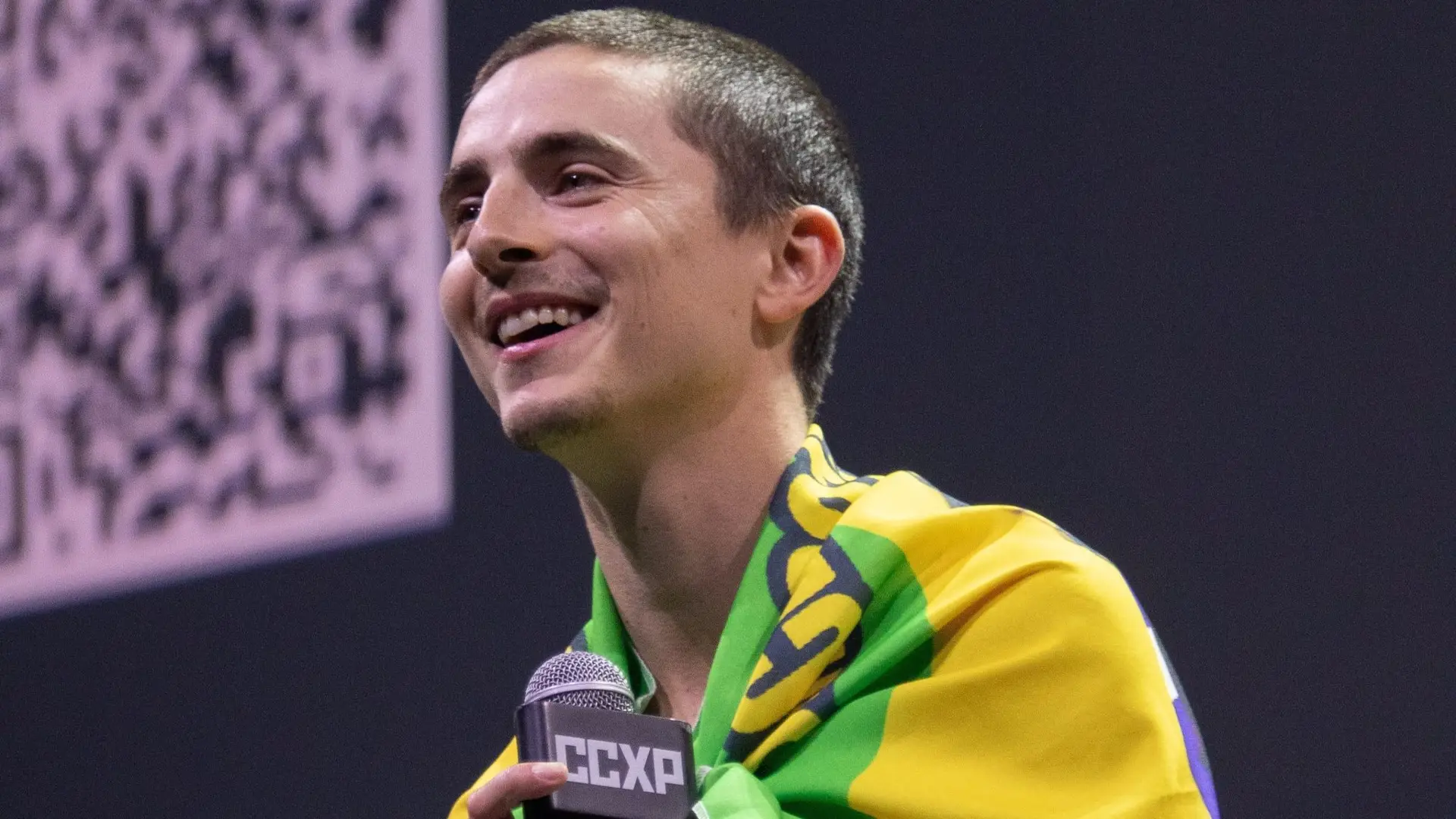
His Saint-Étienne references are unusually specific. He wore the club’s jersey on Late Night With Seth Meyers in 2019. In 2024, while promoting Dune: Part Two on French television, he was given a Saint-Étienne scarf and led the room in song. He has also described following the team bus on his bike as a child, hoping to catch a closer look at a side featuring Dimitri Payet and Bafétimbi Gomis.
In 2026, the connection became even more explicit. During a TF1 news appearance, Chalamet was presented with Saint-Étienne’s new fourth kit and put it on live. The shirt itself was loud enough to stand on its own, a bright green Hummel design with club detailing, but the launch worked because Chalamet’s support already had a paper trail. It was not a celebrity seeding exercise in search of a backstory. The backstory was already there.
His own public language has treated the club as more than an accessory. After winning a Golden Globe, Chalamet told Paris Match that “for 2026 to be truly perfect, Saint-Etienne will have to be promoted back to Ligue 1 next season.” That is not the way most visiting celebrities talk about a club. It is the language of someone tracking a season.
Then Adidas placed him at the center of Backyard Legends, its 2026 World Cup film. The cast around him includes Lionel Messi, Bad Bunny, Lamine Yamal, Jude Bellingham, Trinity Rodman, Zinedine Zidane, David Beckham and Alessandro Del Piero. Chalamet’s role is not a cameo from outside the sport. Adidas frames the film through him, and his connection to the game is built directly into the premise.
The campaign gives the cleanest line of all. Chalamet links the ad to his childhood at Pier 40 in New York, where he played while thinking about Beckham, Del Piero and Zidane. Then he lands the sentence that could define the whole reel: “I don’t know soccer, I know football.”
Plenty of actors wear football shirts well. Chalamet’s case is different because it includes the youth player, the Chelsea follower, the Saint-Étienne loyalist and now the 2026 World Cup pitchman in one continuous arc. His soccer fandom is not one image or one clever styling choice. Taken together, the pieces form something closer to a football biography than a celebrity side interest.
From Manhattan Kickers to Stamford Bridge, from Saint-Étienne green to the World Cup stage, Timothée Chalamet really does know ball.