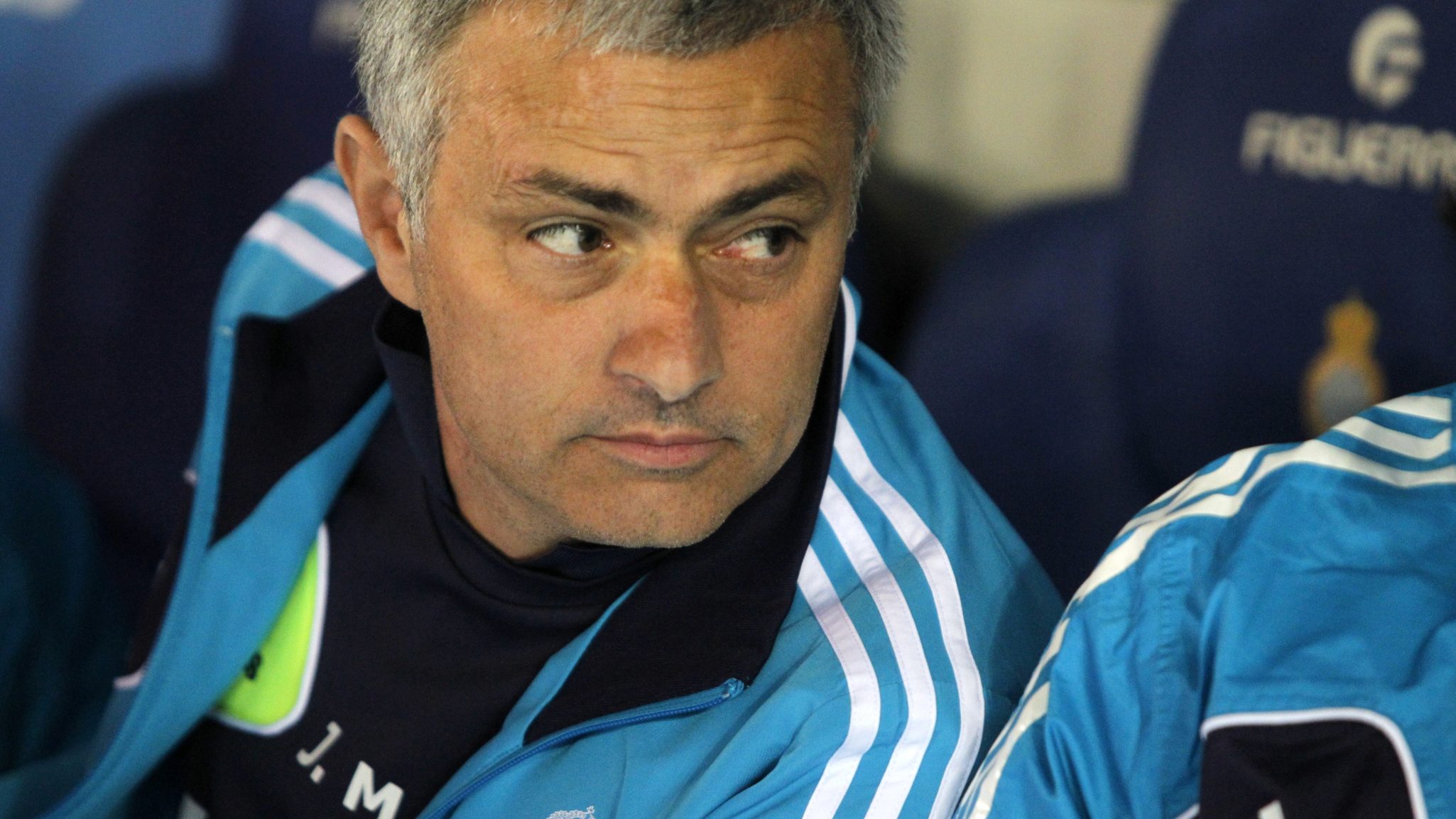
There are two ways to read the latest reporting around José Mourinho and Real Madrid. One is as nostalgia. The other is as psychology. The first asks why a club with Madrid’s resources would look back toward a 63-year-old manager whose recent career has been spent away from Europe’s most powerful benches. The second asks why that same club might now crave someone who can make a dressing room full of famous players feel smaller.
The reported possibility of José Mourinho to Real Madrid is not built on tactical fashion. It is built on authority. Florentino Pérez is said to view Mourinho as a favored candidate to replace Álvaro Arbeloa, who was promoted to the first team in January after Xabi Alonso’s exit. Support inside Madrid is reportedly not universal, which makes the idea sharper rather than weaker. A Mourinho return would not be a consensus appointment. It would be a presidential act.
Mourinho is tied to Benfica until 2027, with a reported break clause worth about $3.5 million. For Madrid, that number is not the obstacle. The real cost would be emotional. Hiring Mourinho means inviting a manager whose presence changes the temperature of every room he enters.
His first spell at Madrid still gives him a claim on the club’s memory. The 2011-12 team won La Liga with 100 points, 121 goals and 32 victories. It did not add another of Real Madrid’s 15 Champions League titles, but it did restore a certain domestic force at a time when Barcelona had been setting the terms of Spanish football.
That Madrid cannot be recreated. Cristiano Ronaldo, Mesut Özil and Xabi Alonso belonged to a different era. The present squad is built around Kylian Mbappé, Vinícius Júnior and Jude Bellingham, players with their own gravity and their own public identities. A normal coach can disappear inside that environment. Mourinho’s appeal is that he rarely disappears anywhere.
The ego above the egos
Mourinho does not manage ego by dissolving it. He manages it by competing with it. His method has always depended on hierarchy, tension and loyalty, on making the manager the central author of the room. At most clubs, a coach has to be bigger than the players. At Real Madrid, he also has to stand beside the president, the shirt, the stadium and the club’s impossible sense of itself.
At this point, the idea becomes more than a reunion. Pérez may not be looking for the most modern technician. He may be looking for a force strong enough to reorder the dressing room. Zinedine Zidane and Carlo Ancelotti gave Madrid calm authority. Mourinho offers command theater. He turns pressure into structure, enemies into fuel and every press conference into a reminder that the manager still exists.
The danger is built into the appeal. Dominance can create quick obedience, but it can also create resistance once results soften. Mourinho absorbs attention, which can protect players when the machine is moving. When it stalls, the same attention can turn the manager into the crisis. In a squad containing Mbappé and Vinícius, a second Mourinho era would become a test of power before it became a test of tactics.
For now, Mourinho’s public posture remains tied to Benfica’s Champions League path. The Madrid question, though, is already revealing. It suggests a club unsure whether its problem is ideas, discipline or control. If Madrid choose Mourinho again, they would not be choosing the future in any clean sense. They would be choosing a familiar force, one whose authority is inseparable from risk.
The psychological pull sits there. Mourinho may no longer look like the game’s next step. He still looks like the ego large enough to confront all the other egos. Real Madrid would be betting that a room of superstars does not need to be soothed. It needs to be mastered. The gamble is obvious. So is the attraction.