
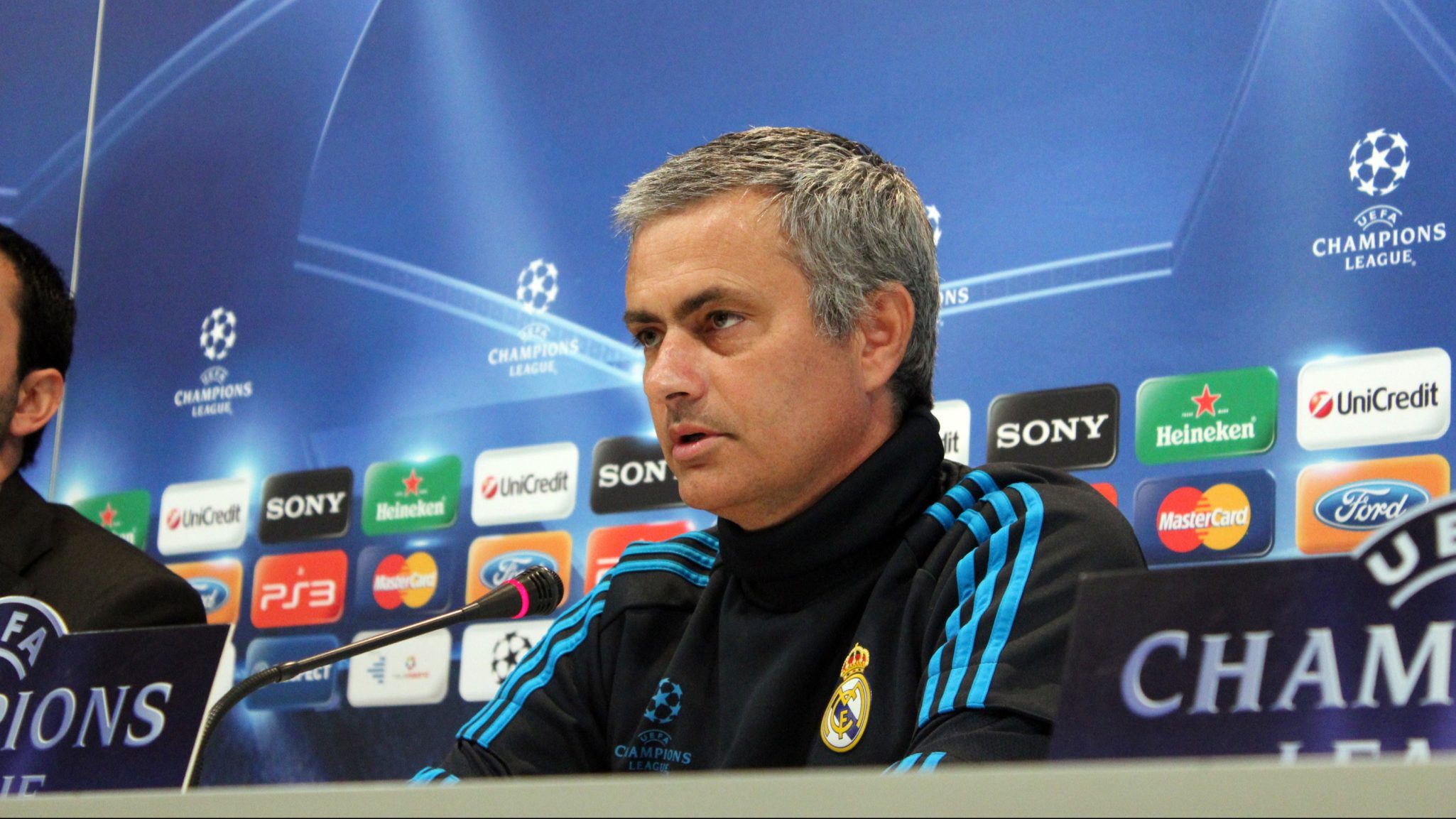
José Mourinho’s name has returned to the center of Real Madrid’s managerial conversation, but the detail that matters most is not nostalgia. It is who reportedly wants him.
The Athletic’s David Ornstein and Mario Cortegana have reported that Florentino Pérez sees José Mourinho as his favored candidate to replace Álvaro Arbeloa, with the decision expected to sit heavily with Madrid’s president rather than the executives who shaped the previous coaching process.
The phrasing is important. Mourinho is not confirmed as Real Madrid manager. He is not, based on the available reporting, the club’s unanimous choice. The strongest reading of this potential hire is more precise: Pérez is considering a former manager with a long institutional memory, a forceful public presence and a record at Madrid that still gives his name unusual weight inside any conversation about control.
Madrid are not approaching this from a position of calm. Arbeloa was officially named first-team coach on January 12 after working his way through the club’s academy structure and Castilla. His Madrid background made the promotion easy to explain. The results have made it harder to defend. Arbeloa had won 14 of his first 23 matches, a 60.9 percent win rate, with seven defeats.
The appeal of Mourinho begins there. He would not be a neutral hire. He would arrive with his own history, language and demands. At Madrid, that can be both an asset and a cost. His first spell from 2010 to 2013 delivered LaLiga, the Copa del Rey and the Spanish Super Cup, but its ending left enough institutional memory that support for a second tenure is reportedly not universal.
A reported financial route exists, too. Mourinho is at Benfica on a deal that runs to 2027, but his contract includes an end-of-season exit mechanism that either side can use within 10 days of Benfica’s final match. Reporting around the Madrid story has put the value of that clause at roughly $3.5 million. For a club of Real Madrid’s scale, the fee would not be the obstacle. The question is whether Pérez believes the risk is worth the cost of reopening.
A return built on memory, not certainty
Mourinho’s case will always start with the 2011-12 season. Madrid finished that LaLiga campaign with 100 points, 121 goals, 32 wins, and 16 away victories. Cristiano Ronaldo scored 46 league goals. Barcelona finished nine points behind. For a club whose modern identity is so closely tied to the Champions League, Mourinho’s great Madrid team is best remembered for the league season that broke records at home.
That team cannot be hired back. The Madrid of 2026 has a different squad and a different dressing room. Vinícius Júnior, Kylian Mbappé and Jude Bellingham are not inheriting the same football environment that Cristiano Ronaldo, Mesut Özil and Xabi Alonso inhabited. A second Mourinho appointment would test whether his authority still translates to an elite squad built around younger global stars.
The recent Benfica episode involving Vinícius gives that question a sharper edge. UEFA suspended Benfica winger Gianluca Prestianni for homophobic conduct in the February Champions League meeting with Real Madrid, after a case that began with Vinícius reporting a slur during the match. That incident would not define Madrid’s search, but it would sit uncomfortably beside any return involving Mourinho, Benfica and a dressing room in which Vinícius remains central.
Mourinho also comes with a recent record that complicates the romance. His move to Benfica followed the end of his Fenerbahce spell after a Champions League qualifying defeat, and he has not won a domestic league title since Chelsea in 2015. The argument for hiring him now is not that Madrid would be securing the same coach who overwhelmed LaLiga in 2012. It is that Pérez may want a manager whose presence changes the internal temperature immediately.
If Madrid move for Mourinho, it would suggest Pérez sees the club’s problem as one of command as much as coaching. The appointment would carry obvious tactical questions, but the institutional signal would be just as revealing. Real Madrid would be choosing a familiar form of authority, knowing exactly how powerful and how difficult that authority can become.