The 2026 World Cup was supposed to make room for more of football’s biggest names. Forty-eight teams. Three host countries. More matches, more groups, more chances for nations that usually live on the edge of qualification.
And still, somehow, this team will be watching from home.
Italy are out again. Nigeria are out. Cameroon are out. Hungary, Slovenia, Serbia, Georgia, Guinea, Denmark and Poland are out too. The expanded format did not save everyone. It only made the absences more striking.
This is not a list of players left off final squads. Those debates will come later. This is stranger: a full XI of elite footballers whose countries failed to reach the tournament at all.
Put them together, and they look less like a collection of unlucky absentees than a side that could survive a World Cup group of its own.
The XI
Formation: 4-3-3
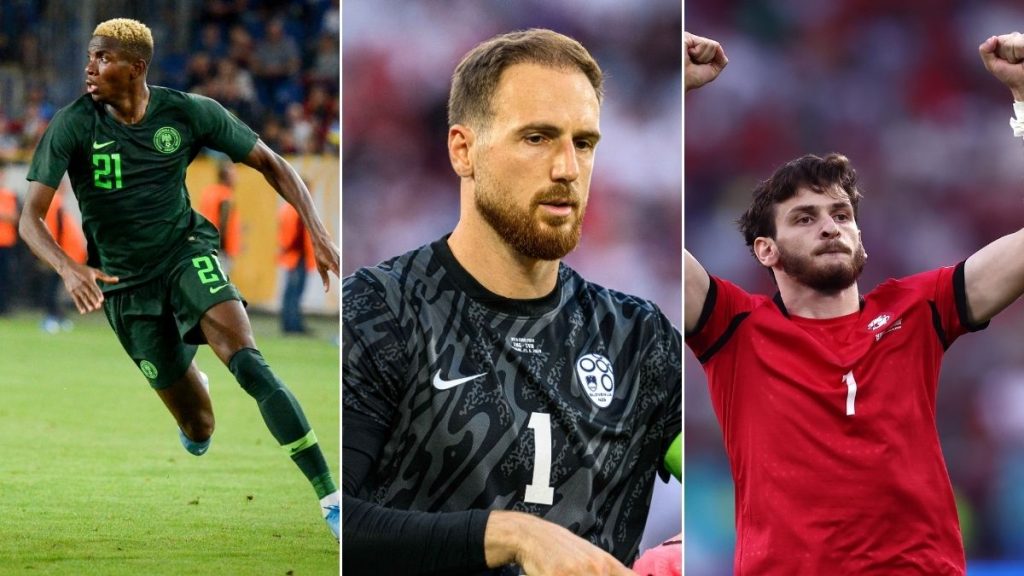
GK: Jan Oblak — Slovenia
RB: Ola Aina — Nigeria
CB: Alessandro Bastoni — Italy
CB: Nikola Milenković — Serbia
LB: Milos Kerkez — Hungary
CM: Nicolò Barella — Italy
CM: Carlos Baleba — Cameroon
CM: Dominik Szoboszlai — Hungary
RW: Bryan Mbeumo — Cameroon
ST: Victor Osimhen — Nigeria
LW: Khvicha Kvaratskhelia — Georgia
Goalkeeper: Jan Oblak gives the ghost team a wall
Jan Oblak has spent years making difficult games look smaller. He is not the loudest goalkeeper in Europe, or the flashiest, or the kind who turns every save into theater. He is simply there — set early, reading angles, killing momentum, turning clean chances into long sighs.
That is what makes Slovenia’s absence feel so sharp. The World Cup is built for goalkeepers like Oblak. Knockout football rewards calm. Penalty shootouts reward nerve. Tight group matches reward the one player who can keep a team alive for ninety minutes longer than it deserves.
Instead, one of the most reliable keepers of his generation will miss another summer on the biggest stage.
Defense: Italy changes the whole back line
The late twist in this XI is Italy.
The Azzurri were once alive. Then Bosnia and Herzegovina happened. Italy lost their playoff final on penalties after a 1-1 draw, extending one of the strangest droughts in modern football: no World Cup in 2018, no World Cup in 2022, and now no World Cup in 2026.
That makes Alessandro Bastoni impossible to ignore.
Bastoni’s red card in Zenica became one of the turning points of Italy’s collapse, but the player himself still belongs in this team. He gives the back line the balance it was missing: left-sided quality, composure in buildup, and the ability to defend large spaces without turning every recovery run into panic. Italy’s tournament absence is historic. Bastoni’s absence from the World Cup will be one of its most visible consequences.
Beside him is Nikola Milenković, a defender made for the uncomfortable parts of tournament football. He is strong in the box, awkward to play against, and comfortable enough in possession to let the team step forward. Serbia never found the rhythm needed to turn individual talent into qualification, but Milenković still gives this XI the kind of defensive presence every coach wants when a game starts to tilt.
At right back, Ola Aina earns the nod. Nigeria’s exit was one of the brutal stories of qualifying: a playoff defeat to DR Congo on penalties after a 1-1 draw. Aina brings flexibility, Premier League sharpness, and the kind of defensive reliability that matters in a team full of attacking names. He can play either side, cover inside, and survive one-on-one duels without needing constant help.
On the left, Milos Kerkez gives the XI its running power. Hungary were minutes away from extending their World Cup dream before Ireland’s late comeback in Budapest destroyed it. Kerkez, like Szoboszlai, will feel that absence deeply. He is exactly the type of fullback who would have turned a sleepy group-stage game into something frantic: aggressive, direct, and always looking to carry the ball thirty yards up the pitch.
This defense has a little bit of everything: Oblak’s calm, Bastoni’s distribution, Milenković’s edge, Aina’s versatility, and Kerkez’s chaos.
It also has no World Cup to play in.
Midfield: Barella, Baleba and Szoboszlai could run a tournament
Nicolò Barella joins Bastoni as the other unavoidable Italian inclusion. If Italy’s latest failure changed the back line, it also changed the midfield.
Barella is the player this XI needed: not just another creator, not just another ball-winner, but a midfielder who turns pressure into rhythm. He can press, recover, combine, and arrive late in the box. In a tournament setting, he gives a team emotional temperature. When games get tense, Barella plays faster without looking rushed.
Next to him, Carlos Baleba gives the midfield its modern engine. Cameroon’s road ended against DR Congo in the African playoff, with Chancel Mbemba’s late goal sending the Leopards forward and Cameroon home. That result removed several big names from the tournament, but Baleba may be the one who feels most like a player built for 2026.
He is young, powerful, and comfortable in the kind of high-tempo midfield battles that define modern international football. He can win the ball, carry through pressure, and turn defensive moments into attacks before the opponent has reset.
Then there is Dominik Szoboszlai, the captain of a Hungary side that came painfully close to the playoff route before Troy Parrott’s stoppage-time winner for Ireland ended their hopes.
Szoboszlai gives this team the spark. Set pieces, long shots, switches of play, late runs, pressing from the front — he has enough tools to influence a match in three or four different ways. He is also one of the players who makes this list feel genuinely unfair. The World Cup should have had him standing over free kicks in front of packed North American stadiums.
Instead, Hungary’s collapse turns him into one of the faces of the tournament that might have been.
Attack: Mbeumo, Osimhen and Kvaratskhelia is a front three worth arguing over
The right wing belongs to Bryan Mbeumo.
Cameroon’s failure means the 2026 World Cup loses one of the most dangerous wide forwards in African football. Mbeumo’s game fits tournament football beautifully. He presses. He runs in behind. He can finish. He can take set pieces. He can play wide or closer to goal. He is not just a highlight player; he is useful in all the small ways that matter when a knockout game gets ugly.
On the left is Khvicha Kvaratskhelia, still one of the purest dribblers in Europe. Georgia’s rise has been one of the best stories in recent international football, but their World Cup route proved too steep. That leaves Kvaratskhelia outside a tournament that would have loved him.
Few players change a stadium’s mood as quickly. Give him the ball near the touchline and defenders start making small, nervous choices. Step too close and he goes by you. Drop too far and he cuts inside. Overcommit and he turns the entire defensive shape into a problem. A World Cup with 48 teams should have had space for that kind of player. It does not.
Through the middle, Victor Osimhen is the easiest selection in the team.
Nigeria missing the World Cup is a footballing loss on its own. Nigeria missing the World Cup with Osimhen in his prime feels even bigger. He is made for the stage: explosive runs, aerial dominance, relentless pressing, and the kind of penalty-box aggression that turns half-chances into goals.
The cruel part is that Nigeria were close enough to make the ending hurt. They led DR Congo early in the African playoff final, were pegged back, and eventually lost on penalties. For Osimhen, that means no group-stage spotlight, no knockout-stage chaos, no chance to drag the Super Eagles through a summer in North America.
A front three of Mbeumo, Osimhen and Kvaratskhelia would be appointment viewing against almost anyone.
The World Cup will have plenty of goals. It will not have these.
The bench might be just as strong
The hardest part of this exercise is not building the XI. It is leaving players out.
Gianluigi Donnarumma could start in goal and no one would blink. Federico Dimarco, Sandro Tonali and Riccardo Calafiori all have arguments after Italy’s latest disaster. Serhou Guirassy gives Guinea a world-class forward who never made it to the tournament. Robert Lewandowski and Rasmus Højlund both miss out after Poland and Denmark fell in the European playoffs. Christian Eriksen, Willi Orbán, Benjamin Šeško, Dušan Vlahović and André Onana could all force their way into different versions of the same team.
That is the point.
Even with 48 teams, the World Cup still has sharp edges. The format is bigger, but the margin is not. A red card, a penalty shootout, a stoppage-time goal, one bad night in qualifying — any of it can remove an entire generation from the stage it was supposed to reach.
The 2026 World Cup will still be massive. It will still be loud. It will still give us new heroes.
But somewhere outside the tournament is a missing XI with Oblak in goal, Bastoni at the back, Barella and Szoboszlai in midfield, and Osimhen waiting between the center backs.
That team would have been worth watching.