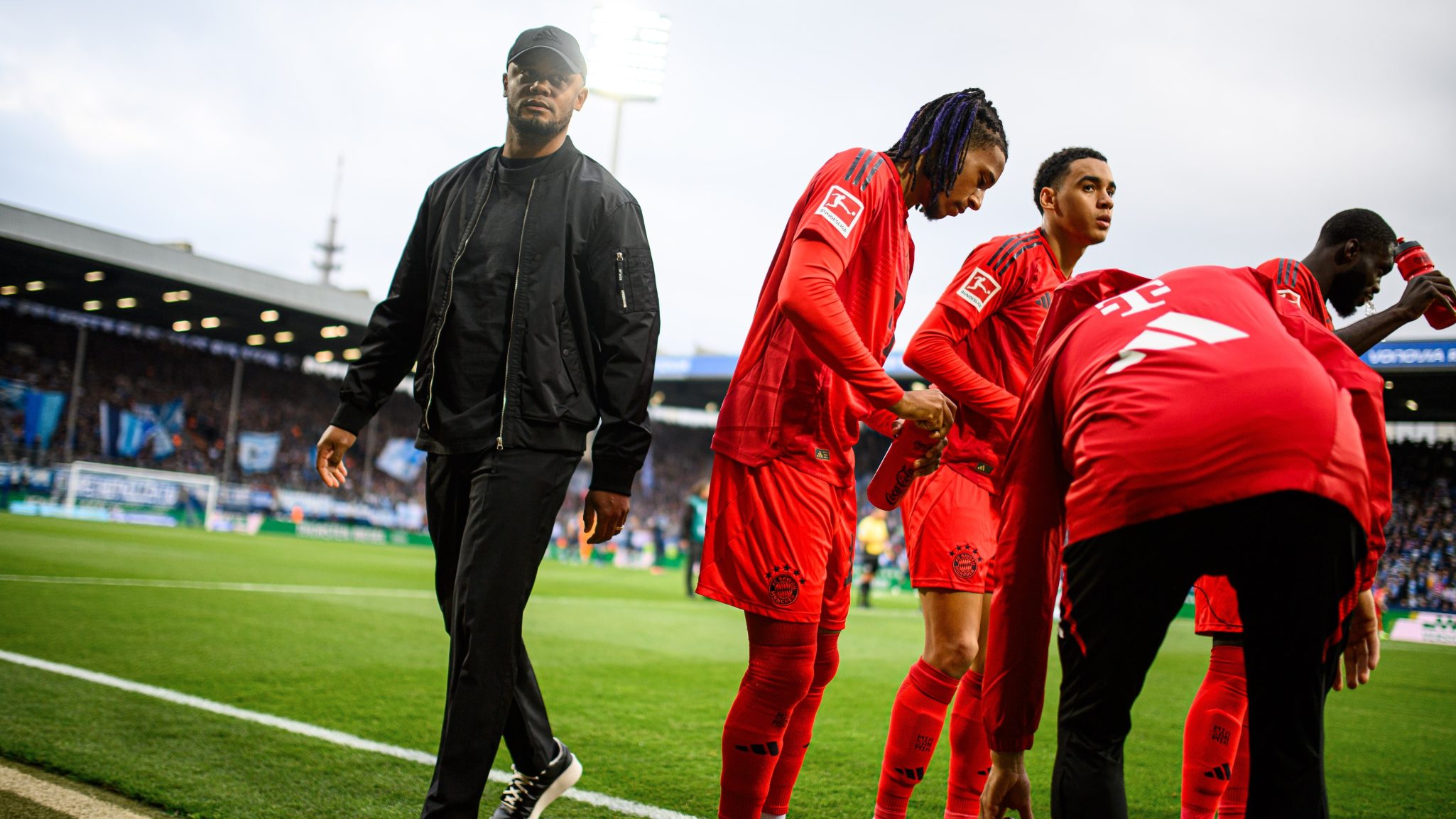
When Pierre Kompany arrived at parliament in Belgium wearing a Bayern Munich scarf, the image was easy to understand. A father was showing public pride in his son. But if that is where the story ends, it misses the more interesting part. Pierre Kompany is not simply Vincent Kompany’s father. He is a political refugee, an engineer, a longtime public servant, and one of the most significant Black political figures in modern Belgian civic life.
FVincent Kompany has never presented leadership as something he discovered only in football. He has pointed back to home. In a Bundesliga profile published last year, Kompany said, “Where I come from is my Dad. His experiences give me strength.” That line lands differently once Pierre’s own path comes into view. In 1975, he fled Congo after being imprisoned for his role in student protest against Mobutu’s regime. He arrived in Belgium without papers, later built a life there, and eventually moved from local politics to the Brussels parliament and later to national office.
Pierre Kompany’s life was also shaped by football, though in a different way. Vrije Universiteit Brussel notes that he played for K.R.C. Mechelen in the 1970s. He later graduated as an industrial engineer in aeronautics and was recognized for his technical work before becoming known in politics. The point is not that Vincent inherited leadership in some neat, linear way. It is that the household appears to have offered a mix of sport, study, migration, hardship, and civic seriousness, all at once.
Vincent has described that environment with unusual clarity. In a 2013 CNN interview, he said his father was “a political refugee” who fought against Mobutu and that his mother was “a union activist.” He called them “very opinionated people,” then explained the larger lesson they gave him. “Education has given us the strength to always kind of, you know, do our own thing.” That is not a decorative detail in his biography. It helps explain why Kompany has often sounded more measured than theatrical, more structural than impulsive, both as a player and now as a coach.
The scarf, then, can be read as a small visual payoff to a much longer family story. Pierre Kompany became the first Black mayor of a Belgian municipality in 2018, when he took office in Ganshoren. VUB later awarded him an honorary doctorate in recognition of what it described as an exceptional journey from political refugee to committed politician. For Vincent, who has spent years being framed through captaincy, discipline, and authority, that family context sharpens the picture. His authority on Bayern’s sideline did not appear out of nowhere. It was shaped in a home where leadership already meant resilience, seriousness, and the ability to carry responsibility in public.
What Pierre Kompany appears to have passed on
There is a temptation to turn family influence into sentiment. The better way to handle it is through Vincent’s own language. He has directly tied his drive to his father’s history. He has also linked his upbringing to a view of leadership that is less about status than duty. In Champions Journal, Kompany said, “If I were to summarise leadership in its simplest form, it would be the ability to put the team before yourself.” He credited the many “reference points” around him for shaping that view. He mentioned players and coaches there, but the family pattern is already visible elsewhere in his record.
One lesson seems to be endurance. Vincent’s public comments repeatedly return to staying power, not glamour. His father’s life in Belgium demanded exactly that, first as a refugee, then as a student and professional, and later as a politician. Another lesson seems to be self-command. Kompany makes clear that his parents refused to let football become his only foundation. He spoke about finishing his studies and about education as the thing that gave the family confidence even when money was tight. That kind of grounding fits the public version of Kompany people have long seen, a figure more comfortable with process than noise.
A third lesson is dignity under pressure. In February 2026, when Kompany criticized Jose Mourinho’s handling of racism allegations involving Vinicius Jr., he spoke from personal and family memory. “My dad is a Black person from the 1960s also who made his way,” he said. The point was not biographical color. It was moral perspective. Kompany was describing a generation taught to absorb insult, stay upright, and outperform the room just to receive a fraction of the credit. That is one of the clearest windows into how he understands leadership, not as image management, but as conduct under strain.
That is why the Bayern scarf is worth more than a passing image. It is a rare moment that compresses decades of history into one frame. A father who survived prison, exile, and political struggle showed up wearing the colors of the club his son now leads. The gesture was small, but it carried a long history behind it. For Vincent Kompany, that history may explain more about the way he leads than any tactical board or post-match soundbite.