Sigurd Haugen is wearing a mask for a simple reason. In December, the TSV 1860 Munich striker collided with Ingolstadt goalkeeper Kai Eisele, fractured his jaw, lost a tooth, and disappeared for weeks. The black lower-face guard he now wears is medical equipment first, not a fashion statement, but it has still produced one of the starkest football images of this season.
Protective facemasks are allowed under the laws of the game as long as they are non-dangerous and made from soft, lightweight padded material. Most of them disappear once the match starts. A few do the opposite. They harden the line of the face, change the player’s outline, and make an ordinary sprint or turn look unusually severe.
Haugen’s case stands out because the injury was to his jaw. Many of football’s most memorable masks sit around the nose or eye socket, which means the design frames the upper face. His cuts lower. It covers the mouth and chin, darkens the lower half of the profile, and gives him a different silhouette than the more familiar orbital shield.
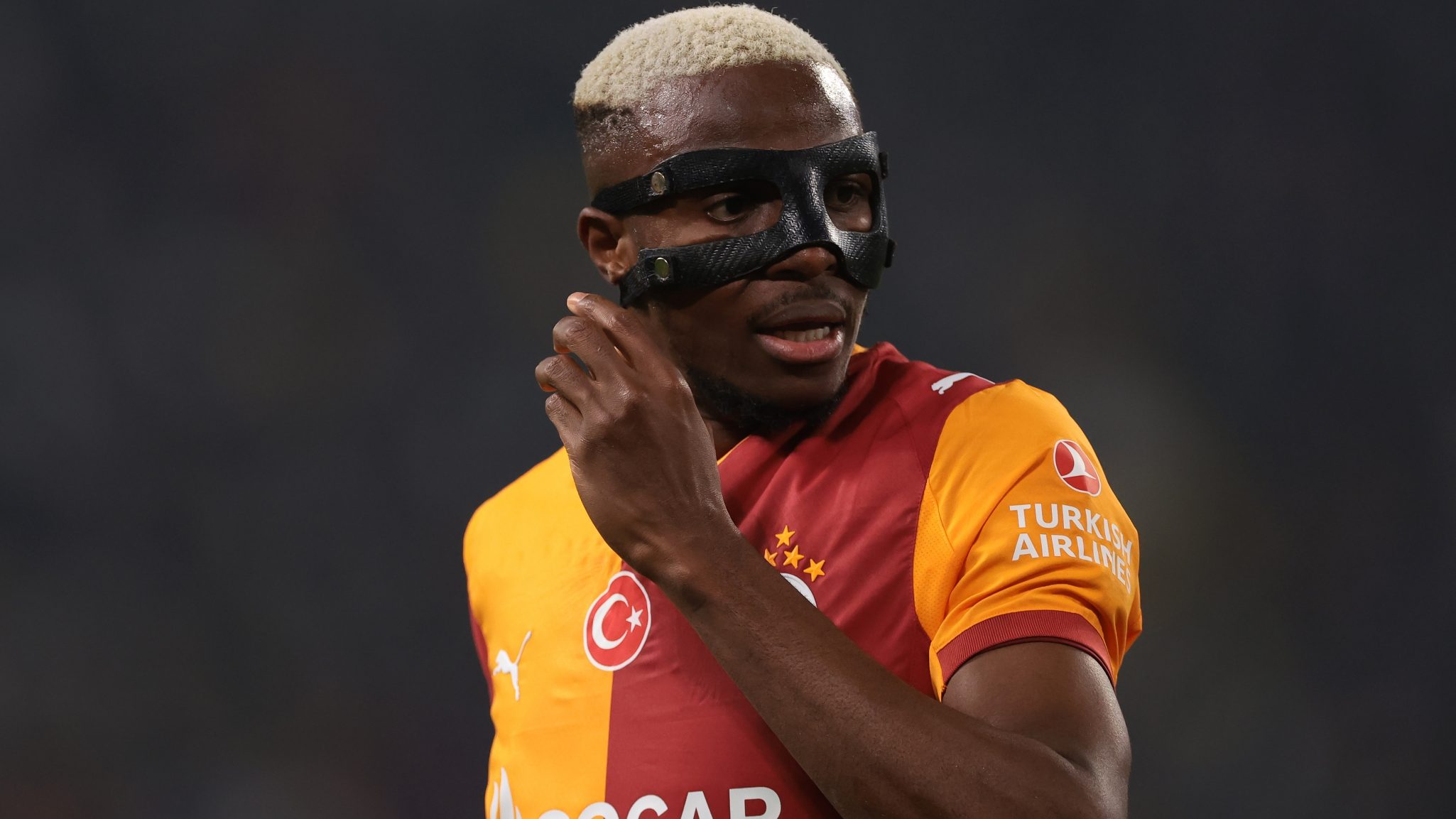
If there is a modern benchmark for the masked footballer, it is Victor Osimhen. After suffering facial fractures in 2021 and returning with plates and screws in his face, he came back in protection and never really let the image go. Even after the most urgent stage of the recovery passed, the mask stayed. What began as medical necessity became part of how he is visually understood.
Son Heung-min and Joško Gvardiol turned the 2022 World Cup into a showcase for the black protective mask. Son’s came after surgery around his left eye. Gvardiol’s followed a broken nose. Both remained recognizably themselves, Son fluid and direct, Gvardiol calm and commanding, but the added shell changed how their presence registered on the pitch and on television.
When the mask becomes the image
Antonio Rüdiger belongs in this conversation because the mask matched the way he plays. After taking a blow to the face for Chelsea in 2021, he wore protection through the rest of that season and into the European Championship. Nothing about his game softened with it on. If anything, the hard shell suited a defender who already plays as if every duel is personal.
Pierre-Emerick Aubameyang’s mask arrived under darker circumstances, after burglars broke his jaw in Barcelona in 2022. Kylian Mbappé brought a different version of the image back to the center of the sport at Euro 2024, when a broken nose forced France’s captain into a protective face guard during the tournament. One case was private and traumatic, the other unfolded in full public view, but both showed how quickly a mask can become part of football memory when attached to an elite forward.
That leaves Haugen in an interesting place. He does not have Osimhen’s global platform or Mbappé’s scale, but his mask may be the most visually severe of the recent group because it reshapes the lower half of the face instead of framing the eyes. Any shortlist of football’s most villainous recent masks starts with Osimhen, moves through Son, Gvardiol, Rüdiger, Aubameyang and Mbappé, and now has room for Haugen. Not because the mask tells us everything about the player, but because football has a strange habit of turning recovery gear into lasting iconography.