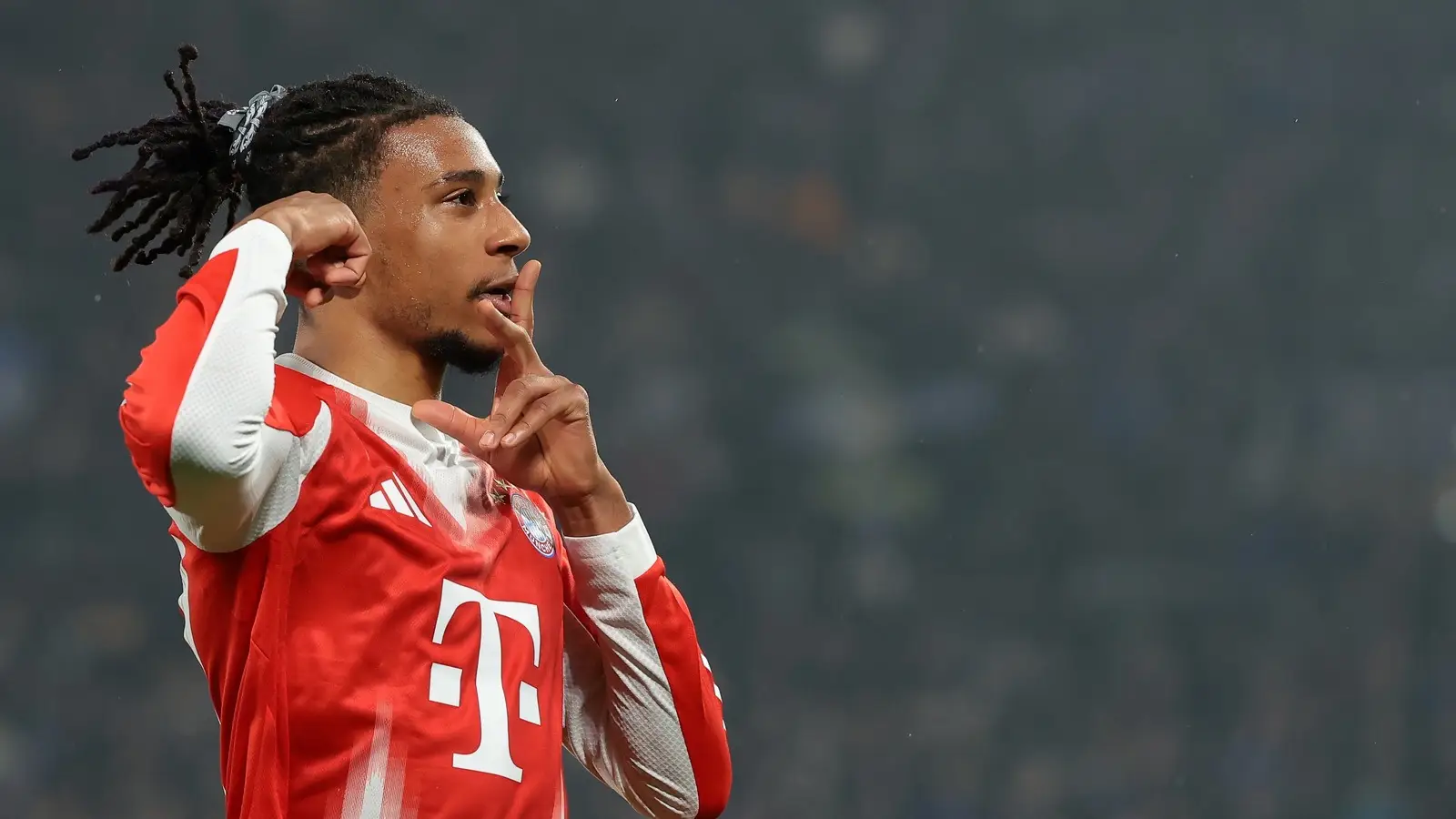
Michael Olise had just scored twice and supplied an assist in Bayern Munich’s 5-0 win over Bodø/Glimt. Asked how it felt to score such goals, he answered, “I don’t know.” Asked how he produced them, he reduced the process to taking a shot and seeing whether it went in.
It fit Olise’s reputation for nonchalance. An extravagant performance had received an economical explanation. But the DAZN exchange left out almost everything that had made his first goal possible, and another interview after the same match suggested he was perfectly capable of filling in the detail.
Before scoring Bayern’s fourth, Olise had carried the ball forward from his own half, passed to Lennart Karl and continued his run to receive the return. The curling finish was the conclusion, not the entire move. His stoppage-time second punished a misplaced pass. Earlier, his free kick had supplied Harry Kane’s header. There were several kinds of contribution hidden inside that simple summary.
Speaking separately to UEFA, Olise discussed Bodø/Glimt’s deep defensive setup, Vincent Kompany’s halftime instruction to persist and Bayern’s understanding of one another’s movements. In archetypical Olise two-step style, he can mix the terse and play the long-verbosity game. But he still doesn’t need to delivering a grand speech. He was explaining how a difficult first half had become a comfortable win, with enough detail to make the answer useful.
Two interviews after one match had captured different aspects of the same player. One made his manner the talking point; the other returned the attention to Bayern’s football. Neither needs to become a complete portrait of his personality.
Kompany sees a demanding player
Bayern’s leadership has since defended Olise’s interview style. Sporting chief Max Eberl emphasized that people differ and that the club values what Olise produces on the field. Kompany argued that the attention generated by the clip also benefited broadcasters and sponsors.
Kompany’s description of the player inside the team is more revealing. In January, he called Olise “very communicative” and spoke about his strong relationships in the dressing room. Dayot Upamecano has offered a similar account, telling Sport Bild that Olise talks and laughs with teammates and describing him as a friend.
The working habits sound less relaxed still. Kompany has described a player frustrated when something doesn’t come off exactly as intended, whose attention to detail challenges the coaching staff to keep improving their own thinking. “His mindset is what makes him so special,” the coach said. Looking unhurried on the ball shouldn’t be confused with being undemanding about the result.
In a Highsnobiety interview, Olise recalled learning about kaizen from a Crystal Palace coach, then researching its approach to incremental improvement. He described his football as instinctive and rooted in muscle memory. Those ideas aren’t opposites. A player can train deliberately for an action that feels instinctive during a match.
Asked about his restrained celebrations, he said, “I don’t react the same way everyone else reacts.” Different expression doesn’t mean an absence of feeling.
His boot sponsorship choices have also become part of his anti-star image. Yet the interview accompanied a fashion shoot photographed by Juergen Teller. He can participate in image-making without approaching every microphone in the same way.
His account of losing at chess to Jamal Musiala offers a less solemn glimpse. “He is not as good as I am, but he beat me,” Olise said. He blamed his concentration. Even a friendly defeat apparently required a qualification.
The interviewer still had a legitimate job to do. Asking what a goal feels like is a reasonable invitation to share the experience. A few words may not give an audience much in return, and admiring Olise’s skill doesn’t require pretending otherwise. Nor does the clip’s reach, which Kompany celebrated, make every answer illuminating.
The fuller UEFA exchange makes a modest point: he can offer the football detail, even when another interview leaves the reporter searching for it. Expecting a better answer is fair. Expecting every answer to explain Michael Olise is asking rather more.