
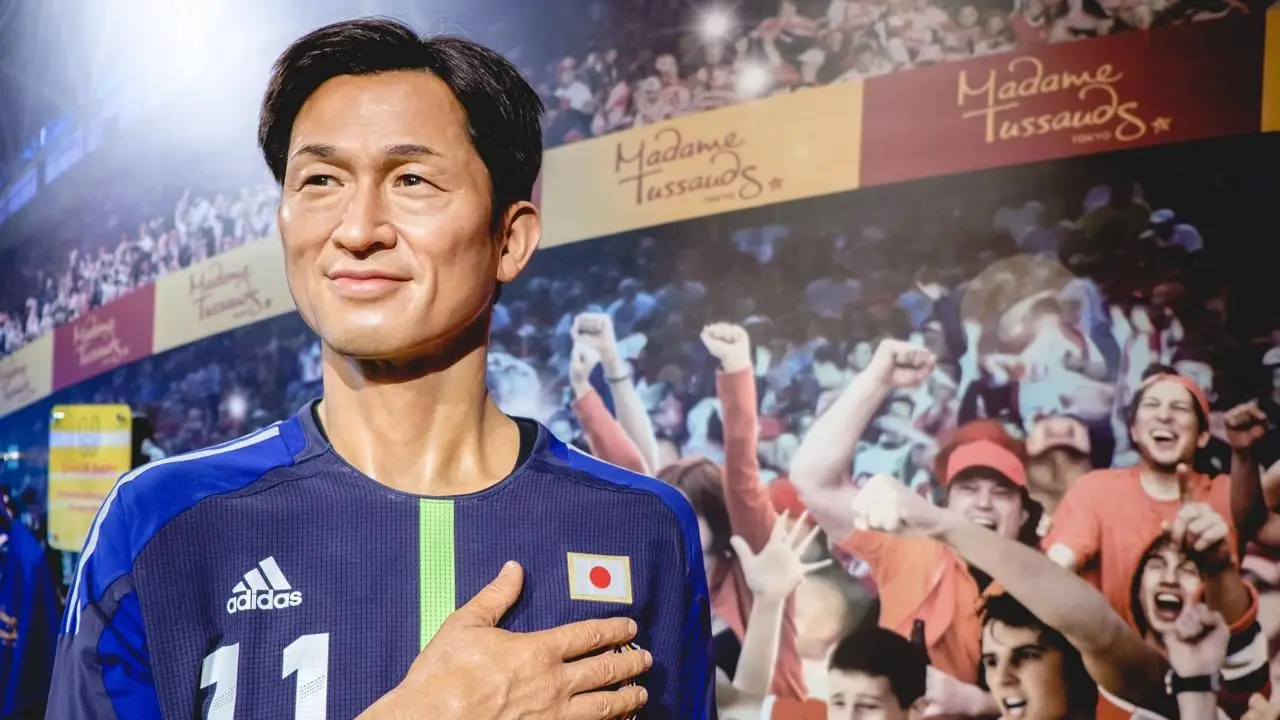
Kazuyoshi Miura had started toward the center before Takatora Einaga released the pass. Einaga drove along Fukushima United’s right side, evaded three challenges and slipped the ball backward into Miura’s path. Miura met it on arrival and directed a right-footed shot into the net. The 52nd-minute goal moved Fukushima 5-0 ahead of Iwaki Furukawa FC. Miura was 59 years, four months and 29 days old.
The finish changed little about the result, but the distance behind it was extraordinary. Santos handed Miura his first-team debut in 1986, seven years before the J.League opened. Four decades later, he remained a registered professional when Japan and the Netherlands met at the 2026 World Cup, a useful measure of how much the national game had changed while he kept playing.
Fukushima’s 7-0 victory came in the Fukushima Prefectural Football Championship final, which determined the prefecture’s entrant in the 106th Emperor’s Cup. The match was neither a J3 league fixture nor part of the national cup bracket. It earned Fukushima a first-round place on August 19. Miura’s contribution was the fifth goal of a rout, not its turning point.
The sequence still explained part of his survival as a forward. Einaga supplied the difficult work with the ball. Miura anticipated the return pass, reached a high-value central position and finished before the back line could recover. Fukushima replaced him in the 55th minute. The action lasted only seconds, but every movement had a purpose.
The previous entry on Miura’s competitive scoring record was dated November 12, 2022. Playing for Suzuka Point Getters, he converted a header in the Japan Football League at 55. The next goal arrived 1,351 days later. He remains contracted to Yokohama FC and loaned to Fukushima through June 30, 2027, four months after his 60th birthday. The deal leaves a path to another age landmark, though only an official appearance could establish it.
The career that became a timeline
São Paulo became Miura’s football school after he moved there at 15. Santos introduced him to senior football in 1986. Japan called him home in 1990, when he signed for Yomiuri Club near the end of the Japan Soccer League era. On May 15, 1993, now representing Verdy Kawasaki, he appeared in the first J.League match before 59,626 spectators at Tokyo’s National Stadium.
He did more than witness the new competition. Miura received its inaugural MVP award in 1993 and finished as its leading scorer three years later. Other assignments took him to Sydney FC, Genoa, UD Oliveirense and Croatia Zagreb. Across the full club chronology, he played in Japan, Brazil, Portugal, Australia, Croatia and Italy. He was also among the veteran professionals featured in Stadio United’s look at footballers still playing in 2025.
His international record combined stature with a lasting omission. The 1992 Asian Cup gave Japan its first continental championship and Miura the tournament’s MVP award. FIFA recognizes 89 appearances and 55 goals; the J.League player page lists 91 caps because two 1997 matches against Romania were later reclassified. He scored 12 times during the qualifying campaign for France 1998, then was excluded from the 22-player group selected for the finals. One of the central figures in Japan’s ascent never played at a senior World Cup.
Record language needs firm borders. Guinness measures his professional career from 1986 through 2020 as five calendar decades. A different Guinness category belongs to his 2017 J2 goal for Yokohama FC, registered when he was 50 years and 14 days old. The Fukushima goal cannot displace that mark because it came outside league play. It also cannot settle a universal oldest-scorer claim when football systems apply different standards to professional status and competition level.
Japan’s calendar change leaves a gap between season labels. The special J2 and J3 transition event in early 2026 accounted for Miura’s 41st professional season; he made six scoreless appearances. The July 25 qualifier came before the regular 2026/27 J3 campaign, the start of his 42nd. His working life in football has now crossed generations, league formats and national calendars.
The fifth goal of a 7-0 win over a regional Division 2 opponent does not show that a 59-year-old can handle the normal demands of a third-tier season. It shows something smaller and more durable. Miura still understands where a striker should arrive, and a player who helped define the J.League’s opening years remains inside its present structure. Forty years after Santos, his career has become one of the clearest records of Japanese football’s transformation. He’s still got it! Ronaldo, take notes.