Morocco’s World Cup journey begins with a clear fact: they are in Group C and will face Brazil in their first match on June 13 at New York New Jersey Stadium in East Rutherford, New Jersey. Kickoff is at 6:00 p.m. Eastern.
A second certainty is that Morocco arrives as something more defined than a tournament curiosity. Their 2022 run to the semifinals established them as the first team from Africa and the Arab world to reach that stage, and it did it with a brand that traveled well: organized defending, clear roles, and a roster built from both domestic roots and European development pathways.
The 2026 tournament continues Morocco’s recent success. They qualified for a third straight World Cup by winning their CAF group with a perfect record, securing their spot with a 5–0 win over Niger in Rabat. This will be Morocco’s seventh World Cup appearance, showing how their modern era is becoming part of football history.
The group stage schedule is straightforward. After playing Brazil in the New York area, Morocco faces Scotland on June 19 at Boston Stadium in Foxborough, Massachusetts, with kickoff at 6:00 p.m. Eastern. Their final group match is against Haiti on June 24 at Atlanta Stadium, also at 6:00 p.m. Eastern. For ticketing and official listings, FIFA uses the names MetLife Stadium, Gillette Stadium, and Mercedes-Benz Stadium.
If you want to get a sense of how Morocco might play in June, watch both the team’s results and the mood around them. In January, coach Walid Regragui defended a cautious approach at the Africa Cup of Nations, focusing on managing the tournament and staying humble. While this does not guarantee how Morocco will play at the World Cup, it gives insight into what their manager believes works in knockout football.
A practical way to follow the Atlas Lions in North America
Begin by checking the main sources for information. FIFA’s website has the latest schedule, ticket updates, and match details. For news about Morocco, follow the Royal Moroccan Football Federation and the national team’s accounts, which share squad lists, training updates, and matchday content. On X, look for FRMF and Équipe du Maroc. On Instagram, use equipedumaroc, and the federation’s YouTube channel features press conferences and other official videos.
Next, think about how you want to watch the tournament. The 2026 World Cup takes place from June 11 to July 19 across the United States, Canada, and Mexico, with 48 teams and 104 matches. The final will be at MetLife Stadium. This long schedule affects how games are broadcast and how fan events develop, even if you are only interested in Morocco’s group matches.
In the United States, the broadcast plan is set. FOX will show every match live on FOX and FS1, with streaming available on its platforms. Telemundo will provide full Spanish-language coverage, with live games on Telemundo and Universo, plus streaming on Peacock and the Telemundo app. Even when Morocco is not playing, these channels are useful for updates on the team’s roster and injuries.
If you plan to attend in person, Group C’s three-city setup is easy to manage. Morocco starts at New York New Jersey Stadium, which will also host the final. Boston and Atlanta are the other group cities, and all matches have set kickoff times, making it easier to plan your trip.
If you are not attending matches, use the host-city fan zones as your guide. FIFA is organizing Fan Festival events in each host city, and local committees are sharing their own plans. In New York, there will be a main fan village at Rockefeller Center from July 4 to July 19, along with other festival sites. Even if Morocco’s games are earlier, these official fan zones are the best places to watch matches with other fans.
Now for the atmosphere. Morocco’s matchday identity is shaped by language, rhythm, and familiar signals. FIFA’s 2022 reports mentioned drums, handclaps, and a chant, “Sir,” which means “Let’s go.” You do not need to join in, but knowing these sounds helps you understand what you hear in the stadium or on TV.
Morocco’s team is also shaped by its search for talent among the diaspora. Fourteen of the 26 players in their 2022 World Cup squad were born outside Morocco, coming from Moroccan communities across Europe. This approach is a real part of the team’s identity, seen in player backgrounds, club ties, and how the team communicates in different languages.
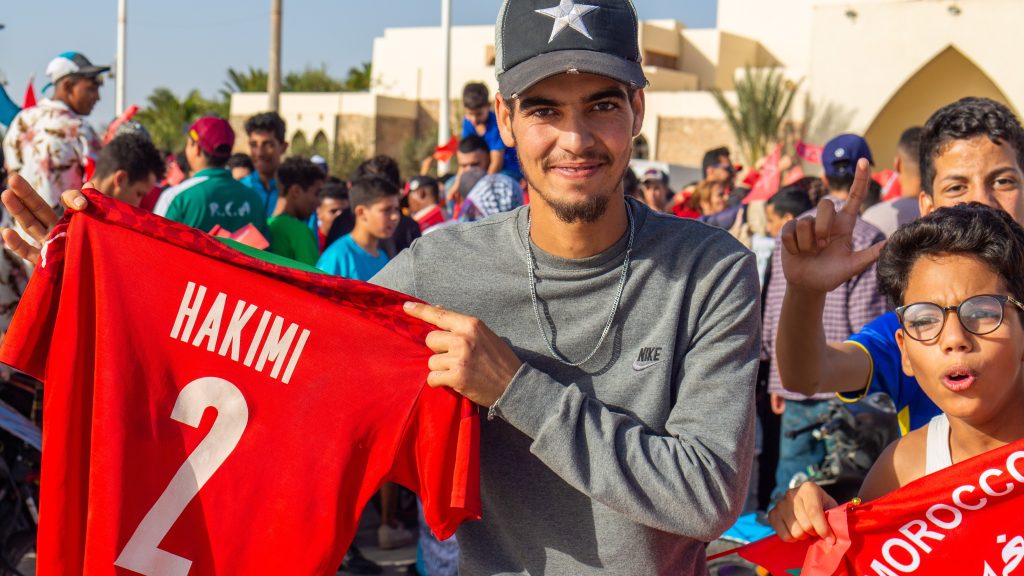
For 2026, three players stand out. Achraf Hakimi is the captain and a key figure for Morocco’s speed and play on the wings. His leadership showed in moments like his assist for Brahim Díaz’s winning goal against Tanzania at the Africa Cup of Nations. Díaz had scored four times by the quarterfinals, showing he is trusted to make a difference in big games.
Hakim Ziyech is another important player. He joined Wydad Casablanca in October 2025, his first time playing for a Moroccan club after a career in Europe and abroad. Whether he starts in June or not, his presence changes Morocco’s attack, and fans pay close attention to his playing time because of his skill with his left foot.
Finally, be aware of rivalries, especially with Algeria. Tense diplomatic relations have affected sports, including club competitions and travel. While you do not need to focus on this, it helps explain why some North African matches have added meaning beyond football.
If you want to follow Morocco in June, keep it simple. First, check official channels and the schedule for updates on squads, kickoffs, and tickets. Second, get to know the key players, since Morocco is built to win close games. Third, remember that their 2022 success and 2026 qualification were earned, not given. Now, it is all about performing in three American cities.
Senegal
How to follow Senegal at the 2026 World Cup
Senegal head into the 2026 World Cup with a nickname that feels earned rather than manufactured. They’re known as the Lions of Teranga, a name drawn from “teranga,” often translated as hospitality. It works as much as a national ethic as a sporting one, shaping how Senegal present themselves to the world: open and welcoming, fiercely competitive, and deliberate about how they carry themselves off the pitch.
That sense of identity now makes the trip to North America under a new head coach. Pape Bouna Thiaw took over on December 13, 2024, and early reporting on his ideas points to a proactive style built on high pressing and quick transitions. If you want to follow Senegal beyond the highlight clips, that’s the first thing to watch for. This is not a team set up just to sit deep, soak up pressure, and hope for the odd counter. Senegal’s aim is to step forward and try to run the game on their own terms.
They secured their spot at the tournament with a qualifying run that left little room for argument. Senegal booked their place at the 2026 World Cup with a 4–0 win over Mauritania on October 14, 2025, finishing top of their CAF qualifying group on 24 points. In that final match, Sadio Mané scored twice, with Iliman Ndiaye and Habib Diallo getting the others. The qualification route shows what Senegal expect from themselves: handle the big moments, then push the scoreline out of reach.
For a lot of casual fans, one date still comes to mind before any other when they hear Senegal’s name: May 31, 2002. That was the day Senegal beat France 1–0 in the World Cup opener, with Papa Bouba Diop scoring the only goal. It was not written off as a lucky break. It showed that a team could arrive with its own history and ask everyone else to learn it in real time.
The 2026 schedule gives that story a second chapter and, at the same time, makes Senegal unusually easy to follow. Their group stage is based in just two places: two matches at MetLife Stadium in East Rutherford, New Jersey, and a third match in Toronto. If you’re planning a trip around one team, Senegal are a rare case where the calendar itself makes the logistics feel manageable.
A North American itinerary built around New Jersey and Toronto
Senegal’s group stage starts on June 16, 2026, with France vs. Senegal at MetLife Stadium, set for a 3:00 p.m. kickoff. Their second match is also at MetLife, against Norway, on June 22 at 8:00 p.m. The third match is on June 26 at 3:00 p.m. ET in Toronto, where Senegal are scheduled to face the winner of FIFA Playoff 2 at Toronto Stadium at Exhibition Place. Three matches, two cities, one simple travel spine.
If you’re following Senegal in person, those first two fixtures are a gift from a practical point of view. Staying in one region for two matches changes the whole feel of a World Cup trip. Instead of constant packing and airport runs, you can settle into a routine: the same commute, the same neighborhoods, the same meeting spots, and a familiar rhythm between matchdays. Even if you’re watching from nearby bars or fan zones rather than the stadium, you can use those dates to shape your week and treat the trip more like a basecamp than a chase.
The New York and New Jersey region also makes it straightforward to follow the tournament without a ticket. Official NYNJ planning includes a FIFA Fan Festival in the region and other designated fan spaces, including a fan village at Liberty State Park and a fan zone at Rockefeller Center. If you’re looking for a reliable “where can I go that will actually be set up for the tournament?” option, those are the best starting points because they’re designed to be there regardless of which teams are playing that day.
From there, a Senegal follow guide benefits from one more layer: a sense of place that connects the team to the city around it. In New York, Little Senegal, also known as Le Petit Sénégal, is generally described as centered in Central Harlem around West 116th Street, between Lenox Avenue or Malcolm X Boulevard and Frederick Douglass Boulevard. That detail doesn’t promise an official watch party or a formal schedule. It does, however, provide a real geographic anchor for readers who want to tie match week to Senegalese food, shops, and community life in the city.
One concrete, historical marker on that strip is the restaurant Africa Kine, which is often described as having opened in 1996 on the West 116th Street corridor known as Le Petit Senegal, before later relocating farther north. Even without turning the neighborhood into a storyline it doesn’t claim for itself, that kind of grounded detail helps the guide stay practical. It gives readers a way to spend a morning or an afternoon around Senegalese culture before the day narrows into a single kickoff time.
Toronto, by contrast, is where the group stage ends, and the host city’s messaging is direct about how it plans to handle crowds and communal viewing. The City of Toronto has identified its FIFA Fan Festival as taking place at Fort York National Historic Site and The Bentway during the tournament, with live broadcasts of matches on large screens, plus programming that includes food and cultural elements. It’s the simplest kind of advice to give in a guide because it’s not speculative. If you’re in Toronto on Senegal’s matchday, those are official places set up to watch.
The Toronto match itself also comes with a notable venue detail that helps readers calibrate expectations. The host committee has stated that Toronto Stadium at Exhibition Place is being upgraded, with extra seating to bring capacity to 45,736. For a fan planning a trip, capacity is not trivia; it shapes ticket pressure, entry and exit timing, and the overall scale of the event.
Once you know where Senegal will be, the next step is understanding who they are likely to be when the matches arrive. The easiest mistake in team coverage is to treat a national side like a static list of famous names. Senegal have star players, but they also have a recent record of important contributions from multiple layers of the squad, including younger players. In early January 2026, reporting from the Africa Cup of Nations described a 3–1 Senegal win over Sudan in which Pape Gueye scored twice, with assists from Sadio Mané and striker Nicolas Jackson, and 17-year-old Ibrahima Mbaye added another goal. For a follower, that’s useful context: this is a team where the story isn’t limited to one veteran carrying the entire load.
A broader profile of Senegal in the same tournament context framed them as an elite African side, highlighting established names such as Mané, Kalidou Koulibaly, and Ismaila Sarr. Those are the players a neutral audience will most likely recognize immediately, and they are also useful guideposts for readers trying to learn quickly. When you see Senegal organize themselves in a match, Koulibaly’s role helps define their defensive posture. When Senegal’s attacking sequences become clearer, Mané and Sarr are often near the center of that understanding.
If you want to follow Senegal like a team rather than a clip reel, one practical approach is to build your attention around the match calendar. June 16 is not only the opener; it is also a rematch with France, a fixture that automatically carries historical weight because of what happened in 2002. June 22 is a second match in the same stadium, which naturally invites tactical adjustments based on what the team learned the first time. June 26 is the closer, in a different country, where group-stage outcomes can change how conservative or aggressive a team needs to be. Even without predicting the table, those are the structural pressures that shape how a team plays.
A matchday guide also needs one sensory, specific detail that doesn’t rely on invented crowd narratives. For Senegal, one documented element is the presence of organized supporters often referred to as Le Douzième Gaïnde, the “12th lion.” Reporting from the 2022 World Cup described supporters associated with that group bringing assiko drums into the stadium ahead of Senegal’s match with England, and noted that “gaïnde” means “lion” in Wolof. You don’t need to guess how a crowd sounded or how an atmosphere “felt” to make the point; the drums are a real part of the way Senegal’s support has been described in tournament settings.
Rivalries are another area where it’s easy to drift into mythology, so the clearest method is to define them through repeated stakes rather than emotion. Senegal’s modern rivalry with Egypt is the best example. On February 6, 2022, Senegal and Egypt drew 0–0 in the Africa Cup of Nations final, and Senegal won 4–2 on penalties. Later, in the World Cup qualifying playoff for Qatar 2022, Senegal again eliminated Egypt via a penalty shootout. Two knockout paths, same opponent, same conclusion, decided the same way. That repetition is the rivalry, and it’s grounded in results rather than rhetoric.
France sits in a different category. Senegal and France are not constant opponents, but their 2002 match remains one of the tournament’s reference points, and the 2026 schedule makes the rematch immediate. That’s what makes June 16 more than just a group-stage date. If you’re introducing Senegal to readers who are not already following CAF football, this is the match that needs the least explanation because the historical link is already baked into the fixture itself.
If you’re following Senegal from home, the questions become simple: what channel, what platform, what language, and what country. In the United States, the tournament is split across Fox and FS1, with Fox carrying 69 matches and FS1 carrying 35, plus streaming options via Fox’s services and apps. For Spanish-language coverage in the U.S., Telemundo has said it will carry all 104 matches live, with most matches on Telemundo and a smaller number on Universo, and streaming options via Peacock and Telemundo’s app. In Canada, Bell Media’s rights position has long been tied to CTV, TSN, and RDS for the World Cup package through 2026.
The clearest way to think about this guide, and the simplest way for a reader to use it, is to treat Senegal’s World Cup as a two-city story with three dates. Start in the New York and New Jersey region, where Senegal open against France and then return to the same stadium against Norway. End in Toronto, where their third match completes the group stage against a playoff qualifier. Between those dates, the follow plan is straightforward. Keep an eye on the official fan-festival locations if you want a reliable communal viewing option. Use neighborhood anchors like Little Senegal in Harlem if you want a cultural reference point that doesn’t depend on official programming. Learn the core names, then leave room for the next contributor to announce himself, because recent reporting on Senegal in tournament settings suggests that can happen quickly. Above all, keep the schedule as the backbone, because Senegal’s 2026 calendar is built in a way that rewards anyone trying to follow one team closely and without guesswork.