Nike was there for Manchester United’s 1999 Champions League comeback. United wore red Umbro shirts, and Teddy Sheringham and Ole Gunnar Solskjær scored their stoppage-time goals with a Nike NK 800 Geo. The swoosh has its own place in the competition’s history, from before Adidas put stars across the ball.
Now Nike will return as the competition’s ball supplier from 2027/28, ending the Adidas partnership that began in 2001. The four-season agreement runs through 2030/31 and also includes the Europa League and Conference League. For the first time, one manufacturer will supply all three of UEFA’s main men’s club competitions.
2027/28. History awaits. pic.twitter.com/kwUubV1PwF
— Nike Football (@nikefootball) November 16, 2026
Adidas will finish the 2026/27 Champions League season, while Decathlon’s Kipsta completes its current agreements with the Europa League and Conference League. Nike’s incoming package also covers the Super Cup, Youth League and Futsal Champions League.
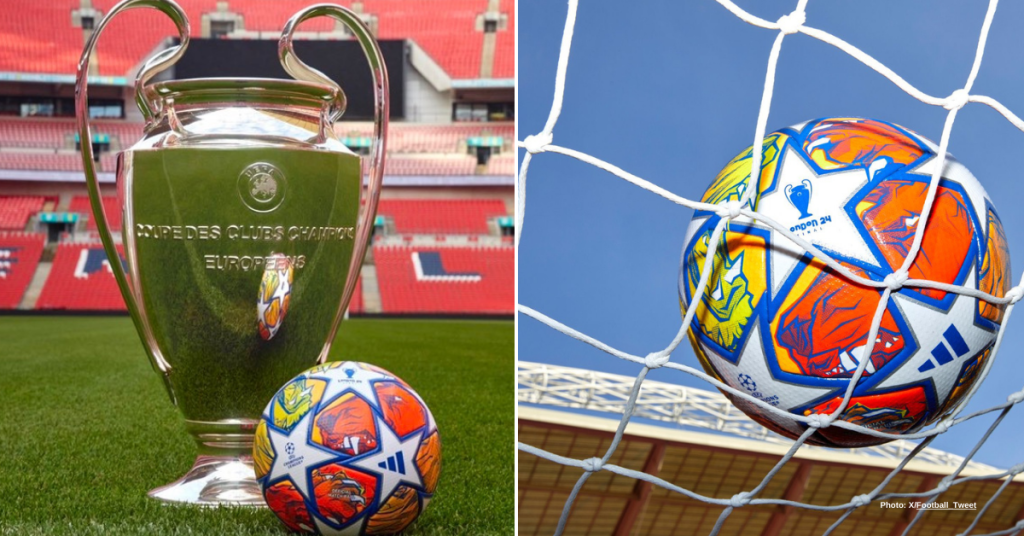
UEFA hasn’t revealed Nike’s new designs, so the supplier change doesn’t yet settle the future of the stars.
Two years after United’s comeback, Bayern Munich and Valencia played the 2001 final in Milan with the first Adidas starball used in a final. Adidas’s regular supply arrangement followed from the 2001/02 season.
🔴 Manchester United made history #OTD in 1999 🏆🏆🏆#UCL pic.twitter.com/rigKUScuVo
— UEFA Champions League (@ChampionsLeague) May 26, 2020
How a match ball became a Champions League signature
The idea of a physical starball predates Adidas’s supply deal. When the Champions League logo was presented in 1992, a matching football was already under discussion. Adidas eventually put the competition’s emblem on the ball itself.
Its reach soon extended beyond the participating clubs. Ahead of the 2002 final in Glasgow, Adidas said sales of the Finale had passed 250,000. The company also reported strong demand in countries that had never had a team in the Champions League. A replica ball offered a piece of the tournament without requiring allegiance to a particular club.
The design also survived changes to the equipment beneath it. Early versions were hand-stitched. The 2004 final ball used thermal bonding, and the 2006 edition introduced a 14-panel construction. The familiar graphics outlasted changes to the way the ball was made.
By 2021, Adidas was using the ball’s own past as design material. Its 20th-anniversary edition brought together graphics from earlier final balls, adding the years and host cities. The product had become a record of previous editions of itself, with each design tied to a particular final.
20 years of history.
— adidas Football (@adidasfootball) February 15, 2021
Introducing the new official @ChampionsLeague match ball, celebrating 20 years of the iconic starball design.
Available tomorrow from https://t.co/FblJVIGgpI#UCL pic.twitter.com/6iRp0x7Y7f
For the 25th anniversary in January 2026, Adidas went back to the original Finale 1 graphics and added an effect that shifts from black to purple as the viewing angle changes. The ball was designated for league-phase matchdays seven and eight. Its campaign brought Zidane, Messi and Toni Kroos together with younger players including Jude Bellingham, using the same object to connect their different eras.
Nike’s return arrives amid other changes in where football brands appear. Puma became the Premier League’s ball supplier in 2025/26, ending Nike’s 25-year run. Nike is now preparing to supply the three main European men’s club tournaments, creating a different route into the game’s weekly broadcasts.
Germany’s switch from Adidas to Nike begins on January 1, 2027, under a DFB agreement running through 2034. A national team shirt and a competition ball are different products, but both changes place Nike inside football imagery long associated with Adidas.
The UEFA contract was arranged through UC3, the commercial joint venture between UEFA and European Football Clubs, working with Relevent Football Partners.
Adidas also makes the 2026/27 Women’s Champions League ball. That competition wasn’t included in the Nike announcement.
For Nike, a ball contract puts the product into matches involving clubs it doesn’t dress and players it doesn’t sponsor. A boot endorsement follows an individual; a kit agreement follows a team. Both sides play with the match ball.
Nike once shared the frame with United’s Umbro shirts. From 2027/28, it won’t need to supply a club’s kit or sponsor its scorer to appear in the Champions League’s next famous goal. It will make the ball.
Get more Stadio United on Google.