
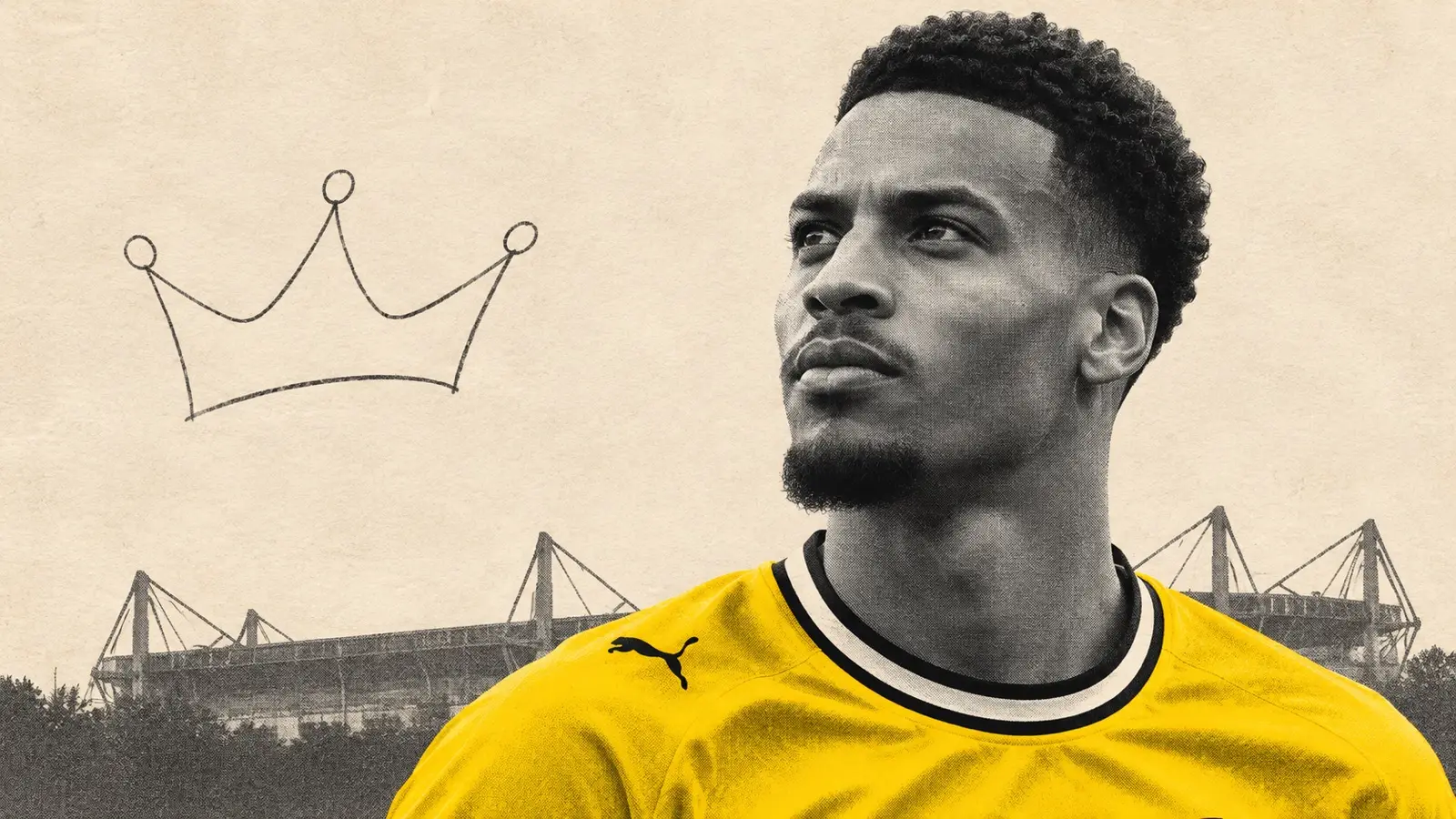
Felix Nmecha took off an imaginary crown after scoring for Borussia Dortmund. His club now reportedly wants him to leave the gesture out of his next celebration.
The gesture, which he also performed after his World Cup goal against Curaçao, involves kneeling and placing the crown on the grass. It appeared again as he scored both goals in Dortmund’s 2-1 win over Elversberg, turning a match-winning performance into another argument over the religious campaign associated with his celebration.
Felix Nmecha finds the back of the net for Borussia Dortmund against Elversberg in the Bundesliga and celebrates by laying down his crown for the King of Kings! pic.twitter.com/w0t90enFF5
— Ballers In God (@BallersinGod) November 7, 2026
Club president Hans-Joachim Watzke told a meeting of Dortmund’s fan department that Nmecha should stop the gesture, according to WDR and Sky. Dortmund also wants Ballers in God, the Christian football network associated with it, to stop promoting current BVB players. Sky reports that legal action could be considered if the network continues.
Nmecha hasn’t publicly agreed to stop. He has asked for time to consider the club’s request, according to joint reporting by Sky and RTL/ntv.
The club’s Fan- und Förderabteilung, its fan and support department, has challenged the network’s connections to messages about sexuality and personal choices that it considers discriminatory. Its statement expressly supports public religious expression. The objection concerns footballers’ enormous reach being used to draw people toward teachings that exclude others, particularly when those players represent a club that promises belonging to everyone.
What Ballers in God has to do with the celebration
Ballers in God was founded in 2015 by former professional footballer John Bostock, whom Nmecha has described as a mentor. The group presents itself as a community led by players, supporting professionals and their partners through prayer, small groups and online gatherings. Its public channels also circulate players’ expressions of faith.
The King’s Return gives those expressions a shared symbol. The campaign’s website describes Christian footballers laying down their crowns during the 2026 World Cup to point people toward Jesus. Nmecha posted his own World Cup celebration with the campaign’s hashtag, according to an investigation by the German public broadcaster ARD.
That investigation, conducted by MONITOR and Sportschau, followed the campaign beyond the images on the pitch. Reporters found that its website linked visitors to a counseling chat operated by Groundwire, a separate American evangelistic organization. They entered conversations under assumed identities and examined a library of sample chats.
A reporter posing as a pregnant 17-year-old received a response describing abortion as “Satan’s plan.” In a sample conversation, a girl asking whether being lesbian was sinful was told that it was. The example also criticized her mother for accepting her sexuality. Those exchanges gave Dortmund’s supporters specific grounds for challenging the campaign’s connections.
Groundwire’s own published statement of faith restricts sexual relationships to marriage between “one man born male and one woman born female.”
The remarks in those conversations came from the counseling provider. They don’t establish that Nmecha personally endorses each position.
Nmecha’s response
Nmecha has explained the gesture in terms of his own faith. “My celebration is not intended to promote myself or any organization,” he wrote on Instagram. He said he was laying his crown before Jesus, whom he described as his hope and strength, and rejected any intention to encourage intolerance, discrimination or hatred.
Felix Nmecha hat sich nach der Kritik an seinem Torjubel bei Instagram öffentlich geäußert. Der Nationalspieler von Borussia Dortmund erklärte, seine Geste habe ausschließlich seinem christlichen Glauben gegolten und nicht der Unterstützung von Diskriminierung oder Hass.
— Sky Sport (@SkySportDE) November 10, 2026
Nmechas… pic.twitter.com/eQQy5msaJy
Ballers in God has also defended itself. In a public statement, it described The King’s Return as a movement originating with players, supported their freedom to express their beliefs and said it wanted to treat people who don’t share its faith with love and respect. The statement didn’t specifically answer the examples involving Groundwire or explain the campaign’s relationship with that service.
A familiar question for Dortmund
Dortmund has faced questions about Nmecha’s public beliefs before. His signing from Wolfsburg in 2023 drew objections over posts he’d shared on Instagram. One was a video from American commentator Matt Walsh mocking the father of a transgender child. Another, shared during Pride Month, connected the word “Pride” with the devil. Supporters questioned whether the transfer was compatible with the club’s values. Nmecha later said the Pride post was about humility and arrogance, and denied holding homophobic or transphobic beliefs.
The club defended him in its official signing announcement. Watzke and then-president Reinhold Lunow said their conversations had convinced them that he “does not hold any transphobic or homophobic beliefs.” They also relayed his assurance that he respected people regardless of religion or sexual orientation. Watzke has continued to speak positively about Nmecha’s personal conduct during the current dispute, according to WDR and Sky.
The issue has reached the national team, where Germany coach Jürgen Klopp and sporting director Rudi Völler have also spoken with Nmecha. The DFB’s position on whether he may keep the celebration is still unclear.
Klopp’s own words have appeared on Ballers in God’s channels. The DFB told Sky and RTL/ntv that he hadn’t known the organization was using clips of his comments about faith. Being featured by the network therefore needs to be distinguished from choosing to support its campaigns, even as Nmecha’s own hashtag provides a more direct connection.
Dortmund’s fan department has told queer members that their place at the club isn’t up for debate. The club now has to make that assurance hold alongside its respect for Nmecha’s faith, including when both are represented by the same yellow shirt.
Get more Stadio United on Google.