Messi and Cristiano Ronaldo make the attack. Buffon, Busquets and John Terry make the argument. Our greatest XI of the 21st century gives its forwards two adventurous fullbacks and a midfield built to escape pressure. Keeping that much ambition together requires a few compromises.
Philipp Lahm and Virgil van Dijk finished above Dani Alves and Terry in our ranking of the century’s greatest defenders. They still miss this team. An individual ranking rewards the whole player; selecting an XI also means choosing partnerships, responsibilities and the risks we’re willing to accept.
Only performances from 2001 onward count. We’re weighing peak ability, sustained excellence and contributions for club and country, then selecting each player at his best within that period. Medals strengthen a case, but the role has to fit. Greatness before 2001 doesn’t earn anyone a place here.
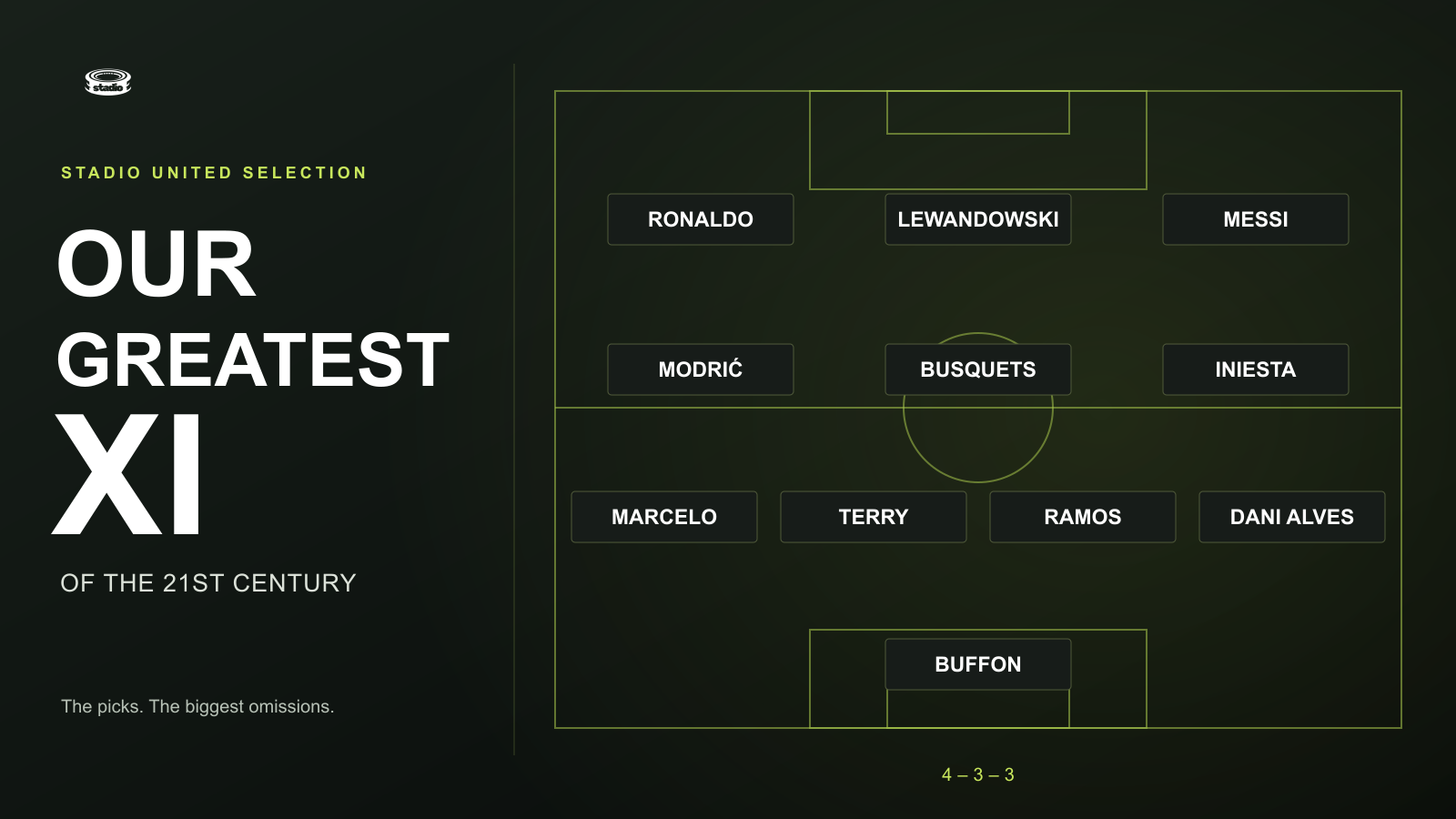
The shape is a 4-3-3: Buffon; Alves, Sergio Ramos, Terry, Marcelo; Sergio Busquets, Luka Modrić, Andrés Iniesta; Lionel Messi, Robert Lewandowski, Cristiano Ronaldo. One fullback must hold when the other attacks. Busquets needs teammates close enough to help when possession turns over. Allowing both sides to empty at once would leave the midfield solving a problem the selection created.
The partnerships that decide the places
Gianluigi Buffon gives that back line a goalkeeper whose positioning often makes the first save look straightforward. His handling and command of the area suit a team that can defend deeper when necessary. Italy’s 2006 World Cup winner and the tournament’s outstanding goalkeeper earns our choice for that authority, sustained across different generations. The save from Zidane’s header in the final shows the explosive response still available when positioning alone isn’t enough.
Dani Alves takes the right side because Messi’s movement invites a partner to fill the space outside him. Alves could overlap, exchange quick passes or arrive inside the box himself. His three Champions League titles during his first Barcelona spell support the pedigree. The established understanding with Messi settles our choice.
Sergio Ramos supplies the aggression to step out and confront an attacker before he reaches the box. His equalizer in the 2014 Champions League final also shows the attacking value of his aerial timing. That willingness to intervene can expose space behind him. Terry’s reading of danger helps balance the partnership.
John Terry earns his place through the work closest to goal: judging a cross, blocking a shot and keeping the line organized. Chelsea conceded 15 league goals in 2004/05, a collective achievement shared with Petr Čech, Ricardo Carvalho and Claude Makélélé. We want Terry’s anticipation without asking him to patrol half a field alone. His passing also gives the defense a calm way to find Busquets before reaching for a longer clearance.
Marcelo gives the left side another player who can create an opening from a crowded touchline. He can draw a defender toward the ball while Ronaldo moves into scoring positions. Five European Cups across 16 Madrid seasons establish his longevity. His best attacking combinations make the stronger case for this particular team.
Sergio Busquets is the pivot because receiving under pressure can be the start of an attack. A turn or a disguised pass can take opponents out of the move and leave the next player facing forward. Across 722 Barcelona appearances, he made that skill dependable. Modrić and Iniesta give him close passing options.
Luka Modrić brings a second escape route when opponents close those options. He can carry the ball beyond pressure and find a pass while the defense is still adjusting. His 2018 Ballon d’Or and World Cup Golden Ball reflect his range. Here, his movement helps connect a deep pivot with an ambitious front three.
Andrés Iniesta takes the other midfield place for what he does after receiving between opponents. He can protect the ball, change direction and advance into the space a defender has just vacated. Euro 2012’s Player of the Tournament gives this side someone who can turn a tight midfield exchange into a run at the back line.
Lionel Messi begins on the right with permission to come inside. Barcelona’s 672-goal scorer can finish the move or supply the pass that makes it possible. Alves keeps width available, Lewandowski occupies the center backs and Ronaldo threatens the far side. Messi would have several ways to punish a defender who steps toward him.
Robert Lewandowski gives the attack a fixed central reference without requiring everyone else to play through him. His movement inside the area rewards service from either wing. Fifteen goals in Bayern’s winning 2019/20 Champions League campaign, followed by 41 in the next Bundesliga season, support our choice of such a relentless penalty-area finisher.
Cristiano Ronaldo starts from the left and attacks the spaces Lewandowski’s presence helps create. His acceleration toward goal, leap and finishing make him the target for crosses as well as through balls. With 140 Champions League goals, he supplies the scoring weight to justify building that side of the team around his movement.
Xavi is the hardest midfield omission. Our greatest midfielders of all time selection reflects his stature. Put him beside Busquets and Iniesta and the passing relationships would need little introduction. We narrowly prefer Modrić’s carrying when control breaks down. Xavi could help prevent that disorder in the first place, which makes the choice close. It’s a preference for one kind of midfield flexibility, not a dismissal of the other.
Rodri offers more shooting power and physical presence than Busquets. Those qualities would help when opponents escape the initial pressure or defend deep enough to concede shots from distance. We favor Busquets’s longer body of work in the holding role and the way his passing can release the players ahead of him. Neither choice excuses leaving the pivot isolated.
Manuel Neuer would be our choice for a more aggressive defensive line. His willingness to leave the area and participate in possession changes where a team can defend. With Terry selected, Buffon’s strengths suit our willingness to retreat. Van Dijk’s recovery speed would ease the burden behind the fullbacks and permit a different approach. Changing the goalkeeper or a center back could alter the entire team’s starting position.
Lahm would make the right side more restrained, while Ashley Cole offers stronger defensive balance on the left. Our choices depend on Alves’s understanding with Messi and Marcelo’s with Ronaldo producing enough to justify the extra cover they need. Paolo Maldini’s claim remains serious even with his pre-2001 achievements excluded. A less adventurous pair of fullbacks would make the team easier to protect.
Luis Suárez’s 40 league goals in 2015/16 make him a formidable alternative to Lewandowski. His improvisation and appetite for unsettling defenders could give this attack a different edge. Karim Benzema offers the strongest argument for changing the center-forward’s job altogether: drop toward the ball, connect the play and open lanes for Ronaldo. We choose Lewandowski to keep a constant scoring threat between the posts while Messi supplies the invention.
Thierry Henry would add another runner who could attack from the left, a role already occupied by Ronaldo. Zinedine Zidane and Ronaldinho bring extraordinary creativity, but fitting either means changing midfield duties or removing a forward. Our greatest XI of the 21st century leaves brilliance outside the team because every place carries a job. The omissions show how easily a different idea of football could produce a different eleven.