
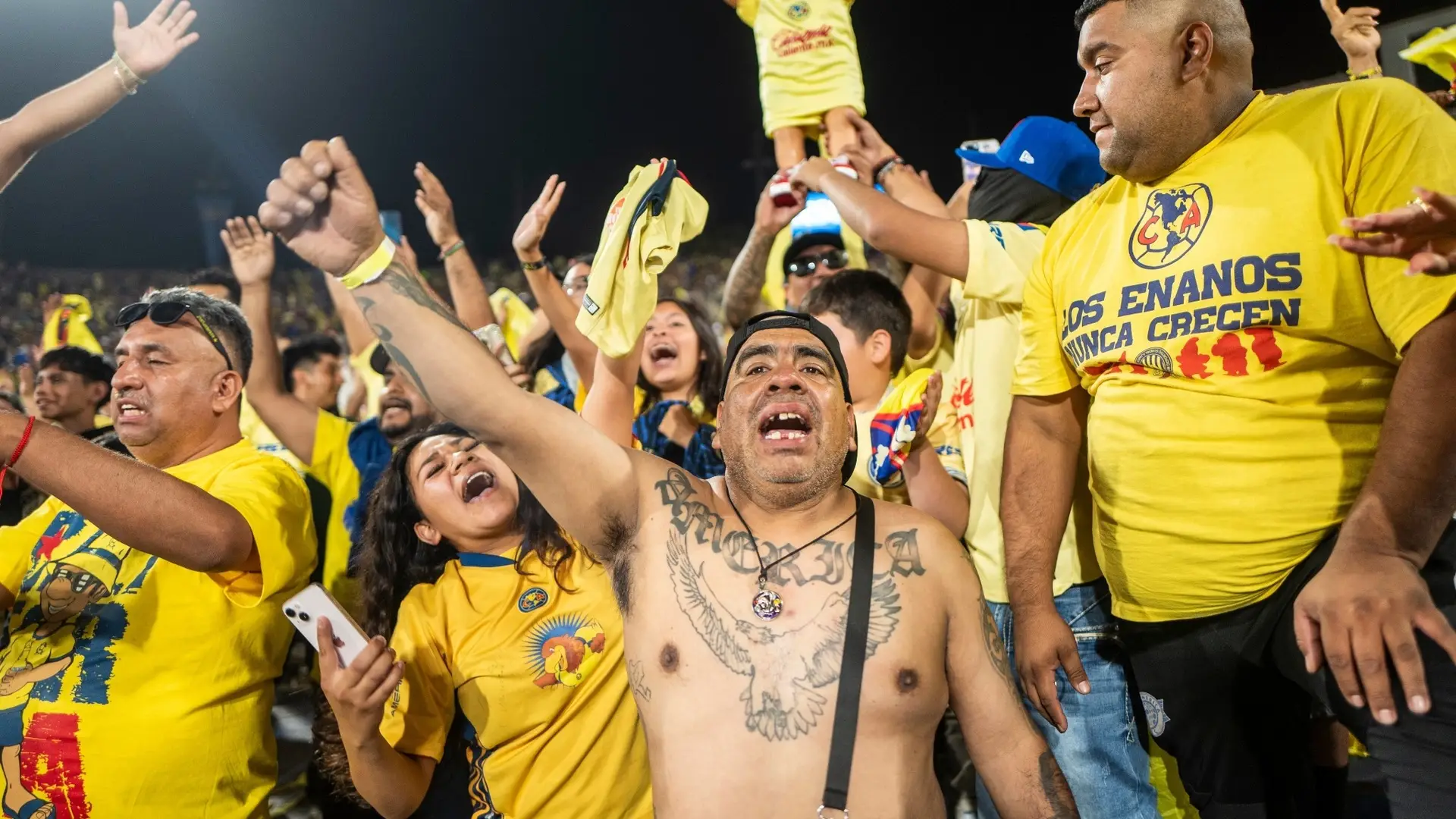
América vs. Chivas returns to Estadio Banorte on September 19, 2026, carrying a rivalry that began with Mexico City against Guadalajara and grew into a national argument about football identity. Geography supplied the first fault line. Decades of winning, television, recruitment and provocation turned it into something supporters could recognize far beyond either city.
The teams don’t share a home, yet their support crosses state lines, family lines and the U.S. border. The fixture now travels through neighborhoods where Hispanic supporters are reshaping American soccer culture. A 2023 edition at the Rose Bowl drew nearly 90,000 people. “Nacional” describes the reach of the rivalry as much as its status.
Chivas built the clearer creed. Guadalajara has preserved a squad tradition centered on players who are Mexican by birth, and the policy became inseparable from the Campeonísimo era, which produced eight league titles from 1957 through 1970. Its power wasn’t merely administrative. A club from Jalisco was winning with Mexican talent and binding regional pride to a larger idea of mexicanidad. The emotional pull behind Chicharito’s return to Chivas drew from the same promise of home.
América’s modern identity accelerated in 1959, when Emilio Azcárraga Milmo acquired the club through Telesistema Mexicano. The new ownership pursued foreign stars, sporting power and a national media platform. Telesistema later became part of Televisa, tying América to one of the country’s most powerful television empires for generations. The corporate line changed in 2024, when Club América moved into Ollamani after a Televisa spin-off. The cultural imprint outlived the old structure.
The hostility was already forming through league games and consecutive Copa México finals in 1954 and 1955, but 1959 supplied the scene everyone could remember. After América beat Guadalajara, Oro and Atlas by the same score, coach Fernando Marcos joked that Guadalajara’s long-distance number should be 2–0, 2–0, 2–0. Chivas answered on November 12 with a 2–1 victory at Ciudad Universitaria, the match both clubs place at the birth of the Clásico de Clásicos.
How the rivalry became national
The 1959 match didn’t invent the contrast. It made the contrast legible. Chivas offered Mexican-born continuity, Guadalajara pride and popular symbolism. América offered the capital, foreign stars, media reach and unapologetic scale. The old shorthand sometimes flattened the clubs into the people against the rich, but no rivalry maps neatly onto the lives of millions of supporters. The symbols endured because they were clear, portable and easy to inherit.
Television carried those stories across the country while results kept renewing them. América ended the Campeonísimo’s league hegemony in 1965–66. The clubs met in their only Liga final in 1983–84, and América won 5–3 on aggregate. Every generation inherited the argument, then added its own goals, villains and humiliations.
Each club also gave the other a useful role. Chivas could defend an idea of belonging that money couldn’t simply buy. América could present itself as the giant with the resources, stars and nerve to absorb everyone else’s hostility. One supplied a tradition to protect. The other supplied the perfect threat to it.
Modern football has complicated the old binaries. Chivas scout internationally while maintaining their Mexican-born rule. América no longer sits directly under Televisa. Both are sophisticated commercial institutions with cross-border audiences. Still, the red-and-white stripes and the yellow shirt make the argument visible before kickoff.
Chivas won the most recent league meeting 1–0 at Estadio Akron on February 14, 2026. The next edition arrives at Estadio Banorte on September 19. The table, coaches and players will change, but the fixture will return to the same collision between inheritance and ambition.
Mexico City and Guadalajara supplied the map. América and Chivas supplied the argument.