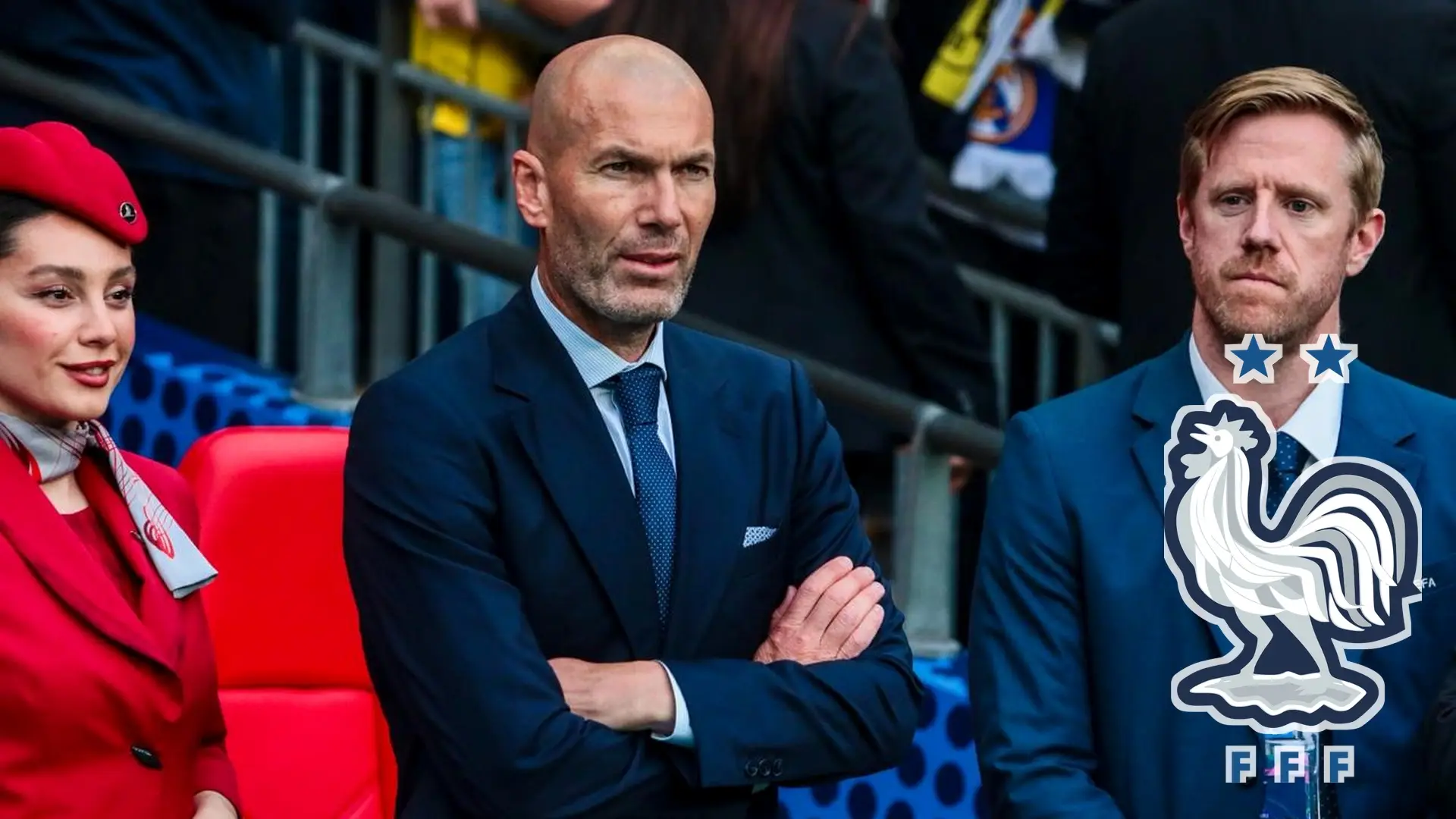
Zinédine Zidane is set to become France’s next head coach, with reporting in France placing the start of his contract on September 1. The agreement is expected to run for four years, through the 2030 World Cup cycle. The French Football Federation has not yet formally presented him, however, and president Philippe Diallo has said the successor to Didier Deschamps will be announced before the end of July. Until that announcement arrives, Zidane remains the reported incoming coach rather than an officially appointed one.
Deschamps left after France’s 6-4 defeat to England in the World Cup third-place playoff, his 185th and final match in charge. He won 120 of them during 14 years as France coach, delivering the 2018 World Cup and the 2021 Nations League while also reaching the finals of Euro 2016 and the 2022 World Cup. His 20 World Cup victories are the most recorded by a coach.
The succession carries an unusual historical symmetry. Deschamps captained France to its first world title in 1998, when Zidane scored twice in the final against Brazil. They also played together for Juventus and helped define the same French generation in sharply different ways. Deschamps supplied order and authority. Zidane became the team’s creative center. Nearly three decades later, one is preparing to inherit the national side from the other.
Zidane’s arrival has been anticipated since Deschamps confirmed in January 2025 that he would leave after the 2026 tournament. Federation officials kept the process away from the team’s World Cup campaign, while French reporting described an agreement taking shape behind the scenes. The timing was deliberate. Deschamps was allowed to complete his tenure without a formally installed successor waiting beside him.
Zidane returns to coaching with 11 trophies across two spells with Real Madrid, including three consecutive Champions League titles and two La Liga championships. He has not managed since leaving Madrid in 2021. France is therefore appointing a coach with proven authority over elite players, but one who has spent five years outside the daily tactical and physical demands of a team.
The team Zidane must build
Zidane’s Madrid sides were not tied to a single formation. He used a 4-3-3, a midfield diamond and two-forward structures according to the players and the opponent. His principles were more consistent than his shape. Possession had to move the team toward goal, the holding midfielder had to protect the players pressing ahead of him, and the fullbacks were expected to create width. He also limited the volume of tactical information passed to the squad, preferring clear individual instructions and a stable collective idea.
France’s World Cup showed the need for that balance. Deschamps kept four attackers against Spain in the semifinal, but France could not establish control and lost 2-0. Four days later, the defense conceded four first-half goals to England before a late recovery ended in a 6-4 defeat. France’s attack remained productive, yet its structure became vulnerable when matches moved away from its preferred rhythm.
The first major choice concerns Kylian Mbappé. Deschamps was already making Mbappé central by design, giving France direct access to its best scorer while asking other attackers to supply width and connection. Zidane could preserve that arrangement, return Mbappé to the left or use a fluid front line.
At Madrid, Cristiano Ronaldo’s freedom was supported by Karim Benzema’s movement and Casemiro’s defensive balance. France has no exact equivalent of that structure, although Michael Olise offers the kind of connective play that could keep Mbappé close to goal without isolating him.
The midfield decision follows from there. Aurélien Tchouaméni can protect the center, Eduardo Camavinga can carry and recover, and Warren Zaïre-Emery gives Zidane another mobile option for the next cycle. Olise, Désiré Doué and Rayan Cherki can create between the lines, but selecting several of them together would increase the defensive burden elsewhere. Zidane’s record suggests he will favor complementary roles over the simple accumulation of attacking talent.
His staff will help determine how quickly those ideas take hold. David Bettoni, his longtime assistant at Madrid, is expected to join him, and reports indicate Zidane wants a larger technical group than Deschamps used, including greater data-analysis support. The complete staff has not been confirmed. With the contracts reportedly beginning on September 1 and four Nations League matches following across late September and early October, the preparation window will be short.
Zidane is not inheriting the damaged national team Deschamps took over in 2012. He is receiving a deep squad accustomed to reaching the final stages of major tournaments. His assignment is narrower and more demanding. France must retain the defensive responsibility and tournament discipline built under Deschamps while finding a clearer way to control matches with the ball.
The symbolism of the appointment will be immediate. The quality of the transition will depend on decisions that are far less ceremonial.