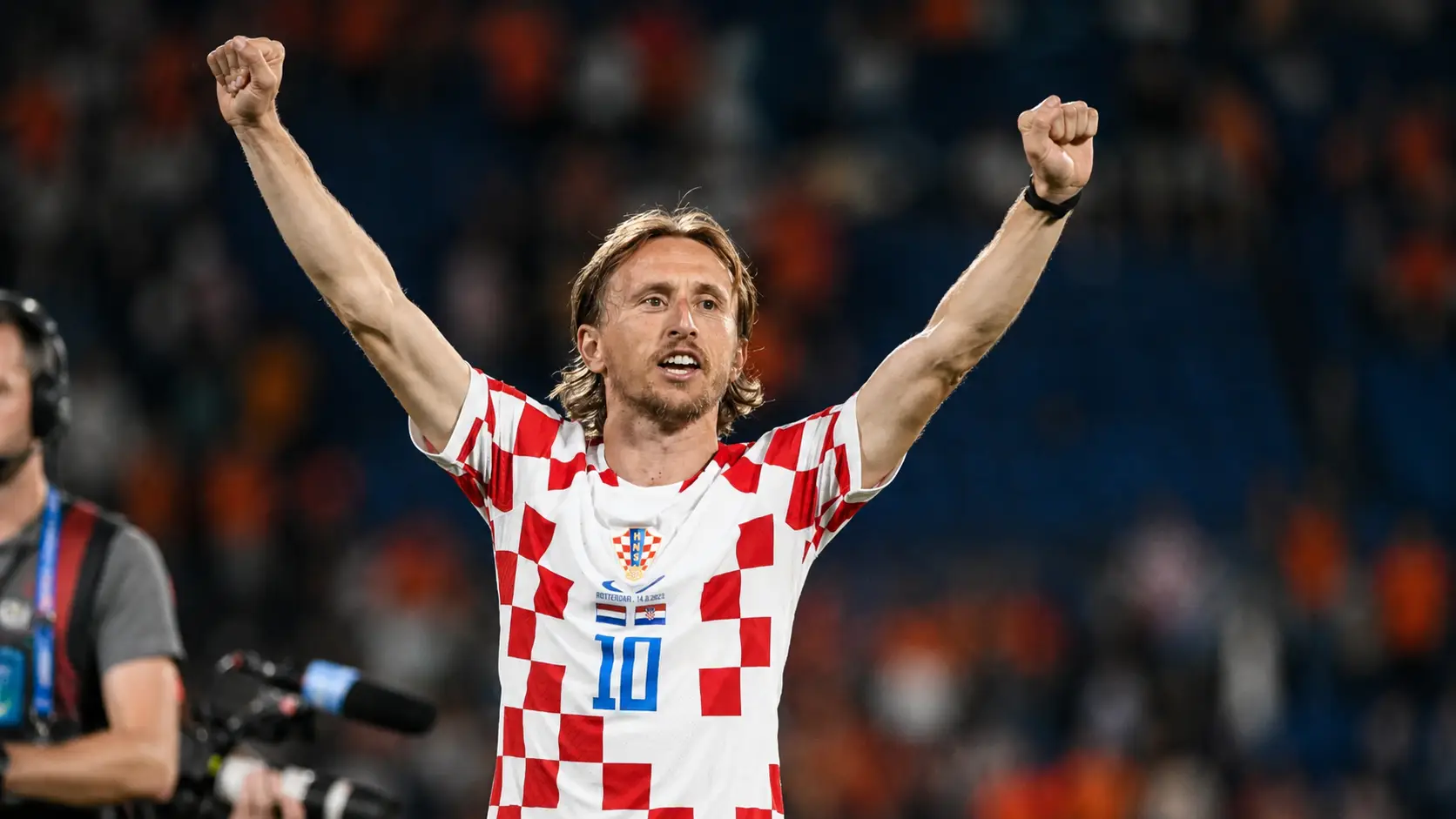
Luka Modrić is preparing for another World Cup in Croatia’s red-and-white checks, and the number alone tells much of the story.
Five World Cups. Twenty years between his first and the next one. A 40-year-old captain still being asked to organize the midfield for a country that has spent the past decade refusing to slide quietly into transition.
Zlatko Dalić named Croatia’s final 26-man squad for the 2026 World Cup, keeping Luka Modrić at the center of it. The midfielder is set to appear at the tournament for the fifth time, after playing in 2006, 2014, 2018 and 2022. If he takes the field in North America, he will do so in a Croatia team still shaped by the memory of its 2018 runner-up finish and its third-place campaign in 2022.
Modrić’s place in that arc is unusual because he’s still the central, albeit most veteran figure, of the squad. He arrives as a starter-level presence, a Milan midfielder, Croatia’s captain and the country’s record appearance maker. At 196 caps, he’s close enough to 200 for the number to follow him into every match preview, even if the more important question is how many minutes Croatia can still pull from his legs.
Croatia’s old rhythm enters one more tournament
There’s a temptation to reduce Modrić’s late-career value to endurance, but that misses how Croatia still uses him. He doesn’t need to outrun a midfield anymore. His game has long been built on receiving under pressure, turning out of narrow spaces and choosing when a match should speed up or slow down. Those habits helped define Real Madrid’s Champions League years. They now give Croatia a familiar structure while younger players settle around him.
Croatia’s squad reflects that handoff. Joško Gvardiol and Luka Vušković point toward the next defensive spine. Mateo Kovačić, Ivan Perišić and Andrej Kramarić remain part of the experienced core. The balance is not new under Dalić, who has been in charge since 2017, but it becomes more delicate when the player setting the tempo is entering a tournament after April cheekbone surgery.
Croatia qualified by topping its group with seven wins and one draw. The reward is a demanding Group L, with England first on June 17 in Arlington, Texas, followed by matches against Ghana and Panama. For a team built on control, patience and tournament memory, the opener will quickly test whether continuity can still function at World Cup speed.
The fifth World Cup is the headline. The harder part is what comes after the milestone. Modrić has already played the role of emerging talent, Ballon d’Or winner, national captain and late-career reference point. What remains is narrower and more difficult. He has to help Croatia compete in the present without turning the tournament into a tribute to the past.
Croatia isn’t bringing him to North America only to merely honor what he has done. It’s bringing him because, even at 40, the team still trusts him with the ball, the rhythm and the first decision after pressure arrives.