Get ready for an effortless matchday experience as Atlanta’s World Cup unfolds in a familiar piece of the city’s map: downtown streets that were rebuilt for one global event (the 1996 Olympics) and will be prepared to do it again for another. The match calendar is now defined. Atlanta is set to stage eight games, beginning in mid-June and culminating with a semifinal on July 15, 2026.
The schedule gives the city a clear rhythm. Five group-stage matches are slated for June 15, June 18, June 21, June 24, and June 27, followed by a Round of 32 match on July 1 and a Round of 16 match on July 7, before the semifinal. The times are posted as well, including a stretch of noon kickoffs early in the tournament and the semifinal in mid-afternoon.
For travelers, Atlanta’s advantage starts before anyone reaches the stadium gates. Airports Council International’s 2024 rankings again placed Hartsfield-Jackson Atlanta International at the top globally by total passengers, reporting 108.1 million passengers in 2024. The local host committee also frames the airport as a central access point for this tournament, emphasizing the city’s nonstop connectivity.
From the airport, the core of Atlanta’s World Cup footprint is reachable on MARTA rail. The host committee says downtown is about 20 minutes away via MARTA, and local visitor guidance similarly describes the airport-to-downtown train trip as a sub–30-minute ride.
Downtown will also be where Atlanta’s official fan centerpiece sits. Centennial Olympic Park has been named the site of the FIFA Fan Festival in Atlanta, with the city and the Georgia World Congress Center Authority set to collaborate on operations. The host committee says the festival will be open for 20 days, including matchdays and the day before each match.
How Atlanta will work on matchday
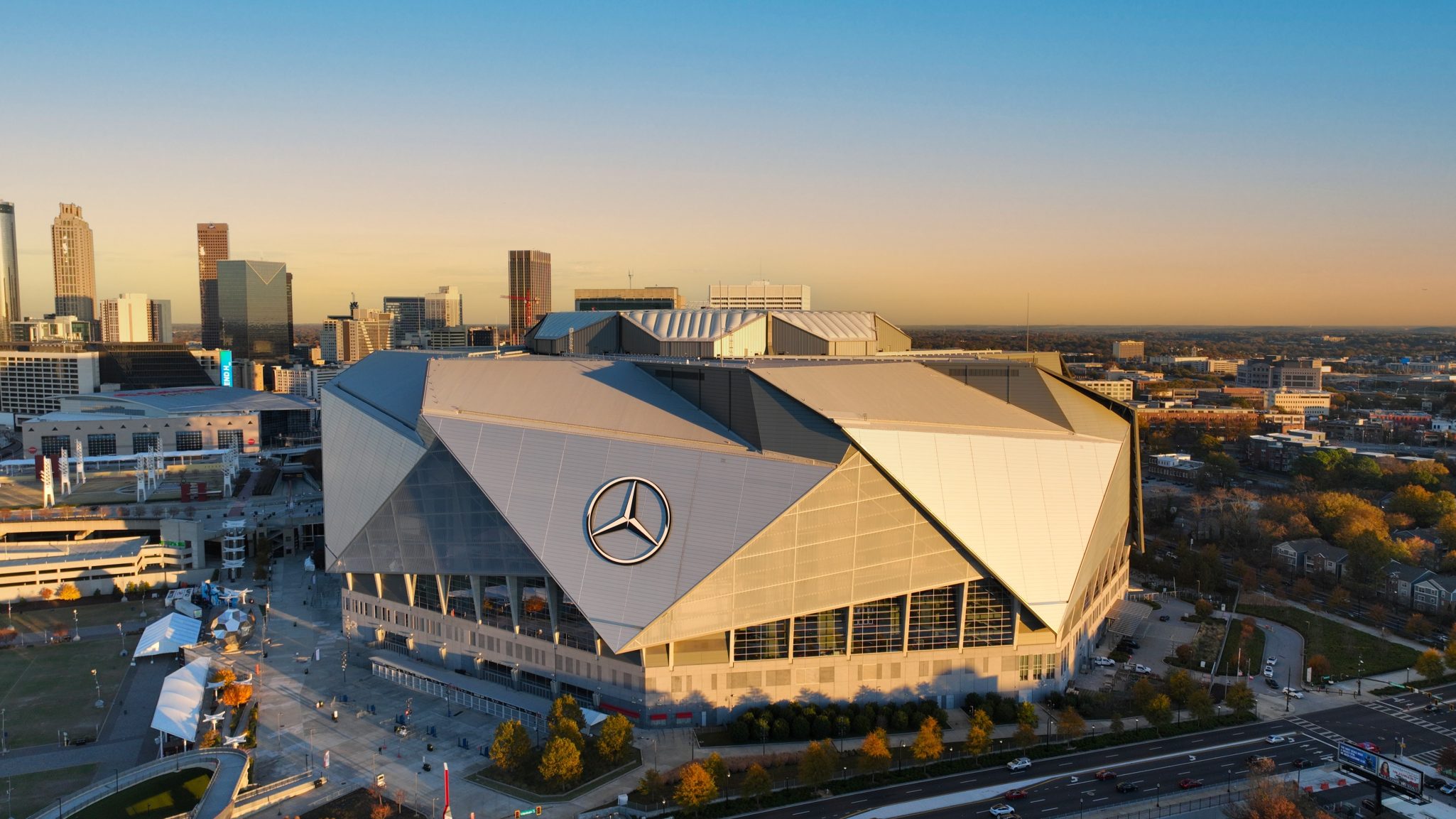
Mercedes-Benz Stadium, which FIFA materials refer to as “Atlanta Stadium,” is the anchor. The host committee describes the venue as opening in 2017, located in downtown, home to the NFL’s Falcons and MLS’s Atlanta United, and capable of accommodating more than 75,000 spectators. Atlanta’s match list, including the semifinal, is built around that capacity and that central location.
The stadium’s résumé matters because it hints at how Atlanta will manage scale. The host committee notes the building has hosted events including Super Bowl LIII, the College Football Playoff National Championship Game (2018 and 2025), and major international soccer dates. Separately, the stadium itself has highlighted sustainability credentials that are unusual for a modern arena: a Mercedes-Benz Stadium release says the venue achieved LEED Platinum in 2017 and received TRUE Platinum certification for zero waste efforts in 2023, with the release also citing a 75,000-seat capacity.
The stadium’s immediate transit geometry is straightforward, even if the wider region isn’t. Two MARTA rail stations sit closest. MARTA’s station page notes that the former Dome/GWCC/CNN Center station has been renamed the Sports, Entertainment and Convention District Station, shortened to SEC District Station, and it explicitly points riders there for Mercedes-Benz Stadium, State Farm Arena, the Georgia World Congress Center, and Centennial Olympic Park. It is on the Blue and Green lines, and MARTA notes there is no parking and no bus service at the station.
The second nearby stop is Vine City. MARTA’s Vine City page notes the station is on the Blue and Green lines and that the stadium and Georgia World Congress Center are connected via a pedestrian bridge over Northside Drive. That bridge link becomes more than a convenience on the largest event days, when walking routes can function as crowd-control tools as much as they do as shortcuts.
Mercedes-Benz Stadium’s own transportation guidance reinforces the same two-station logic and gives it a preference order: it calls SEC District Station the preferred stop and notes Vine City as a nearby alternative, including language about using Vine City for “expedited departure” in cases of extended rideshare waits. The stadium page also lists MARTA’s one-way fare as $2.50.
The bigger transit story, though, is not just where to exit. It is what visitors will use to pay. MARTA says it is transitioning to a new fare collection system called “better Breeze,” with open payment that allows riders to tap a bank card or mobile wallet at gates or validators. MARTA also states that current Breeze cards are not compatible with the new system and that new cards and a new app are part of the transition, with fares remaining unchanged at $2.50 for a one-way trip. For a June and July 2026 tournament, that timing is relevant because MARTA positions the new system as especially convenient for international visitors during the World Cup.
Where to stay in Atlanta depends on what you want to repeat every matchday: a walk, a train ride, or a car trip. The host committee points visitors toward downtown hotels near the stadium, Midtown options, Buckhead properties, and lodging near Ponce City Market. MARTA connects the airport to downtown, Midtown, and Buckhead, so the most reliable matchday plan is usually the one that stays close to the rail spine.
Centennial Olympic Park sits within the same downtown cluster of venues and attractions, which limits cross-city travel on days when the city will already be strained. The Fan Festival announcement notes the park welcomed the world during the 1996 Summer Olympics, and the 2026 festival returns there 30 years later.
The Georgia World Congress Center Authority calls the Fountain of Rings the park’s iconic centerpiece and says it features water jets that rise over 15 feet. The authority also posts specific showtimes, which can help visitors plan a non-match day in a tournament window that spans a month.
Outside downtown, Atlanta’s World Cup experience will still be shaped by corridors that locals use year-round. The host committee points to the Atlanta BeltLine and Ponce City Market as east-of-stadium destinations for dining and nightlife. The BeltLine’s own visitor-facing description frames it as a 22-mile loop of trails and parks connecting dozens of neighborhoods, with restaurants, breweries, and arts activity along the way. Ponce City Market operates as one of the most recognizable access points to that Eastside Trail zone.
A second kind of corridor, less about leisure and more about history, sits on Auburn Avenue. Martin Luther King Jr.’s National Historic Site, administered by the National Park Service, is anchored by a visitor address on Auburn Avenue in Atlanta. It is a reminder that for visitors building a World Cup trip that includes more than match tickets, Atlanta offers an itinerary that can move from sports infrastructure to civil rights history without needing to leave the city limits.
The open question for most host cities right now is not whether people will watch matches together, but what is officially sanctioned and how it is managed. Atlanta has one confirmed answer, the FIFA Fan Festival at Centennial Olympic Park. The Atlanta host committee says anyone can apply for a public viewing license and directs questions to FIFA via publicviewing@fifa.org. FIFA also maintains a public viewing information page describing its public viewing program as part of tournament organization. Atlanta has not yet published a definitive citywide calendar of additional sanctioned sites, partner activations, or neighborhood-scale official programming.
Matchday logistics will also be shaped by two predictable Atlanta variables: heat and entry rules. The National Weather Service office serving north and central Georgia says summers in north Georgia typically bring long spells of warm and humid weather, with average afternoon highs in the upper 80s to around 90°F and thunder heard on 50 to 60 days in a typical year. The Georgia Department of Public Health’s heat guidance emphasizes reducing risk by spending time in air conditioning and balancing outdoor activity with cooler breaks.
Inside the stadium perimeter, the rules become even more concrete. Mercedes-Benz Stadium’s posted bag policy recommends not bringing a bag at all and allows only clear bags up to 12 by 6 by 12 inches, or small non-clear clutches up to 4.5 by 6.5 inches, plus a one-gallon clear plastic freezer bag. Those details can decide whether a fan reaches their seat before kickoff.
What makes Atlanta distinctive on the World Cup stage is not a single landmark, but a stack of infrastructure choices that align unusually well with the tournament’s needs: a stadium built for large-scale events, a downtown park selected for the official Fan Festival, a rail line from the airport into the core, and a transit payment overhaul that MARTA explicitly frames as helpful for international visitors in 2026.
Atlanta also has a proven soccer baseline. MLS reported in 2018 that Atlanta United set a league record for total home attendance, 901,033 across 17 games, and an average of 53,002. Those numbers show that Atlanta has already operated at crowds that resemble international-event scale in the same building that will host the World Cup’s deepest round in the city.
Atlanta’s World Cup plan is already visible in the places that matter most: the match dates, the stadium, the downtown fan zone, and the transit routes that connect them. The details still to come, especially the daily Fan Festival schedule and any additional sanctioned viewing sites, will shape the final visitor experience. But the basic map is now clear enough for travelers to start planning with confidence.