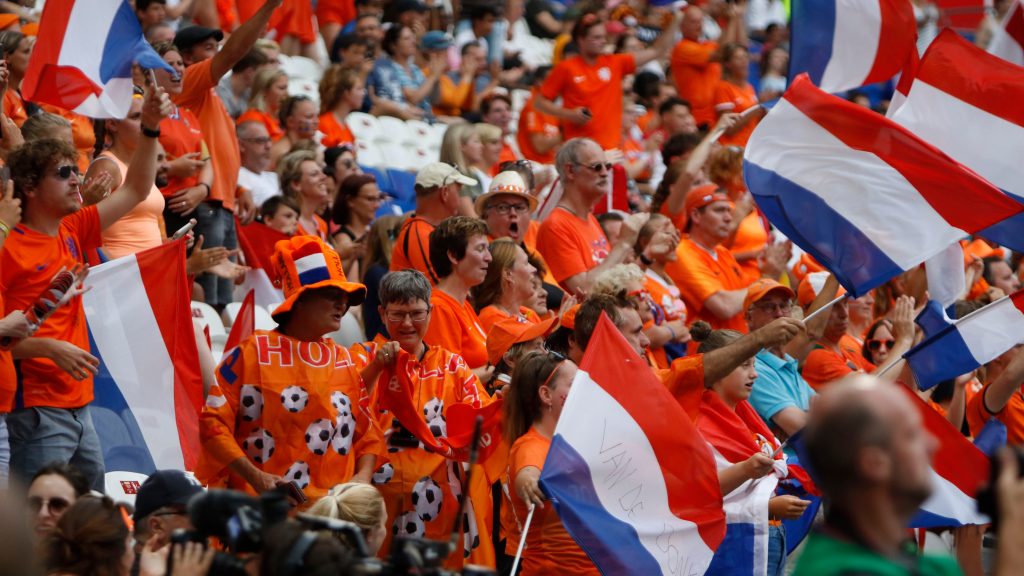
Orange isn’t one of the Netherlands’ flag colors, and yet it’s the first thing most people associate with the country’s national team. The nickname “Oranje” is simply the Dutch word for orange, but in this context it’s shorthand for a deeper national symbol tied to the House of Orange-Nassau, the royal line that has shaped Dutch national identity for centuries.
That symbolism matters because it explains why the Netherlands feels like more than a team you stumble onto during a tournament. The color is part branding and part national marker, and it’s one of the few elements in international soccer that stays instantly recognizable across generations, coaches, and playing styles.
The Netherlands is also one of the sport’s most influential exporting nations, even when the record book doesn’t give them the headline that usually follows influence. “Total football,” the tactical idea most associated with Rinus Michels and the 1970s Dutch era, made the Netherlands synonymous with intelligence, movement, and players who can solve problems outside their job description.
The results have been close enough to touch and painful enough to linger. The Netherlands has reached three World Cup finals, in 1974, 1978, and 2010, and lost them all. The country’s defining men’s trophy remains Euro 1988, which means every strong Dutch cycle ends up carrying two storylines at once: what the team is, and what it still hasn’t done.
That’s what makes 2026 a useful moment to plan around instead of waiting for the first whistle. FIFA has scheduled the tournament for June 11 through July 19, and it’s the first men’s World Cup with 48 teams, structured so that 12 groups feed 32 teams into the knockout rounds. The Netherlands arrives qualified, having secured its place with a 4-0 win over Lithuania that completed an unbeaten qualifying group campaign, reported as 20 points and first place.
A practical Netherlands plan for June and July 2026
The simplest way to follow the Netherlands starts with the draw, because it determines everything else. The Netherlands landed in Group F with Japan, Tunisia, and a UEFA Playoff B winner that FIFA lists as a placeholder until that path is decided. If you’re planning ahead, that last slot is the only part of the group-stage picture that remains unsettled.
The locations, though, are set, and they form a followable route through the middle of the United States. The Netherlands is scheduled to open against Japan on June 14 in the Dallas area, listed as Dallas Stadium in Arlington, Texas. Their second match is set for June 20 in Houston at NRG Stadium against the eventual UEFA Playoff B winner. The group closes on June 25 in Kansas City, where FIFA’s host-city materials list Tunisia vs. Netherlands at Kansas City Stadium.
That three-city sequence shapes how you should think about the tournament, even if you never buy a ticket. These are major markets with established event infrastructure, and they come with official public gathering points that can anchor a matchday when you want something reliable. Dallas’ host planning places the FIFA Fan Festival at Fair Park. Houston’s local organizing committee has said its FIFA Fan Festival will be in East Downtown, commonly shortened to EaDo. Kansas City’s local planning identifies its FIFA Fan Festival at the National WWI Museum and Memorial.
In other words, the best “default setting” for matchday in each city has already been named. If you’re traveling, those sites can act like a compass: they tell you where the organizers expect crowds, broadcasts, and programming to concentrate. If you’re local, they offer a way to build a day around the match without turning it into a scavenger hunt.
The home-viewing plan in the United States is also unusually straightforward for a tournament still months away. FOX has said it will carry all 104 matches live across FOX and FS1, with streaming on its platforms. Telemundo has described Spanish-language coverage carrying all 104 matches live, with streaming on Peacock and the Telemundo app. That means you can decide now how you’ll watch, then spend the tournament focusing on the soccer instead of the logistics.
To keep up with the Netherlands between matches, it helps to separate tournament information from team information. FIFA’s pages are where the official schedule, standings, and opponent resolution live. For the Netherlands’ camp news, training coverage, and federation updates, the official KNVB ecosystem runs through OnsOranje, including its primary hub site and its main social channels on Instagram, X, and YouTube. If you want one place to check daily, start there.
Ticketing is the one area where it’s worth being cautious early, not because the process is mysterious, but because it’s the part most likely to attract confusion and bad information. FIFA’s ticket portal and ticketing updates outline how purchases and sales phases work, including phases that can involve random selection draws. When your goal is to follow a team across a tournament, that official pipeline is the only one that won’t shift beneath you.
Once the structure is set, the next question becomes familiar: who actually makes this team go. The cleanest way to talk about key players without pretending to forecast the tournament is to start with what directly decided qualification. In the match that clinched the spot, Reuters reported goals from Tijjani Reijnders, Cody Gakpo, Xavi Simons, and Donyell Malen. That list tells you a lot about the current Dutch profile: midfielders who can arrive in dangerous spaces, wide attackers who don’t need many touches to create a chance, and forwards who can turn a game in a short burst.
Then there are the names that define shape and pressure. Virgil van Dijk has been described in qualifying coverage as captain, and he remains the organizing presence in the back line, the kind of player whose value shows up when a game gets tense or chaotic. Frenkie de Jong is a different kind of anchor, less about a single decisive action and more about controlling tempo and connecting the team’s phases so they don’t fragment.
You don’t need a tactical manual to watch the Netherlands well, but you do need a basic expectation. This team’s reputation will always pull your attention toward style, because that’s how Dutch soccer has been framed for decades. At the same time, modern Dutch cycles have also been willing to adjust to opponents and circumstances. It’s a useful mindset for a World Cup: look for the moments where they choose control over risk, and the moments where they decide the match needs speed and directness instead.
“Matchday culture” is where follow guides often wander into invented atmosphere, so here the safest approach is to stick to documented examples. The KNVB has described supporter-facing tournament concepts that include organized public-event formats such as Oranjepleinen and Oranjeparades, alongside federation-run fanzones and activities. That’s a reminder that Dutch tournament life is not only spontaneous, it is also deliberately organized.
There are also reported snapshots of how Dutch tournament traditions show up away from stadium gates. The Associated Press has written about a residential street in The Hague that has been decorated in orange for major tournaments, tying the tradition back to 1988 and describing the volunteer effort behind it. The Guardian has reported on a long-running tradition involving a bright orange double-decker bus used to lead fan parades at European Championships, noting that it has been endorsed by the Dutch football association. Those examples don’t claim to represent every Dutch supporter’s routine. They do show how visible the team’s national symbols can become when a tournament is underway.
Rivalries are best treated as context, not fuel. Belgium is the obvious neighbor reference, and the long history between the federations is rooted in the Netherlands’ first official international match in 1905, played against Belgium. Germany sits in the Dutch football memory because it intersects with the 1974 final era that shaped the Netherlands’ global reputation. Argentina is the modern World Cup counterpart, tied to multiple tournament meetings across decades, including the 1978 final that remains one of the defining moments in Dutch World Cup history.
Put all of that together and the follow plan becomes clear without needing hype. Start with the group schedule and the three host cities. Set your broadcast route now, so matchdays stay simple. Use FIFA for the official competition spine and OnsOranje for team-specific updates. If you’re traveling, treat the official fan festival sites as your matchday anchors. Then, when the games start, you’ll be watching with context instead of catching up in real time, and that’s the difference between casually tuning in and genuinely following a team through a World Cup.