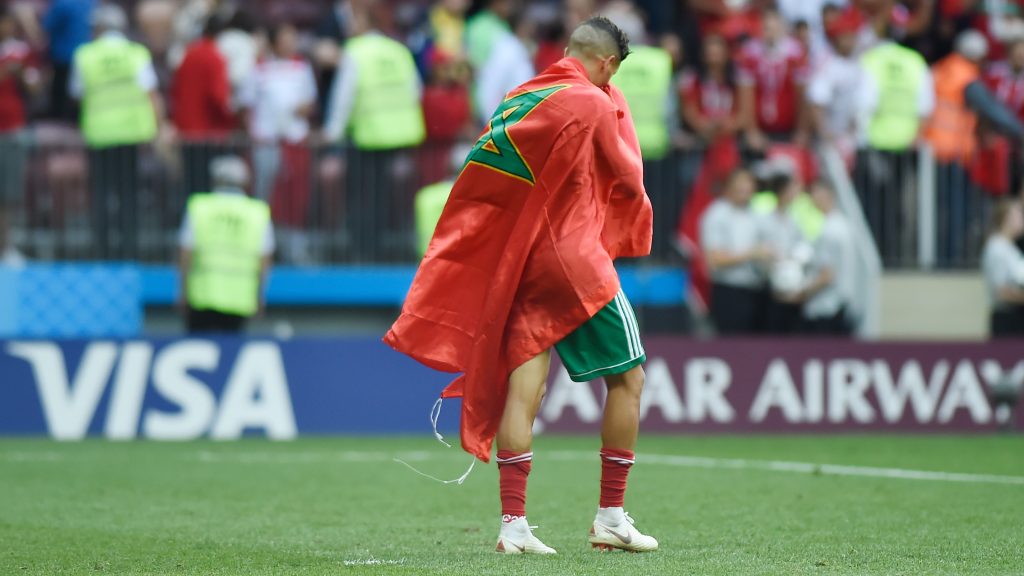
Morocco enter the 2026 World Cup in an unusual position. They are too accomplished to be treated as a surprise, yet they still sit outside the small group of teams broadly viewed as favorites. That is what gives the dark-horse label real weight in their case. A recent odds board listed Morocco at 60-1 to win the tournament, while the latest world rankings place them eighth. Those markers suggest a team with real pedigree, but not one fully trusted to go all the way.
This is not an argument built on memory alone. Morocco were the first African nation to qualify for the 2026 World Cup, doing so with a 5-0 win over Niger in September 2025. They reached the tournament with six straight qualifying wins and a perfect 18 points from six matches. That matters because it suggests the run to the 2022 semifinal was not a brief spike followed by decline. Morocco have remained strong enough for this cycle to be judged on its own merits.
Their recent record in tournament football supports that idea. Morocco reached the Africa Cup of Nations final and were later awarded the title after CAF’s Appeal Board ruled that Senegal had forfeited the match by walking off during the final. It was an unusual ending to a major tournament, but it still added another significant result to a team that has spent the last few years building one of the strongest résumés outside the traditional elite.
At their best, Morocco still look like the side that made life difficult for major opponents in Qatar. They are organized without the ball, hard to stretch, and capable of turning a match into something far more controlled than an opponent might want. The spine of the team remains persuasive. Yassine Bounou is one of the most dependable goalkeepers in international football, while Achraf Hakimi gives Morocco a player who can change the rhythm of a game from the back or the flank.
There is also enough technical quality around that core to make Morocco more than a defensive story. Azzedine Ounahi, Bilal El Khannouss, Ismael Saibari, and Brahim Diaz give them options between midfield and attack, and that matters because Morocco are no longer built to survive only one kind of match. They can defend deep if needed, but they have also shown they can press, carry play, and attack with purpose. That range is part of what makes them hard to measure cleanly. They do not look like a conventional outsider.
A contender with real complications
The strength of the player pool is matched by a development pipeline that has become difficult to ignore. Morocco’s U-20 side won the World Cup in 2025. Their U-23 side won the Africa Cup of Nations and later claimed Olympic bronze in Paris. That does not guarantee senior success, but it does suggest the federation has created something more stable than a single strong generation. At an expanded 48-team World Cup, where the strain of the tournament can expose a lack of depth, that matters.
The complication is timing. Walid Regragui stepped down on March 5, 2026, just over three months before the World Cup, despite leaving behind a strong overall record. He said the moment required a “new vision” and “different energy.” Whatever the reasoning, a coaching change that close to the tournament introduces uncertainty for any team, especially one whose progress had been built on collective clarity and discipline.
Mohamed Ouahbi’s first matches offered signs of continuity rather than upheaval. Morocco drew 1-1 with Ecuador and then beat Paraguay 2-1 four days later. The shape and general structure remained familiar, which was probably the most sensible short-term choice. Still, continuity is not the same as certainty. Morocco enter the World Cup with some unresolved questions in central defense, where selection and chemistry are still being tested, and with a new coach who has not yet had to manage this group under the pressure of a major tournament.
Their group gives them a realistic path, but not a comfortable one. Morocco are in Group C with Brazil, Scotland, and Haiti. Brazil are the obvious heavyweight. Haiti, on paper, are the match Morocco must win. That leaves Scotland as the likely pivot point in the group. In the 48-team format, the top two teams advance along with the eight best third-place finishers, so Morocco do not need a perfect first round. They need enough control, discipline, and attacking sharpness to make that middle match work in their favor.
That is why Morocco still make sense as a dark horse, and a credible one. They are not being discussed this way because of nostalgia for 2022. They have recent World Cup pedigree, one of the best full-backs in the tournament, a proven goalkeeper, a deepening youth system, and a squad with more flexibility than most teams outside the favorites. The hesitation is also real. A late managerial change, some uncertainty in defense, and the burden of proving that this cycle can be as coherent as the last one keep them just outside the first rank of contenders. That tension is exactly what defines a serious dark horse.