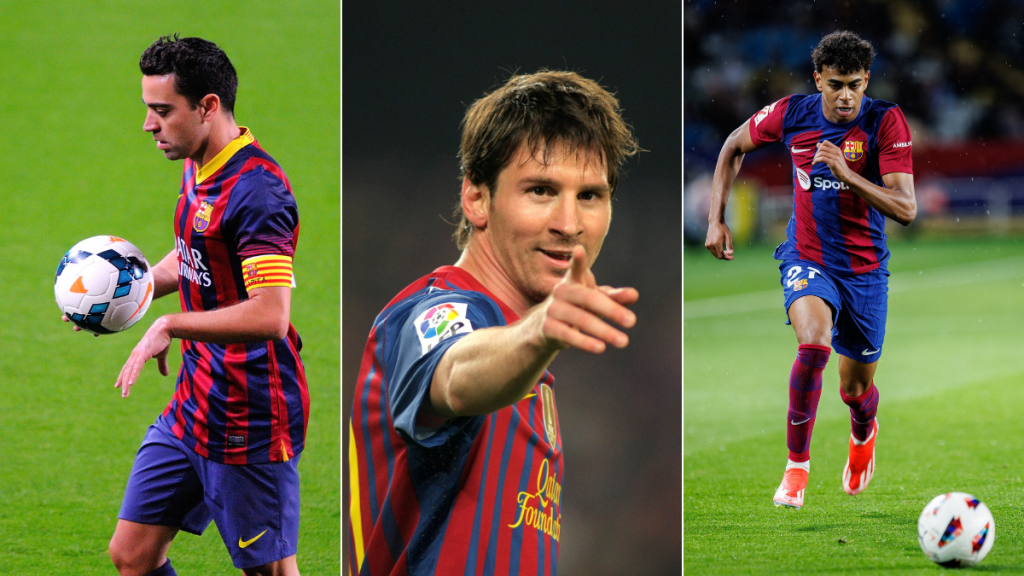
La Masia is where Barcelona turns a football idea into players. Lionel Messi, Xavi Hernández and Andrés Iniesta made the academy synonymous with one of the greatest teams the sport has seen. In 2026, Gavi and Lamine Yamal became the academy’s latest World Cup winners as Spain lifted its second title.
10. Gavi
Gavi joined Barcelona’s academy from Real Betis at 11 and reached the first team at 17. His football is built on scanning, pressure and commitment rather than size. The 2022 Kopa Trophy and Golden Boy winner returned in March 2026 after more than six months out following right-knee meniscus surgery, then became a world champion with Spain that summer.
Barcelona honors: La Liga in 2022–23, 2024–25 and 2025–26; Copa del Rey in 2024–25; Spanish Super Cup in 2023, 2025 and 2026.
9. Pedro
Pedro Rodríguez was rarely the biggest name in Barcelona’s front line, but he repeatedly supplied goals in the biggest settings. In 2009 he became the first player to score in six different official club competitions in a calendar year. He later scored in the 2011 Champions League final against Manchester United and left Barcelona with 99 goals in 321 official competitive appearances.
Barcelona honors: Five La Liga titles, three Copas del Rey, four Spanish Super Cups, three Champions Leagues, three UEFA Super Cups and two Club World Cups.
8. Lamine Yamal
Lamine Yamal joined La Masia at seven and debuted for Barcelona at 15 years and 290 days, the youngest first-team player in club history. He then became the youngest player and scorer at a European Championship as Spain won Euro 2024. By 19, he had finished second in the 2025 Ballon d’Or and won the 2026 World Cup, starting as Spain beat Argentina 1-0 after extra time in the final.
His place at No. 8 reflects the careers still above him, not a limit on where he can finish. No La Masia graduate since Messi has accumulated this much senior influence so early.
Barcelona honors: La Liga in 2022–23, 2024–25 and 2025–26; Copa del Rey in 2024–25; Spanish Super Cup in 2025 and 2026.
7. Gerard Piqué
Gerard Piqué entered La Masia at 10, left for Manchester United and returned in 2008 as a defender ready for Pep Guardiola’s first team. His height, passing range and comfort stepping into midfield made him an ideal Barcelona center back. Alongside Carles Puyol, he gave the club a partnership that could defend space and begin attacks.
Barcelona honors: Eight La Liga titles, seven Copas del Rey, six Spanish Super Cups, three Champions Leagues, three UEFA Super Cups and three Club World Cups.
6. Sergio Busquets
Sergio Busquets reached Barcelona’s first team in 2008 and made the holding-midfield role look simpler than it was. He received under pressure, moved the ball before opponents could close him and protected the center without chasing the game. His 722 appearances place him third on Barcelona’s all-time list.
Barcelona honors: Nine La Liga titles, seven Copas del Rey, seven Spanish Super Cups, three Champions Leagues, three UEFA Super Cups and three Club World Cups.
5. Carles Puyol
Carles Puyol joined Barcelona’s youth system at 17 and built his career through force of will, anticipation and adaptability. He played at full back before becoming the central defender and captain who set the team’s competitive standard. Puyol made 593 first-team appearances and captained Barcelona through three Champions League-winning campaigns.
Barcelona honors: Six La Liga titles, two Copas del Rey, six Spanish Super Cups, three Champions Leagues, two UEFA Super Cups and two Club World Cups.
4. Pep Guardiola
Before his coaching career reshaped the sport, Pep Guardiola was the central reference point in Johan Cruyff’s Dream Team. He entered La Masia at 13 and played as the pivot who connected defense with attack. Guardiola’s positioning and passing supplied an early version of the ideas that later defined his teams from Barcelona to Manchester.
Barcelona honors as a player: Six La Liga titles, two Copas del Rey, four Spanish Super Cups, the 1992 European Cup, the 1997 Cup Winners’ Cup and two UEFA Super Cups.
3. Andrés Iniesta
Andrés Iniesta arrived from Fuentealbilla at 12 and became Barcelona’s master of tight spaces. His first touch, changes of direction and timing allowed him to escape pressure without forcing the play. Across 674 appearances, he connected Barcelona’s midfield control to the final pass and carried that same calm into the largest matches for club and country.
Barcelona honors: Nine La Liga titles, six Copas del Rey, seven Spanish Super Cups, four Champions Leagues, three UEFA Super Cups and three Club World Cups.
2. Xavi Hernández
Xavi joined Barcelona at 11 and grew into the midfielder who set the rhythm of its greatest side. He constantly adjusted his body before receiving the ball, found the next pass early and controlled matches through repetition rather than spectacle. His 767 appearances stood as the club record until Messi passed it.
Barcelona honors: Eight La Liga titles, three Copas del Rey, six Spanish Super Cups, four Champions Leagues, two UEFA Super Cups and two Club World Cups.
1. Lionel Messi
Lionel Messi entered La Masia at 13 and left Barcelona as its record appearance maker and scorer. He produced 672 goals in 778 first-team games, combining a winger’s acceleration, a playmaker’s passing and a striker’s finishing. He went on to win a record eight Ballon d’Or awards.
Barcelona honors: Ten La Liga titles, seven Copas del Rey, eight Spanish Super Cups, four Champions Leagues, three UEFA Super Cups and three Club World Cups.
Other La Masia graduates
Cesc Fàbregas, Thiago Alcântara, Víctor Valdés, Jordi Alba, Mikel Arteta, Albert Ferrer, Guillermo Amor, Dani Olmo, Marc Cucurella and Pau Cubarsí also came through Barcelona’s academy. Olmo, Cucurella and Cubarsí joined Gavi and Yamal in Spain’s 2026 World Cup-winning squad, extending La Masia’s influence into the country’s second title.