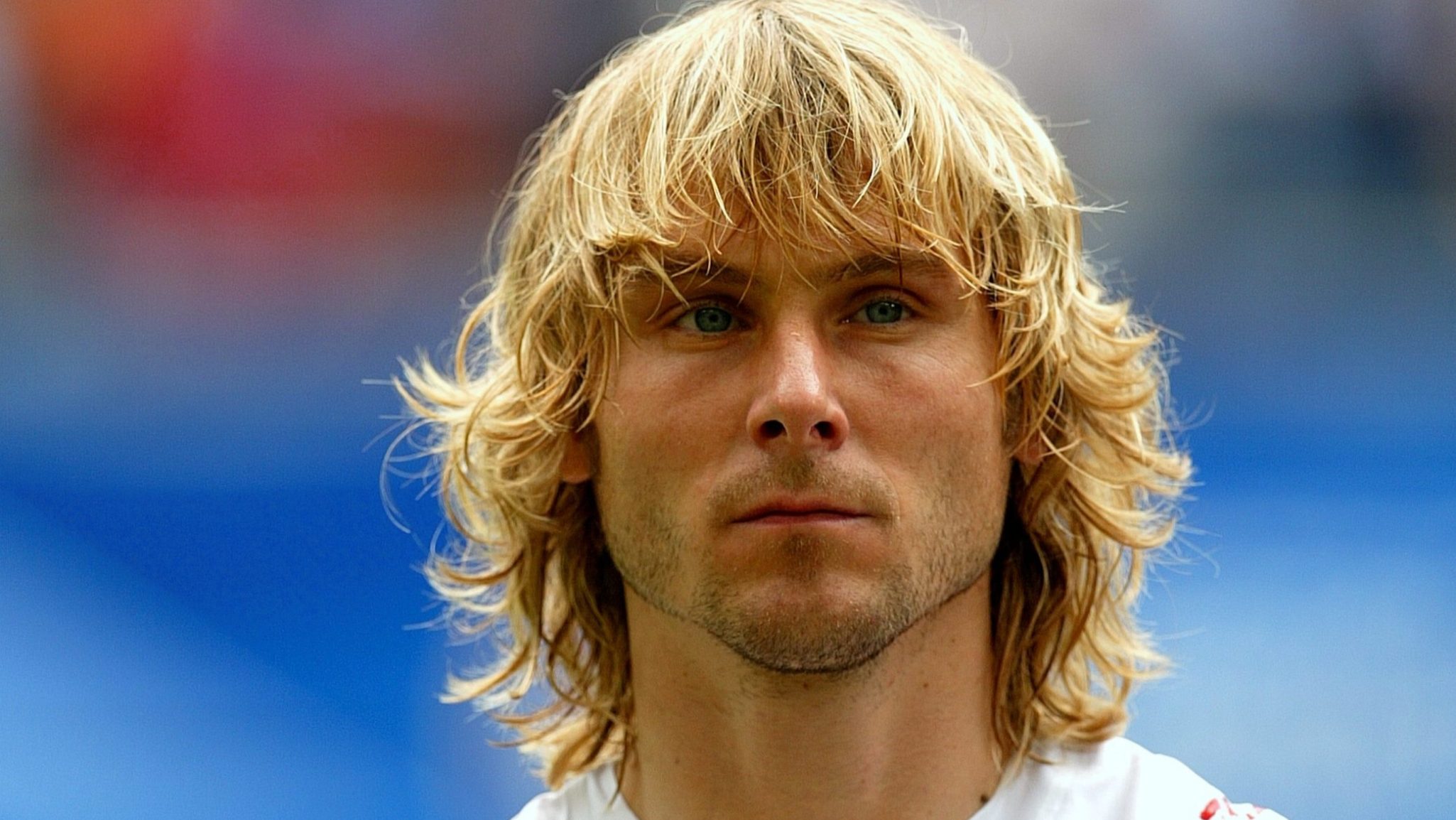
Pavel Nedvěd’s image as “Czech fury” remains unique and tireless, like the player himself. By the time he emerged at Sparta Prague and helped the Czech Republic reach the Euro 1996 final, he already looked like a player whose game carried unusual force. He was two-footed, direct, and able to shape a match from almost any zone of midfield.
That profile deepened at Lazio. He helped the club reach the 1998 UEFA Cup final, scored the decisive goal in the 1999 UEFA Cup Winners’ Cup final against Mallorca, lifted the UEFA Super Cup later that year, and was part of the side that won both Serie A and the Coppa Italia in 2000. Nedvěd’s standing was established well before Juventus turned him into a larger symbol.
The decisive turn came in 2001, when Juventus signed him after Zinedine Zidane left for Real Madrid. It was one of the hardest inheritances in elite football, and Nedvěd did not answer it by imitation. He answered it by becoming something more forceful and more complete, a player who could cover ground, create pressure, and still decide games with quality.
Across eight seasons in Turin, he made 327 appearances and scored 65 goals before retiring in 2009. Those numbers only tell part of it. The larger point is that he made the transition from high-level midfielder to defining figure at one of Europe’s biggest clubs, and he did it without changing the basic terms of his game.
The season that fixed his place in memory was 2002-03. Juventus beat Real Madrid 4-3 on aggregate in the Champions League semifinal, with Nedvěd scoring in the second leg, but his booking that night ruled him out of the final against Milan. By the end of that year he had won the Ballon d’Or. The sequence is powerful without any added drama, pressure, performance, absence, and recognition.
Why his look, game, and career choices still feel different
What made Nedvěd singular was the tension inside his football. He was not simply a stylist, and he was not only an endurance player. He had technique, range, and timing, but he also had the kind of physical intensity that could break the rhythm of a match. He could carry possession, strike from distance, arrive late into space, or keep running until the structure around him gave way.
The off-field side matters for the same reason. Nedvěd’s appeal came from restraint. Even at his most recognizable, with the blond hair and hard expression, he never gave the impression of someone performing himself for the camera. The look worked because it matched the player, disciplined, severe, and stripped of excess.
That coherence became sharper in 2006. When Juventus were relegated to Serie B after Calciopoli, Nedvěd stayed. For a piece about style, that is not a side note. It is part of the style itself, because it gave the image a kind of weight that pure aesthetics cannot carry. It made the surface feel earned.
Not as a nostalgic football heartthrob, and not as a fashion case study attached to an old era, but as a rare figure whose visual identity, playing style, and career decisions all pointed in the same direction. He looked unmistakable, played with force, and made choices that gave the look substance. Nedvěd’s aura remains stronger than ever.