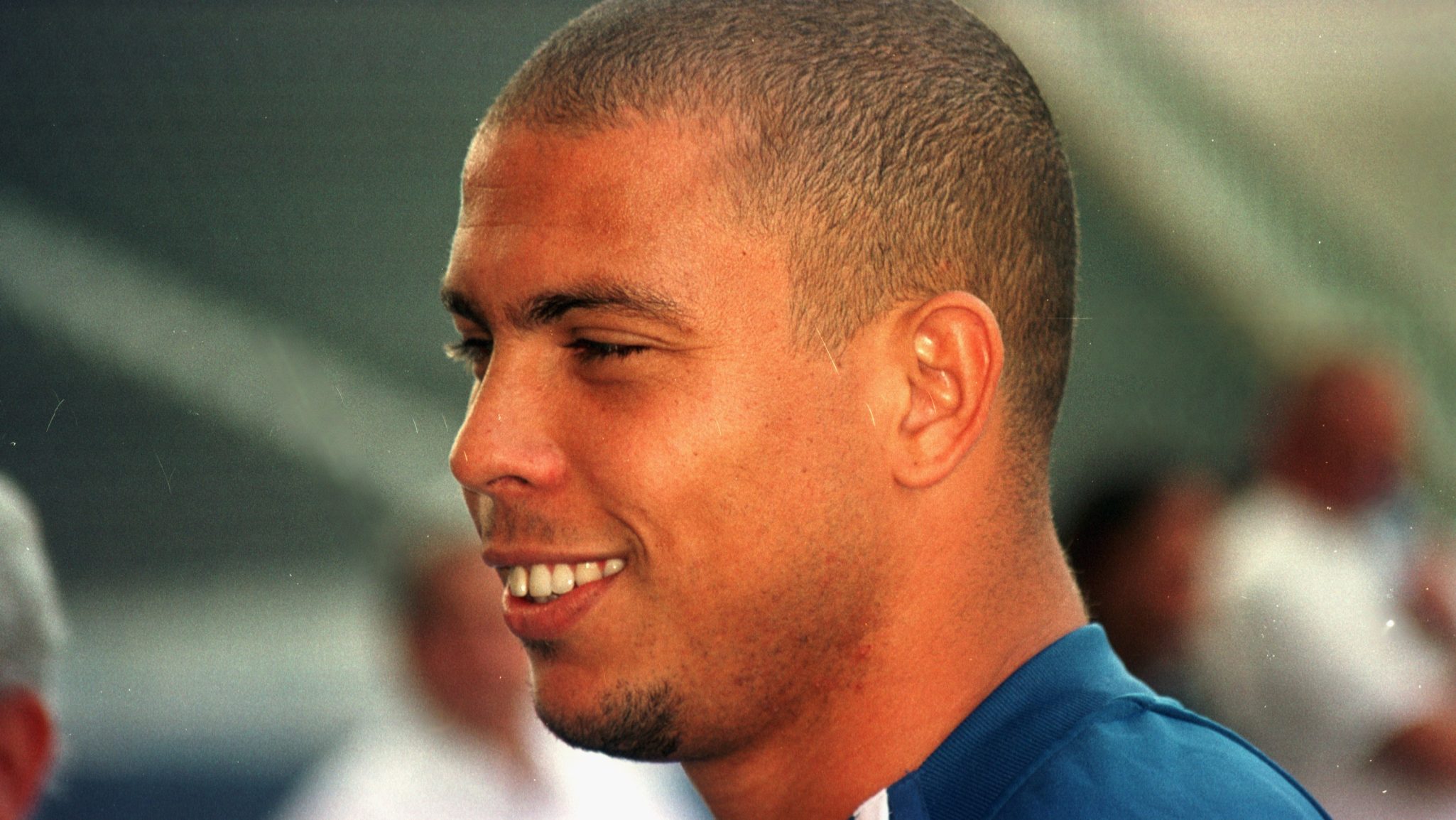
When people talk about aura in football, the word can get vague fast. With Ronaldo Nazário, it can be tied to something more precise. He made defenders feel short on time. The danger was not only in the finish, but in the seconds before it, when a stable situation suddenly stopped being stable.
At Barcelona, that quality came into focus almost immediately. Ronaldo scored 34 league goals in 37 matches in the 1996-97 season, but the numbers alone do not explain the effect he had on games. He could take the ball early, open his body, and drive straight through the center of the pitch before a defense had time to reset. He was not waiting for a move to develop. He was the move.
The Compostela goal is not just a famous highlight. It is one of the clearest examples of how Ronaldo turned open grass into panic. He collected the ball deep, accelerated through pressure, held off challenges, and finished the run himself. What stands out even now is how little separation there seems to be between power and control. Most forwards tilt toward one or the other. Ronaldo could hold both at once.
His move to Inter came with the weight of a world transfer record, and the setting sharpened the point. Serie A in that period was still defined by defensive structure, narrow spacing, and physical discipline. Ronaldo was still devastating there because he did not need many touches to change the geometry of a match. One touch to turn, one burst to separate, one final action before the defense could recover its shape.
The 1998 UEFA Cup final against Lazio captured that version of him well. He did not overwhelm the game with noise or volume. He bent it toward himself through repeated moments of imbalance. A defender who stepped too early was gone. A defender who held position was forced backward. A goalkeeper left his line knowing the margin for error was already thin.
What changed, and what stayed
The knee injury in 1999 broke the continuity of his career and forced a second version of Ronaldo into existence. He lost a long stretch of time, and when he returned he was no longer the same runner over distance. The explosive carries from deep came less often. What remained was the instinct, the timing, and the efficiency in front of goal.
That is what made the 2002 World Cup so significant. Ronaldo did not need to look like the Barcelona version to decide the tournament. He scored eight goals, won the Golden Boot, and finished the final against Germany with the kind of authority that only great penalty-box forwards possess. The movements were tighter now, the touches fewer, the reading of rebounds and second phases even sharper.
The Real Madrid years confirmed that the threat had survived the transformation. He remained a scorer of the highest order, but by then the deeper truth of his career was already clear. Ronaldo had produced two elite versions of himself. The first could tear through a game in open space. The second could end it with a few decisive touches in crowded areas.
That is the cleanest way to explain his aura. It was not mythology for its own sake. It was the feeling that once he moved forward with the ball, the number of good defensive options began to disappear. Even after the injury, that feeling never fully left. It simply took a different form.
Ronaldo Nazário still sits so high in any serious discussion of great forwards. He did not dominate in only one style, or in only one phase of his career. He made himself decisive twice.