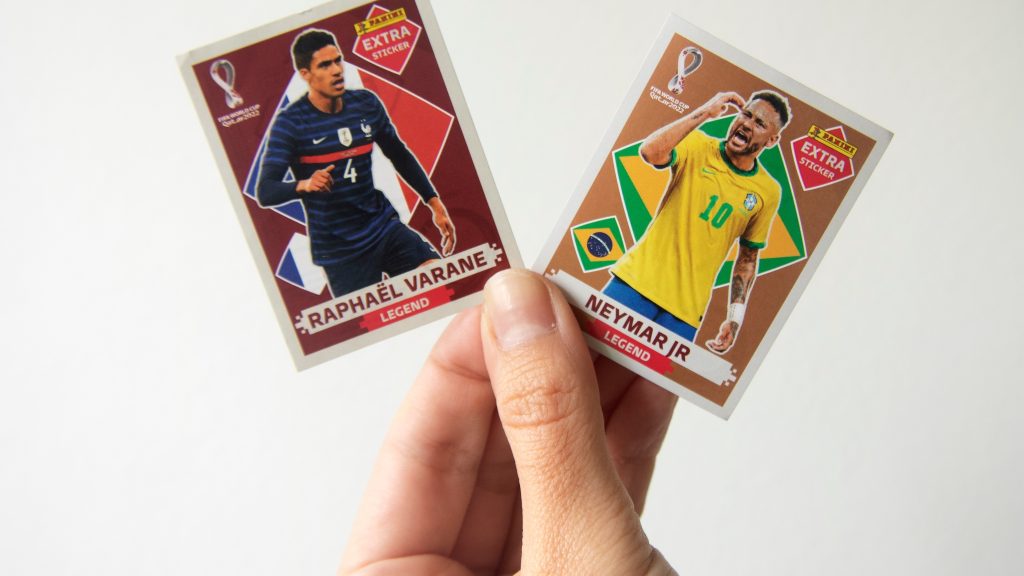
Panini’s World Cup sticker album acts like a warmup for the tournament. Before the games begin, it turns the World Cup into a checklist of faces and badges you can complete, count, and keep. This design makes a huge event feel personal and manageable, one page at a time.
Panini began in 1961 in Modena, Italy, far from football’s main arenas. Over time, it became a global publisher and collectibles company, with branches in Europe, Latin America, and the United States. Today, Panini calls itself a leader in stickers and trading cards, selling in over 150 countries.
The World Cup link is central, not incidental. Panini and FIFA describe the first Panini FIFA World Cup sticker collection as being produced for Mexico 1970, and the partnership has since expanded across physical stickers, trading cards, and digital collectibles.
To see why the album is a World Cup staple, look at its structure. Modern albums use team spreads, with space for a team photo, logo, and set player slots. For example, Panini’s Qatar 2022 album in the U.S. had 80 pages for 670 stickers, giving each of the 32 teams a two-page spread with a set mix of team and player stickers.
This setup also allows Panini to produce stickers on a large scale. Stickers come in small, random packs, so getting duplicates is part of the process. The album is more than just a book—it’s a system that keeps the checklist active in stores and among collectors.
In May 2014, news reports said Panini’s factory near São Paulo made over 8 million sticker packets a day for the Brazil World Cup album, with 70% sold in Brazil. The same reports said Brazilian newsstands sold 220 million packets during the 2010 World Cup, and 2014 sales were expected to be even higher.
From paper to platforms, Panini’s World Cup product keeps expanding
The World Cup album survived the smartphone era partly by moving onto it. FIFA’s reporting on the official digital sticker album gives unusually concrete scale: during Brazil 2014, FIFA said 195 million virtual packets were opened and 243 million stickers were swapped on the digital platform.
By the time of Russia 2018, FIFA said the digital album caught on quickly. In the first three weeks, two million people joined, 193 million digital stickers were in circulation, 32.6 million swaps took place, and 19 million codes from physical packets were scanned for digital rewards.
This mix of print and digital shows what Panini offers during a World Cup year. It’s more than just stickers—it’s a whole system that includes print, retail, licensing, and digital features, all tied to the tournament schedule.
Panini’s ownership history shows how valuable the company became. De Agostini’s records say it bought Panini with Investitori Associati in 1992 and sold it to Marvel in 1994 for ten times the original price. In July 1994, United Press International reported Marvel agreed to buy Panini for $150 million. A later U.S. federal court case mentioned Marvel’s expansion and listed the Panini purchase at $158 million in August 1994.
By 2025, financial news described Panini as big enough to be compared to major global consumer companies. Reports said Panini hired Citi to look at options, including a possible sale, and made about $1.9 billion in revenue the year before. The same reports estimated Panini’s value at $3.5 to $4.7 billion, based on the euro figures and exchange rates given.
The album’s place in World Cup history is also shown by how it’s preserved. Fondazione Ago’s Museo della Figurina in Modena says Giuseppe Panini donated over 500,000 small color prints to the city in 1992, and the permanent exhibit at Palazzo Santa Margherita displays part of this archive. This isn’t just about nostalgia—Panini’s work is seen as an important record of popular print culture.
There’s also the question of whether players care about the album. It’s hard to measure, but one clear example is from CBS’s 60 Minutes, which said Italian goalkeeper Gianluigi Buffon told them he still collects Panini stickers. This may not be true for every player, but it shows something important: Panini’s World Cup album is more than just a reflection of the tournament. It’s a unique part of the sport itself.
Panini’s next test is scale. FIFA and Panini have already framed the 2026 sticker collection as the largest Panini World Cup collection ever, reflecting the 48-team expansion, and they have promoted a host-region cover concept tied to the Canada-United States edition. If Panini’s history shows anything, it’s that the World Cup album remains a flexible format, one that can absorb bigger tournaments and new distribution layers while keeping the same core idea intact: a tournament you can complete.